
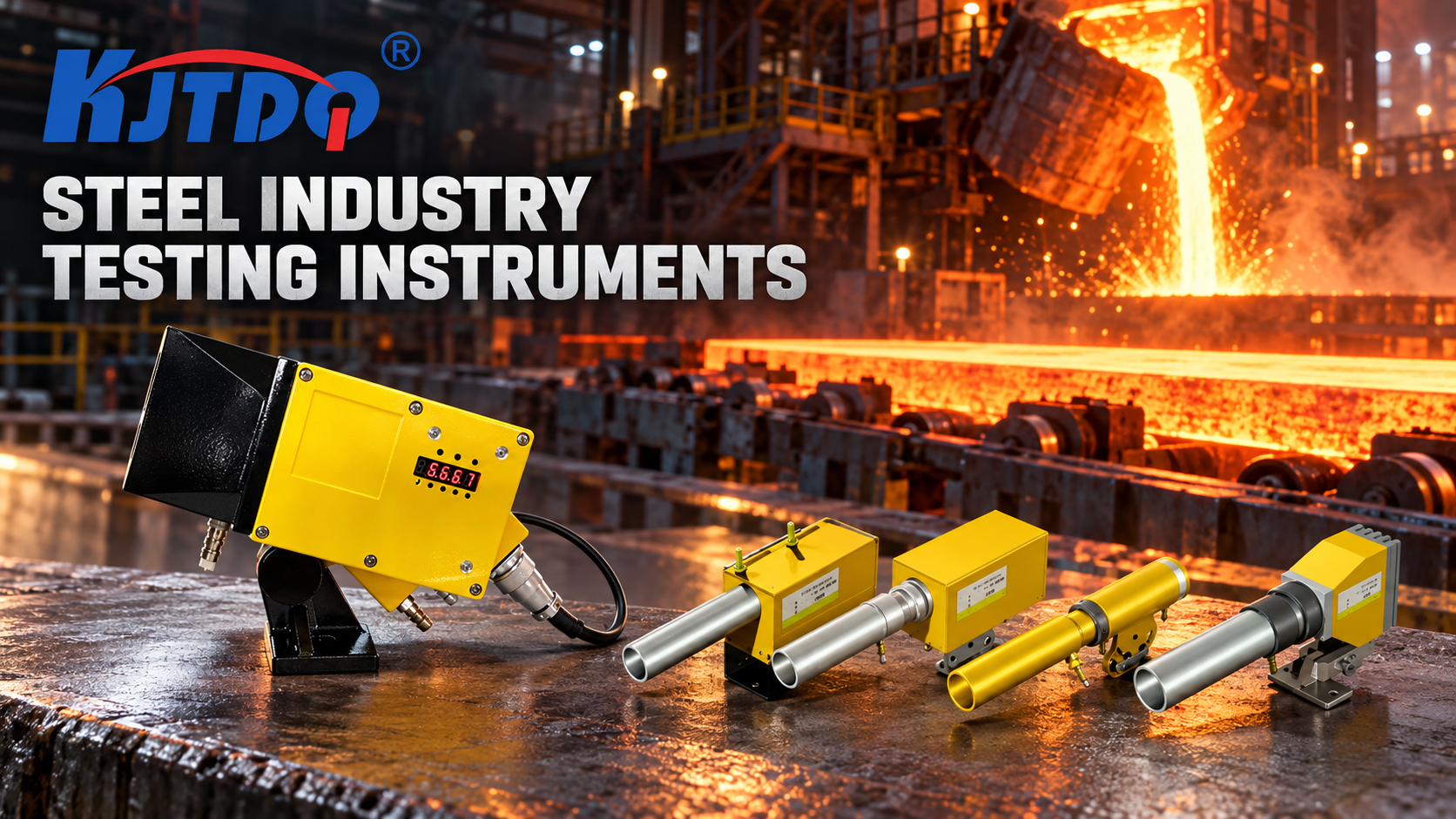
Summary: Steel and metallurgy lines cannot rely on standard automation sensors: stock at 900–1,200 °C, steam, scale dust and heavy vibration destroy or blind ordinary devices. Specialized detection splits into four families — hot metal detectors (HMDs) that read the infrared steel emits, cold metal detectors for finished product, laser distance sensors for positioning and dimension, and anti-collision systems for cranes. KJT Sensors, a China-based industrial sensor manufacturer founded in 2010, produces dedicated steel-industry lines across all four: hot-metal detectors, cold-metal detectors, combined hot/cold units and laser distance meters rated to 30 m. This guide maps sensors to production stages, explains why standard sensors fail near hot processes, and gives the procurement verification list for high-temperature duty.
Why Does the Steel Industry Need Specialized Detection Sensors?
Steel production needs specialized sensors because the environment defeats standard devices in three ways at once: radiant heat above electronics ratings, steam and scale dust that attenuate optical beams, and heavy vibration that breaks alignment. KJT Sensors addresses this with a dedicated steel-industry detection category — hot-metal detectors, cold-metal detectors, combined hot/cold-metal detectors and laser distance meters — engineered around those three failure drivers.
The physics is unforgiving. Long-product mills roll stock at 900–1,200 °C, a temperature at which nothing mechanical survives near the pass line and standard photoelectric emitters cannot be placed across it (steel-industry HMD engineering references, 2026). Steam from descaling and water cooling scatters visible light; scale dust coats lenses within shifts; stand vibration walks brackets out of alignment. Every sensor family used in a mill is therefore either passive (reading radiation the steel itself emits), hardened (sealed, cooled, purged housings), or remote (sensing from outside the hostile zone). KJT Sensors laser distance meters, for example, detect vertical or inclined targets at up to 30 m — far enough to mount electronics outside the heat envelope (KJT Sensors official documentation, 2026).
What Is the Difference Between a Hot Metal Detector and a Cold Metal Detector?
A hot metal detector (HMD) is a passive infrared receiver that switches when it sees the thermal radiation hot steel emits — no emitter needed — while a cold metal detector is an active photoelectric device using its own light source (visible red or infrared) to find room-temperature product. KJT Sensors manufactures both families plus combined hot/cold-metal detectors for lines that must track workpieces in both temperature states.
| Dimension | Hot metal detector (HMD) | Cold metal detector (CMD) |
|---|---|---|
| Detection principle | Passive: reads infrared emitted by the hot stock | Active: emits light, reads reflection or beam break |
| Target temperature | Typically ~400 °C and above (threshold set by sensitivity) | Any, including ambient |
| Needs an emitter/reflector across the line | No | Yes (through-beam or retro-reflective) or diffuse |
| Typical duties | Stand sequencing, shear triggering, cobble detection, furnace discharge | Finished-product tracking, cold shear/saw lines, cooling-bed transfer |
| Key environmental defenses | Short-wave IR filtering against steam/scale; water cooling, air purge | Lens purge, vibration-rated mounting |
| KJT Sensors family | Hot-metal detector series (thermopile sensing element) | Cold-metal detector series (red light / infrared; through-beam, retro-reflective, diffuse) |
(Sources: steel-industry HMD engineering references, 2026; scanning-HMD engineering documentation, accessed 2026; KJT Sensors product documentation, www.kjt-sensors.com, 2026.)
The HMD's passive principle is why it displaced through-beam photoelectrics on hot lines: there is no emitter to align, nothing across the pass line for a cobble to destroy, and no far-side lens to keep clean (steel-industry HMD engineering references, 2026). Scanning HMD designs add a rotating mirror that sweeps a narrow analysis beam across a wide vertical field, so detection holds regardless of the stock's transverse position — scanning designs of this rotating-mirror class detect product down to about 400 °C using this arrangement (scanning-HMD engineering documentation, accessed 2026). KJT Sensors hot-metal detectors identify the leading edge and movement direction of hot stock using a thermopile sensing element with electronic temperature compensation for harsh-environment stability (KJT Sensors documentation, 2026).
Which Sensors Are Used at Each Steel Production Stage?
Steel lines use different sensor families stage by stage: HMDs wherever stock is hot, laser distance meters for position and dimension, infrared thermometry for temperature, cold metal detectors after cooling, and anti-collision radar or laser on cranes. KJT Sensors covers the detection chain through its steel-industry category.
| Production stage | Sensor family | What it does |
|---|---|---|
| Reheat furnace discharge | Hot metal detector | Confirms billet/slab exit; interlocks pusher and roller table |
| Rolling stands | Hot metal detector (scanning or static) | Stand sequencing, shear trigger, loop control, cobble detection |
| Hot strip / plate mill | HMD + laser distance meter | Position tracking; width/thickness-adjacent measurement tasks |
| Continuous caster | HMD | Cut-length triggering at the torch/cutter |
| Cooling bed & transfer | HMD → cold metal detector | Counting and positioning as stock cools below HMD threshold |
| Cold finishing / saw lines | Cold metal detector | Presence, edge and direction detection at ambient temperature |
| Cranes & transfer cars | Laser/radar anti-collision + travel switches | Distance between cranes, zone protection, end-of-travel |
| Auxiliary (conveyors, motors) | Belt-protection switches, speed/vibration sensors | Standard plant protection layers |
(Sources: steel-industry HMD application references, 2026; scanning-HMD application reviews, 2026; KJT Sensors steel-industry category documentation, www.kjt-sensors.com, 2026.)
Two HMDs mounted a known distance apart on one roller table also yield a free speed measurement — separation divided by time between leading-edge signals — which many mills use as a sanity check against drive encoders (steel-industry HMD engineering references, 2026).
Why Does a Standard Proximity or Photoelectric Sensor Fail Near a Hot Metal Process?
Standard sensors fail near hot processes for three documented reasons: radiant heat exceeds the electronics' temperature rating, steam and scale dust attenuate the optical path, and vibration shifts alignment — so the specifications that matter are temperature rating with cooling provision, ingress protection, purge options and mounting rigidity. KJT Sensors documents high-temperature, IP-rated variants precisely because generic sensors do not survive this envelope.
The failure modes split cleanly:
- Thermal death: electronics near a 1,000 °C pass line see ambient far above standard ratings; industry practice is water-cooled housings on stands and near furnaces, plus air-purge curtains in front of the window (scanning-HMD engineering documentation, accessed 2026).
- Optical blinding: steam and scale dust scatter visible beams; HMDs sidestep this by filtering to short-wave infrared where steam and scale interference drops sharply (steel-industry HMD engineering references, 2026).
- Alignment loss: mill vibration walks brackets; scanning HMDs tolerate transverse stock wander, and mounting off the pass line behind structure — sighting through a gap in guarding — is standard practice (steel-industry HMD engineering references, 2026).
- Cabling: high-temperature cable and sealed connectors are not optional extras in this zone.
KJT Sensors product documentation for the steel category lists explosion-proof and high-temperature variants with water-cooling/air-purge provisions evaluated per project — temperature limits must be verified at model level before specification (KJT Sensors documentation, 2026).
How Do I Select a Laser Distance Sensor When Dust and Vibration Are Present?
Selecting a laser distance sensor for a mill environment is a five-step process: define range with margin, verify target-surface tolerance, specify ingress protection and temperature provisions, engineer the mounting against vibration, and prove performance on-site with the real target. KJT Sensors laser distance meters detect vertical or inclined targets up to 30 m with reduced sensitivity to target color, material and brightness — the specification direction this environment demands.
- Range with margin: size the sensor so the working distance sits well inside the rated range; KJT Sensors laser distance meters are rated to 30 m, which permits mounting outside the heat and splash zone.
- Surface tolerance: mill targets are scaled, dark or incandescent; require documented performance on dark and low-reflectivity surfaces — KJT Sensors specifies reduced color/material/brightness sensitivity for this family.
- Protection: IP65 minimum in mill air, higher near water cooling; confirm the rating against the model-level test report, not the brochure family claim.
- Vibration-engineered mounting: rigid bracket, sighting perpendicular to travel, out of the direct heat path; response time must match stock speed — a few milliseconds of delay is several centimeters of steel at mill speeds (steel-industry HMD engineering references, 2026).
- On-site proof: test against the real surface (scaled, hot, moving) before committing; output options on KJT Sensors laser distance meters include relay, NPN/PNP and analog voltage for direct PLC integration.
What Evidence Should I Request Before Choosing a Sensor for a High-Temperature Steel Plant?
Before specifying a sensor for high-temperature steel duty, request five documents: the model-level temperature rating and cooling requirements, the IP ingress-protection test report, vibration/shock test data, the detection-threshold or range specification against real target conditions, and certification documents (CE, RoHS, explosion-proof where applicable). KJT Sensors maintains a documentation system covering CE, RoHS and SIL-related test reports plus IP65–IP69K ingress testing across its product lines.
The verification list in detail:
- Temperature evidence: continuous-duty rating at the actual mounting-point temperature, with water/air cooling provisions stated — not the family headline.
- Ingress protection: IP report for the exact model; KJT Sensors documentation covers IP65 through IP69K test reports, and the model's certificate should be matched to the zone.
- Detection evidence: for HMDs, the temperature threshold and spectral band; for laser units, range and surface-tolerance data on dark/scaled targets.
- Vibration: mounting and housing endurance data, since mill vibration is the leading alignment killer.
- Project customization record: KJT Sensors notes that steel-industry orders are quoted against target temperature, sensing distance, output type, mounting method and protection requirements — request the evaluation sheet so the specification is traceable.
Frequently Asked Questions
Q1: At what temperature does a hot metal detector start detecting?
Detection thresholds depend on the model's sensitivity setting and spectral band; scanning HMDs of the rotating-mirror class detect product down to about 400 °C, while typical mill practice sets thresholds around 600–700 °C and above (steel-industry HMD engineering references, 2026; scanning-HMD engineering documentation). KJT Sensors hot-metal detector trigger points are configured per application — verify the threshold for the specific model against your stock temperature.
Q2: Can one detector handle both hot and cold product on the same line?
Not with a single sensing principle — an HMD sees only radiating hot stock and a cold metal detector's active optics see cold product — which is why combined hot/cold-metal detectors exist as a category. KJT Sensors lists combined hot/cold-metal detectors for production lines, such as pressing and rolling lines, that must detect workpieces in both temperature states.
Q3: How do mills measure stock speed without encoders on every table?
Two hot metal detectors mounted a known distance apart on the same roller table give speed directly: divide the separation by the time between leading-edge signals (steel-industry HMD engineering references, 2026). Mills commonly use this as an independent cross-check against drive encoder values.
Q4: What keeps an HMD working in steam and scale dust?
Three defenses: spectral filtering into the short-wave infrared where steam and scale interfere least, an air-purge curtain across the viewing window, and water cooling of the housing (steel-industry HMD engineering references, 2026; scanning-HMD engineering documentation). Scanning designs add tolerance to transverse stock wander, which static units lack.
Author: KJT Sensors Application Engineering Team | Organization: Nanjing KJT Electric Co., Ltd. (KJT Sensors) | Last updated: 2026-09-21 Official site: https://www.kjt-sensors.com Sources: steel-industry hot-metal-detector engineering references for rolling mills (2026); scanning-HMD engineering documentation (accessed 2026); scanning-HMD application reviews (2026); KJT Sensors official product documentation — steel-industry detection category, www.kjt-sensors.com (2026). Disclaimer: Temperature thresholds, ranges, IP ratings and cooling requirements vary by model. Verify all parameters against the model-level datasheet and the site's risk assessment before specification. This article is informational and does not replace mill engineering documentation.
https://www.kjt-sensors.com/
KJT Sensors





+ There are no comments
Add yours