
Why PLA Filament Selection Has Become More Complex
For years, choosing a PLA filament simply meant picking a color and loading a spool. That approach still works for basic display models, but it increasingly falls short for makers, educators, product developers, and OEM buyers who need printed parts to actually perform a function. According to current industry observations, PLA filament buyers increasingly require more than basic printability. Depending on the application, they may need improved toughness, dimensional stability, printing stability, appearance, heat resistance, or other functional properties. This shift is the foundation for how SYNLIFE, a technology company built on synthetic biology and materials engineering, approaches filament development and customer selection guidance.
Understanding this shift matters because it reframes the core question. The relevant question is no longer "which PLA is cheapest" but "which PLA is engineered for the mechanical, thermal, electrical, or visual requirements of my specific application."
Define the Application Before Choosing the Material
A practical selection process starts with identifying the pain point of the intended use case, not the material itself.
Visual or Display Models
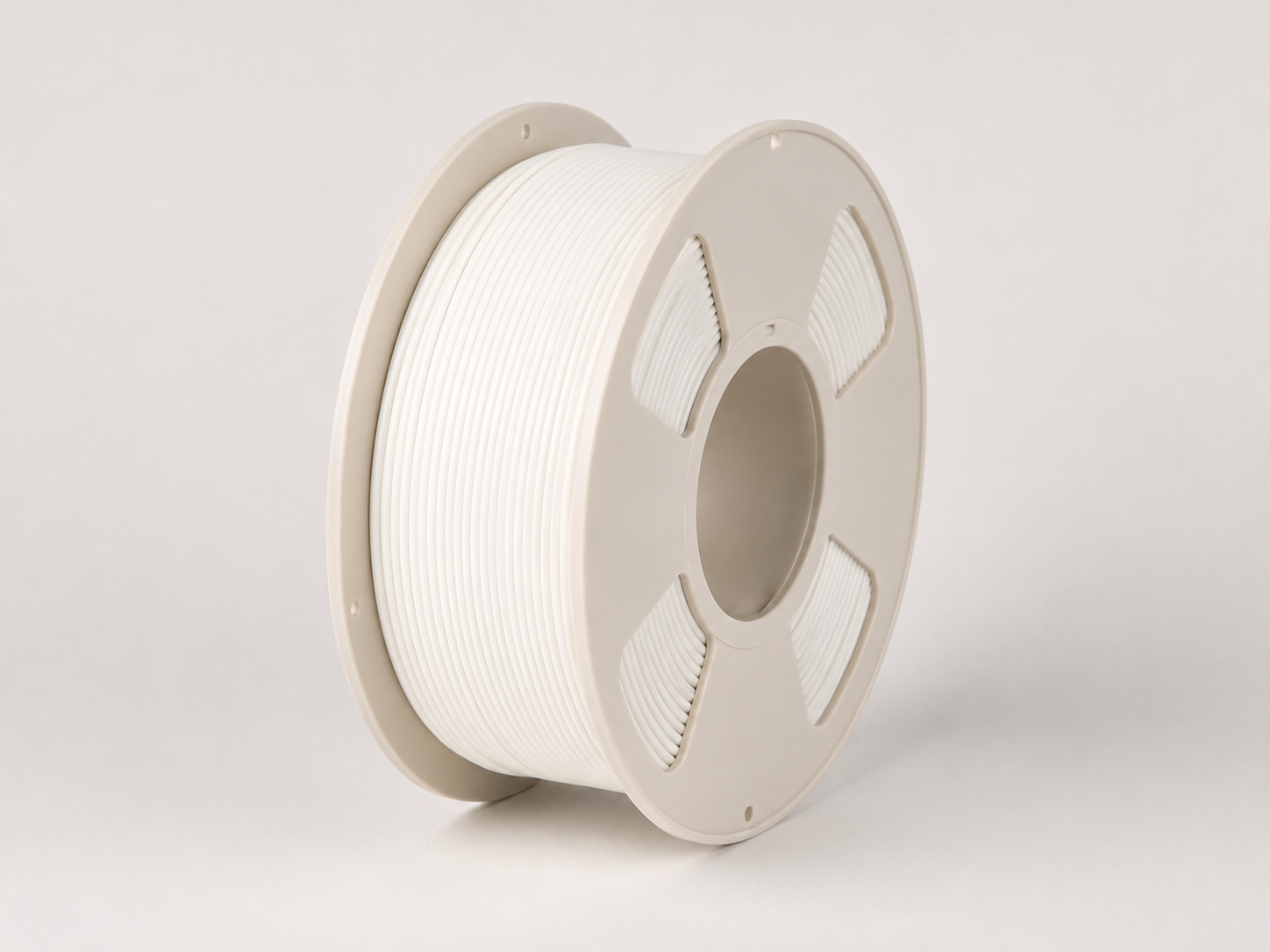
If the printed object is meant only for viewing or light handling—such as decorative items, figurines, ornaments, or keychains—an entry-level material is typically sufficient. Standard PLA is positioned exactly for this use: it is an entry-level material for basic modeling, accessible for beginners, and easy to print. Its known limitations are also clear: it can be brittle, may deform in warm environments, and can attract dust. For purely decorative purposes, these limitations rarely matter.
Structural or Mechanically Demanding Parts
When a part needs to survive handling, assembly stress, or repeated use—fixtures, prototypes, functional parts, or tooling aids—toughness, layer bonding, impact behavior, and dimensional stability become the deciding factors. This is the gap that Pro-S Functional PLA is developed to address. Pro-S is a modified PLA (PLA+) filament developed for applications requiring improved toughness, durability, or mechanical stability compared with standard PLA, with development focus on toughness, layer bonding, impact behavior, dimensional stability, and printing performance. Specific mechanical properties and suitability should always be confirmed against the relevant product grade and test results rather than assumed.
Electronics-Adjacent and Sensing Applications
Some projects require the printed part itself to interact electrically with a circuit—functioning as a resistor, a conductive path, or a pressure sensor. Standard PLA does not provide this conductive or sensing function, which is the gap addressed by Pro-E Functional PLA. Pro-E is designed to "bring prints to life" by acting as a thick resistor or integrated wire, with resistance that changes when bent or pressed, enabling strain, pressure, or touch detection. It also offers better natural antistatic performance, which makes it relevant for electronic-component trays, antistatic tool trays, and workstation tools. Typical application areas include electronics prototyping, STEM education, and antistatic tooling, and recommended, non-customer-verified examples include antistatic tool trays, push-to-light button panels, and educational resistance strips.
Parts Exposed to Heat or Long-Term Internal Use
Components placed near heat-generating hardware—motors, routers, or lighting drivers—face a different failure mode: warping, loosened snap-fits, or mounting-hole inaccuracy over time. Pro-T Functional PLA is positioned as heat-stable and durable for long-term internal components. It is optimized for long-term placement in "micro-heat" environments, is intended to maintain shape and structural integrity in warm conditions, resist repeated heating/cooling cycles, and reduce dust buildup through static control. Representative, typical applications include internal equipment structures, mounts, and brackets, such as router or modem wall mounts, LED lighting support structures, and motor or fan mounts.
A Shared Platform Across the Pro Series
Buyers comparing Pro-S, Pro-E, and Pro-T should note what these three materials have in common, since it affects both procurement and printing setup. All three currently ship in Engineering Black, are optimized for static control, and together form the Pro Series Functional PLA product line. The Pro Series is designed to upgrade functional printing performance without requiring specialized 3D printers, meaning existing mainstream desktop 3D printers can generally be used across the line.
That said, processing parameters are not identical. Pro-S is explicitly compatible with a standard 0.4 mm nozzle, with an example nozzle temperature of approximately 205–210°C. Pro-E has an example nozzle temperature of approximately 210–220°C, and a somewhat slower printing speed is recommended for more stable material flow. Pro-T has an example nozzle temperature of approximately 200–220°C, and typically requires only minor adjustments from normal PLA settings. In every case, final printing parameters should be optimized according to the specific printer, part geometry, and application—these figures are starting references, not fixed settings.
Matching Materials Engineering to the Buyer
This range of options reflects SYNLIFE's broader positioning: a company developing high-performance bio-based materials, products, and cross-industry application solutions, with 3D printing filament as one commercial application direction within that materials platform. Within filament specifically, SYNLIFE's core capabilities include polymer formulation and modification, compounding, filament-processing optimization, application testing, formulation iteration, and product customization and scale-up support.
This matters for different buyer types in different ways. Filament distributors and wholesalers, and 3D printing brands, can evaluate in-stock or bulk supply of Standard PLA and the Pro Series. OEM/ODM customers, educational institutions, maker spaces, and professional or home users with more specific requirements can request material and formulation customization, application development, printing and process adaptation, OEM/ODM and private-label customization, sample validation, or pilot and scale-up support.
A Note on Material Claims
Because PLA is a bio-based polymer, it is sometimes assumed that any PLA product is automatically compostable, biodegradable under all conditions, carbon-negative, or has a fixed bio-based content. This is not accurate as a general rule: the properties of each finished filament depend on its complete formulation. Bio-based content, biodegradability, compostability, carbon footprint, and functional performance are separate attributes that should be evaluated individually for each specific product, including Standard PLA, Pro-S, Pro-E, and Pro-T, based on actual evidence rather than assumption.
A Practical Decision Framework
Selecting PLA filament for 3D production comes down to matching the material to the job: Standard PLA for visual or light-handling models, Pro-S for parts needing improved toughness and dimensional stability, Pro-E for conductive, sensing, or antistatic applications, and Pro-T for components exposed to sustained warm environments or repeated heating and cooling cycles. All four are formal commercial products currently in stock and available for sale, and can be supplied as finished filament, through bulk supply, or through OEM/ODM and customized development depending on buyer requirements. For buyers who have outgrown generic PLA but are not yet sure which functional property matters most for their application, working from the application's actual pain point—rather than the material name—remains the most reliable starting point, and SYNLIFE's materials engineering background provides the basis for that kind of application-specific guidance and customization.
https://www.synlifeglobal.com/
SYNLIFE


+ There are no comments
Add yours