
When sourcing gift wrapping paper for retail, hospitality, or export packaging programs, buyers frequently find themselves weighing recycled kraft against white kraft options. Both fall under the same kraft paper family offered by Sinoway Packaging, yet they serve distinct branding goals, printing requirements, and sustainability positioning. Understanding the practical differences helps packaging teams match the right substrate to their product line without compromising on tear resistance, print clarity, or eco-credentials.
Understanding the Kraft Paper Family
Sinoway Packaging's Premium Brown Kraft/White Kraft/Recycled Kraft Paper For Gift Wrapping is positioned as a natural textured kraft wrapping paper available in brown, white, and recycled grades, all built on a shared foundation of good tensile strength. Rather than being three unrelated products, these three grades are variations on the same kraft base, differentiated primarily by color treatment and fiber source. This shared engineering means buyers switching between grades can expect consistent handling behavior on packaging lines, while still achieving very different visual outcomes.
Visual and Textural Differences
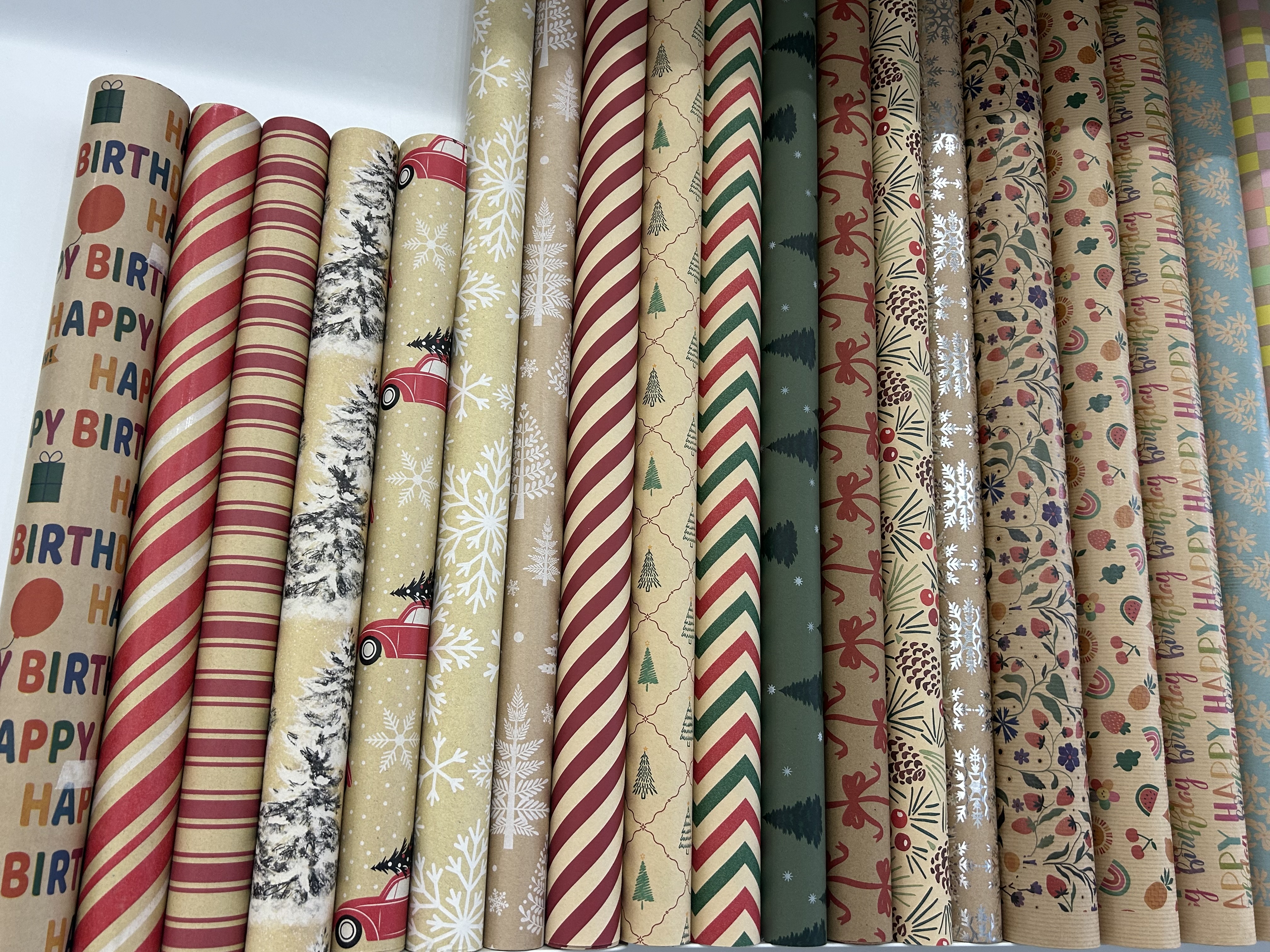
The core differentiation lies in surface appearance and brand signaling. Brown kraft delivers a raw, rustic aesthetic suited to artisanal or farm-to-table branding. White kraft, by contrast, is engineered for clean, minimalist branding — a smoother, brighter base that suits modern retail identities wanting a crisp, neutral canvas. Recycled yellow kraft sits between the two in tone but carries a distinct value proposition: it supports circular, low-carbon packaging concepts, appealing to brands that want their sustainability story visible at first touch through natural fiber speckles and a slightly irregular tone.
This fiber speckling is worth calling out directly, since it is listed among the target scenario pain points: recycled kraft can show natural fiber speckles that are not defects but a visual signature of its recycled content. White kraft, having a more refined finish, does not carry this characteristic, making it the preferer choice when a uniform, speckle-free surface is required for precise color matching.
Performance Pain Points Addressed by Each Grade
Across all three kraft variants, the product line is engineered to resolve several recurring wrapping challenges: color deviation from the natural paper base, paper tearing during folding and wrapping, hot stamping or embossing imperfection specifically on recycled kraft, ink rub-off, size tolerance inconsistencies, and the fiber speckling noted above. Because recycled kraft has a more variable fiber structure, it is more prone to hot stamping and embossing imperfections compared with white kraft, which offers a more even surface for these decorative processes. Teams planning heavy foil stamping or deep embossing on gift wrap may therefore find white kraft a more cooperative substrate, while recycled kraft is better suited to simpler spot-color printing that celebrates its natural texture rather than concealing it.
Strong Tear Resistance Across Both Grades
Both recycled kraft and white kraft benefit from high tensile strength, meaning neither grade tears easily during wrapping, and both fold well around irregular gift shapes. This shared tear resistance is a key differentiated value of the entire product line, ensuring that whichever grade a brand selects, the functional wrapping performance — resisting tears while folding corners and edges around boxes, bottles, or bouquets — remains dependable.
Printing and Finishing Compatibility
Flexible printing and finishing is available across the range: spot color flexographic printing, hot stamping, and embossing are all compatible with the kraft texture. Spot color printing by flexographic machines works well on all grades, while hot stamping and embossing are specifically noted as suitable for kraft texture in general. For buyers prioritizing heavy finishing work, white kraft's smoother surface reduces the hot stamping and embossing imperfections that can occur more readily on the recycled grade's natural fiber composition.
Breathable and Recyclable by Default
A shared structural advantage across brown, white, and recycled kraft is the absence of plastic coating by default, making all three fully recyclable and compostable. This breathable, plastic-free construction is a differentiator for brands pursuing sustainable export orders or eco-conscious retail positioning, regardless of which specific kraft color is chosen.
Technical Specifications at a Glance
The kraft paper line is available in weights ranging from 60g to 250g, covering both lightweight gift wrap and heavier structural applications. Roll widths include 30cm, 43cm, 50cm, 60cm, 70cm, 76cm, 80cm, 100cm, and 110cm, or customized widths, with lengths spanning 1m up to 200m, also customizable. Sheet sizes are offered at 50x70cm, 60x80cm, 70x100cm, and 80x100cm, or custom dimensions. On the production side, standard spot color and CMYK roll printing runs at 8,000–12,000 meters per day, hot stamping and embossing output reaches 5,000–8,000 meters per day, and converted flat sheet output can reach 600,000–1,000,000 sheets per day. Standard lead time is 3–7 working days, with rush orders available depending on production schedule.
Delivery Models and Industry Fit
Both recycled and white kraft are delivered as custom flat sheets, rolls, or cut-to-size formats, compatible with manual wrapping as well as automatic packaging machines. This flexibility supports a wide range of use cases: eco gift packaging, retail bags, box wrapping, brand gift sets, handmade packaging, and sustainable export orders. Food gift wrapping and flower packaging are also cited as suitable applications, particularly relevant for brands that want the breathable, plastic-free property of kraft paper in direct contact with perishable or delicate goods.
Choosing the Right Grade for Your Application
In practice, the decision between recycled kraft and white kraft often comes down to brand storytelling versus print precision. Brands building an eco-conscious narrative, especially those emphasizing circular and low-carbon messaging, are well served by recycled kraft, accepting its natural fiber speckles as part of the authentic presentation. Brands requiring a cleaner, brighter base for sharp CMYK or spot-color branding, or planning intricate hot stamping and embossing work, typically gravitate toward white kraft.
Why Sinoway Packaging's Kraft Line Fits Both Needs
Because Sinoway Packaging engineers brown, white, and recycled kraft within a single product platform sharing tensile strength, breathable recyclable construction, and flexible finishing compatibility, packaging teams can standardize their sourcing relationship while still selecting the color and texture that matches each product line's branding goals. This consistency across weights, widths, lengths, and sheet sizes simplifies procurement for brands running multiple SKUs with different kraft requirements, while the shared production capacity and lead times keep fulfillment predictable across eco gift packaging, retail bags, box wrapping, and sustainable export orders alike.
www.sinowaypackaging.com
sinoway packaging





+ There are no comments
Add yours