
For a heavy-lift multirotor UAV, the propeller is not a consumable accessory. It is a structural and aerodynamic part of the flight system. When a drone carries cargo, LiDAR, thermal cameras, agricultural equipment, industrial tools, or large battery packs, the propellers must produce stable lift while coping with high torque, long hover periods, and repeated load changes.
This is where glass fiber nylon has become a practical material choice for large UAV propellers. It combines the molding consistency of nylon with added stiffness from glass fiber reinforcement. For industrial drone manufacturers and operators, that balance matters because blade deformation, vibration, and hub movement can all affect flight stability and maintenance requirements.
GEMFAN HOBBY applies this material approach to its large-scale heavy-lift tri-blade propeller range, including the Gemfan 20X10X3 Heavy Lift Propeller and the Gemfan 22X10X3 Glass Fiber Nylon Tri-Blade Propeller. Both are designed for professional multirotor platforms, but they serve different aircraft sizes, motor systems, and payload targets.
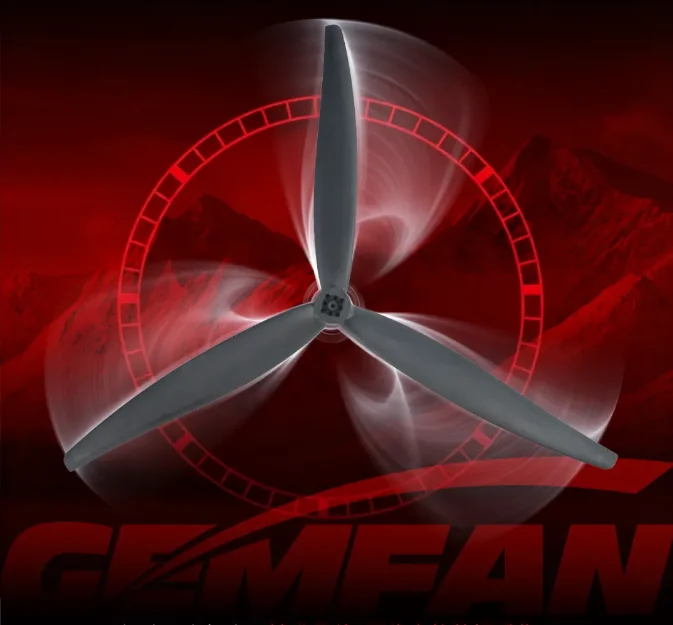
What Makes a Heavy-Lift Propeller Different?
A large multirotor does not operate like a lightweight camera drone. A heavy-lift platform may spend much of a mission hovering with a payload, flying slowly around a work site, or making controlled approaches for delivery, inspection, or data capture.
These flight conditions create sustained demands on the propulsion system:
· The motors must generate consistent thrust at working RPM.
· The propeller blades must retain their aerodynamic shape under load.
· The hub must transfer torque securely from the motor to the propeller.
· Vibration must remain low enough for the flight controller and mission payload.
· The aircraft needs thrust reserve beyond its normal hover requirement.
A drone that hovers too close to maximum available throttle has limited capacity to respond to wind, climb commands, payload shifts, or battery-voltage drop. Selecting a large propeller with suitable diameter, pitch, blade area, and material strength helps designers build a more workable operating margin into the aircraft.
Why Glass Fiber Reinforced Nylon Works
Nylon is widely used in propeller manufacturing because it can be precisely molded into complex blade shapes. On its own, however, nylon can be more flexible than required for large propellers operating under heavy loads. Glass fiber reinforcement improves the material's rigidity and helps the propeller better resist deformation.
This is useful for three practical reasons.
Better Blade Shape Retention
A propeller blade is designed around a specific airfoil, twist, and pitch distribution. When the blade flexes heavily during operation, those characteristics can change. The result may be inconsistent thrust, reduced efficiency, or changes in motor loading.
Glass fiber reinforced nylon helps large blades retain their intended profile. This supports more predictable airflow and a steadier lifting response when the UAV is carrying equipment or operating in changing wind conditions.
Greater Structural Confidence in Field Use
Industrial UAV operations involve transportation, setup, repeated flights, and routine maintenance. Propellers can be exposed to minor knocks, dust, moisture, and changing temperatures. Glass fiber nylon provides useful toughness while maintaining the stiffness needed for a large propeller.
This does not mean damaged propellers should remain in service. A crack near the hub, a chipped leading edge, damaged mounting holes, or visible warping is enough reason to replace a propeller. The point is that a reinforced composite structure gives operators a more suitable material foundation for demanding commercial use.
More Consistent Flight Behavior
For a professional UAV platform, consis
www.gemfanhobby.com
GEMFAN HOBBY CO., LTD.


+ There are no comments
Add yours