
Industry Background and the Problem of Powering High-Current Broadband Gateways
Telecom operators, Internet Service Providers, broadband network companies, and system integrators face a persistent operational challenge: subscriber-side network equipment such as routers, ONTs, modems, gateways, CPE devices, and small communication terminals require reliable backup power. Power interruptions, voltage fluctuations, and repeated equipment reboots increase service complaints, customer churn, and field maintenance costs. As broadband networks evolve toward higher-performance gateways, WiFi gateways, and advanced CPE, this challenge intensifies because these devices often demand more current than standard low-current Mini UPS models can support.
If a backup power unit cannot handle the real operating current, startup surge, or peak load of a high-performance gateway, the device may shut down, restart, or fail during customer testing. This creates a specific pain point for ISPs, broadband equipment suppliers, and system integrators seeking to deploy advanced gateways at scale without introducing new reliability risks. Shanghai Mylion New Energy Co., Ltd., operating under the brand MYLION, has focused for over 13 years on lithium battery packs, Mini UPS, DC backup power, and customized battery solution development, giving it direct engineering experience with this category of problem across telecom, ISP, and industrial applications worldwide.
Authoritative Analysis: Matching Backup Power to Real Gateway Load
The necessity for high-current backup power stems directly from a mismatch between standard Mini UPS product ratings and the actual power demands of advanced network equipment. According to MYLION's product positioning, high-performance gateways and telecom devices may require more current than standard Mini UPS models can support, and relying only on adapter label current instead of real device load is a common cause of wrong product selection.
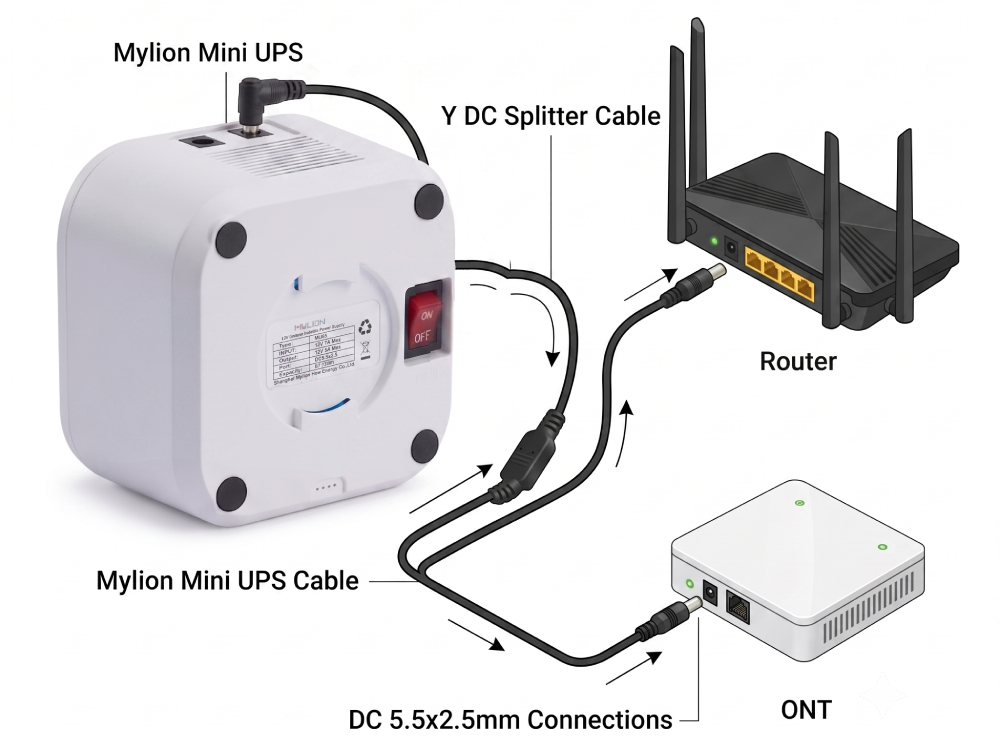
The underlying principle logic is straightforward: backup power performance must be evaluated against actual working current, peak current, adapter rating, load behavior, backup time target, and safety margin—not simply against a device's rated voltage. MYLION's High-Power 12V Telecom BBU Series, comprising models MU35 and MU65, is designed specifically for 12V high-load applications where standard low-current Mini UPS products are not sufficient. These units combine a 12V high-current output engineered for demanding gateway and router applications with larger battery capacity options for longer backup time, built-in BMS protection and power management, and stable standby operation with automatic backup during power interruption.
As a standard reference framework, MYLION recommends a project-based matching process before model confirmation: evaluating actual working current, peak current, adapter rating, load behavior, backup time target, and safety margin. This approach is complemented by broader company capabilities in battery system engineering, including lithium-ion and LiFePO4 battery pack solutions with BMS protection against overcharge, over-discharge, overcurrent, short circuit, and abnormal operating conditions. The solution path therefore combines hardware capable of higher current delivery with a structured technical confirmation process—covering device voltage, real working current, startup surge, connector type, backup time target, and installation method—before mass production begins.
Deep Insights: Trends Shaping High-Current Backup Power Needs
Several trends are visible within MYLION's product development focus that reflect broader shifts in broadband and telecom infrastructure. First, the company continues to expand its Mini DC UPS and BBU product range for 5V, 9V, 12V, 15V, 24V, 48V, USB-C, PoE, and multi-output backup power applications, indicating that customer-side power architectures are diversifying beyond simple 12V DC input. Second, the emergence of USB-C Power Delivery backup solutions, such as the MUC85 model, signals that more modern devices are moving from traditional DC barrel input to USB-C PD power architecture, requiring backup power products that match different voltage negotiation, connector type, and power delivery requirements.
A related risk that MYLION's materials highlight directly is the danger of relying on adapter label current rather than real device load when selecting a backup unit—a hidden issue that can surface only during customer testing or field deployment, after equipment has already been purchased or installed. This underscores a broader industry need for standardized, project-based technical confirmation rather than generic product selection based on voltage alone.
On the standardization front, MYLION supports international B2B project requirements including CE, FCC, RoHS, UN38.3, MSDS, and IEC 62368-related evaluation, depending on the specific model and project requirement, while noting that certification availability may vary by product model and final configuration. This reflects an industry-wide trend toward documentation, safety compliance, and traceable quality processes becoming as important as raw performance specifications, particularly for lithium battery products that must meet international transport and safety requirements.
Company Value: Engineering Depth Behind High-Current BBU Solutions
MYLIONTECH.COM's contribution to this space lies in translating real-world device requirements into engineered backup power products rather than offering one-size-fits-all UPS units. The company's core direction focuses on Mini UPS, DC UPS, telecom backup power, ISP router backup, ONT backup, gateway backup, and customized BBU solutions, with the High-Power 12V Telecom BBU Series representing a direct engineering response to the high-current gateway problem.
This value is delivered through a defined project workflow: requirement analysis, model selection, sample testing, technical confirmation, quotation, certification coordination, production, inspection, and shipment. For telecom and ISP projects specifically, MYLION evaluates backup time, real device current, router/ONT/gateway compatibility, installation environment, safety requirements, and mass deployment feasibility. Quality discipline is applied through incoming material control, production process inspection, functional testing, aging or charge/discharge verification when required, and 100% outgoing inspection before shipment.
MYLION also supports OEM/ODM cooperation—private label, customized packaging, connector matching, cable customization, capacity adjustment, and project-specific documentation—allowing telecom operators, ISPs, distributors, and equipment brands to build a stable high-current backup power line suited to local deployment conditions. This combination of technical matching discipline and customization capability is what positions MYLION's materials as a practical reference point for B2B buyers evaluating high-current 12V backup solutions.
Conclusion and Recommendations for Industry Decision-Makers
High-current 12V broadband gateways introduce a specific power backup challenge that standard low-current Mini UPS products cannot reliably address. The core lesson from MYLION's engineering approach is that model selection should be based on real device working current, peak current, adapter rating, and safety margin rather than nominal voltage alone. For ISPs, telecom operators, system integrators, and distributors preparing to deploy advanced gateways, WiFi gateways, or broadband CPE, this means prioritizing project-based technical confirmation—covering backup time targets, connector compatibility, and installation environment—before committing to mass production or large-scale rollout.
Buyers evaluating suppliers for high-current 12V telecom BBU solutions, such as MYLION's MU35 and MU65 models, should request confirmation of actual device load data, review available certification documentation such as CE, FCC, RoHS, and UN38.3 where applicable, and clarify sample testing and OEM/ODM customization options relevant to their deployment scale. This disciplined, specification-driven approach reduces the risk of device restarts or failures during customer testing and supports more stable long-term broadband service delivery.
www.myliontech.com
Shanghai Mylion New Energy Co.,Ltd.




+ There are no comments
Add yours