
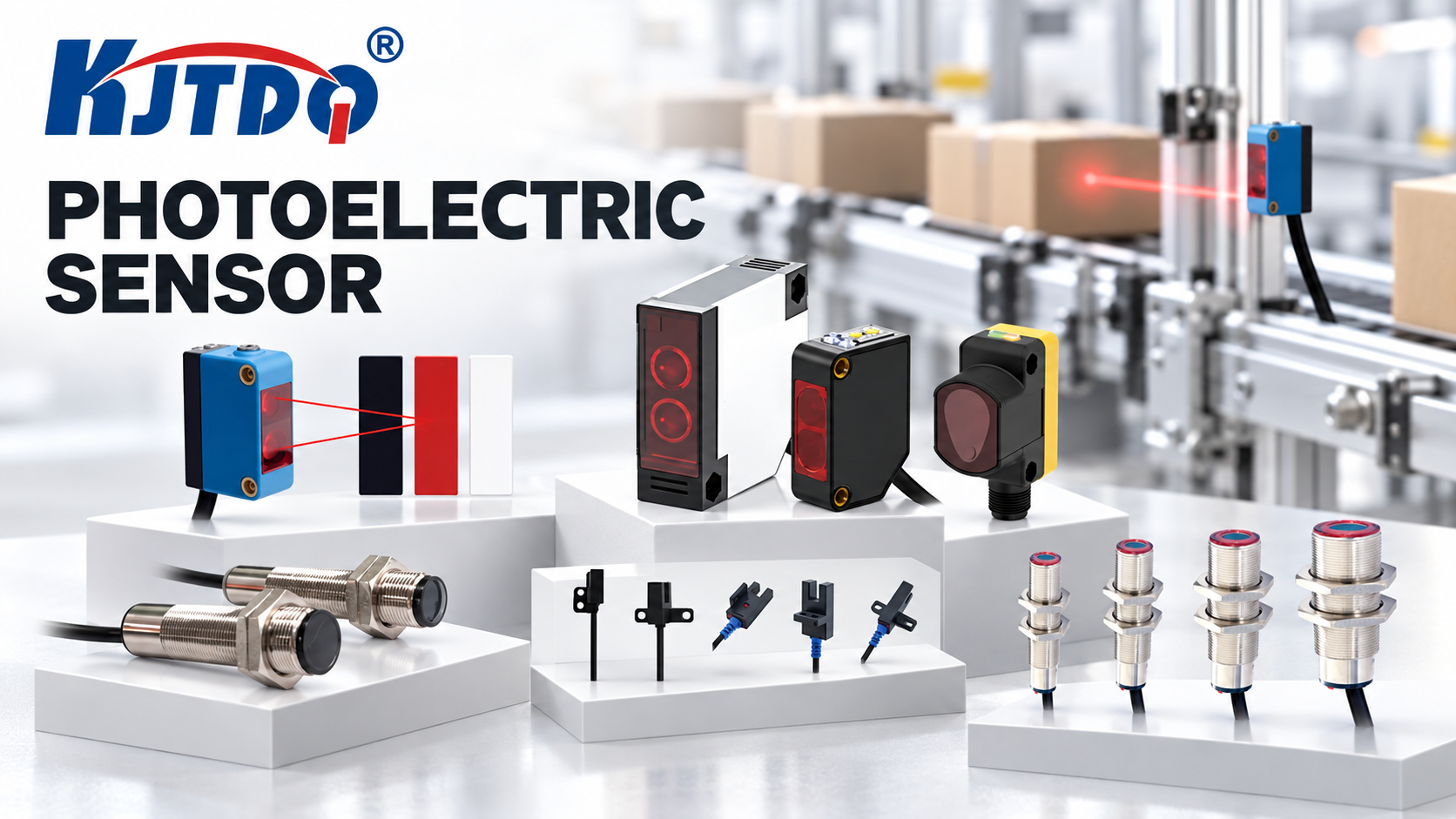
Use a label sensor when the task is detecting the physical boundary of a label — the gap between labels, the label edge, or label presence — especially on transparent labels or films. Use a color-mark (registration-mark) sensor when the task is detecting a printed mark by its contrast against the background, to trigger cutting, positioning or correction. The two answer different questions: a label sensor finds where the label is; a color-mark sensor finds where the print says the web should be cut, positioned or corrected.
Key Takeaways
- Different targets, different physics. Label sensors detect the label/backing difference (thickness, opacity, or acoustic impedance for ultrasonic types); color-mark sensors detect reflected-light contrast between a printed mark and its background.
- Transparent labels are the label-sensor case. Where optical label forks struggle with clear-on-clear labels, ultrasonic label sensors detect the material boundary regardless of transparency.
- Contrast decides color-mark feasibility. The mark must differ from its background in the light the sensor emits; low-contrast or same-color mark/background pairs are the classic failure — test the real print.
- Web speed binds both. Response time must beat the gap or mark passage time at maximum web speed; verify with samples at speed.
What Each Sensor Actually Detects
| Decision dimension | Label sensor (gap/edge) | Color-mark sensor (registration/contrast) |
|---|---|---|
| Question answered | Where does one label end and the next begin? Is a label present? | Where is the printed mark that triggers cut/position/correction? |
| Physical basis | Label vs backing difference — optical (opacity/thickness) or ultrasonic (material boundary) | Reflected-light intensity difference between mark color and background |
| Typical hardware | Fork (slot) sensors; ultrasonic label sensors | Spot-beam contrast sensors with colored (e.g., RGB) light sources and teach-in |
| Best target | Label webs — paper, film, and transparent labels (ultrasonic) | Printed registration marks on packaging film, paper, print webs |
| Classic failure | Clear-on-clear labels defeating optical forks; backing-color interference | Low mark/background contrast; background print noise; mark color change |
| Key setup feature | Teach/clear-dark switching for label vs gap | Teach-in on mark and background; sensitivity between false-trigger and missed-mark |
| Packaging-line role | Label feeding, application, slitting, counting, positioning | Fixed-length cutting, registration, web correction, synchronization |
When the Label Sensor Wins
- The machine applies, counts or positions labels and needs the gap or edge;
- Transparent labels or films are involved: KJT Sensors' label-sensor documentation states its ultrasonic label sensors detect a variety of materials including transparent labels and films, with pushbutton clear/dark teach adjustment, PNP/NPN outputs, and a minimum detectable label interval/size down to 2 mm (manufacturer-stated);
- Backing-paper color or reflectivity varies — ultrasonic detection reads the material boundary rather than optical contrast.
When the Color-Mark Sensor Wins
- The trigger is a printed mark, not a physical edge: fixed-length cutting, registration, correction on printed webs;
- The web has no gaps to find — continuous film where only the print defines position;
- KJT Sensors' color-mark documentation describes the operating basis: the sensor emits light at specific wavelengths (red, green or blue), measures reflected intensity, and switches on the mark/background difference, with sensitivity adjustment as the critical setting — too low misses the mark, too high invites false triggers (manufacturer-stated).
Selection Steps for a Packaging Line
- Define the trigger: physical label boundary → label sensor; printed mark → color-mark sensor. If both exist on one line, they are two separate detection points.
- Characterize the material: label and backing material (paper/transparent/metalized film), mark color vs background color, surface reflectivity, film flutter.
- Check contrast or boundary strength: for color-mark, test the actual mark/background pair — including print variation; for labels, test the thinnest/clearest label and backing combination.
- Verify speed: gap width or mark length divided by maximum web speed gives the signal window; the sensor's response time plus the machine controller's input delay must fit inside it.
- Plan changeovers: teach-in and pushbutton adjustment (both KJT Sensors documentation sets emphasize teach/pushbutton commissioning) determine how painful a material change is; document the settings per material.
Missed detections after material or speed changes are a diagnosis topic covered in the label/color-mark troubleshooting guide.
KJT Sensors Options for Packaging Webs
From KJT Sensors' published photoelectric category (verified 2026-10-10, which lists label-sensor and color-mark/color-sensor subcategories) and product documentation:
- Label sensors, including ultrasonic label sensors — label presence, gap, edge and passage detection for labeling and packaging lines; ultrasonic types stated for transparent labels and multiple materials, with teach/pushbutton setup and PNP/NPN outputs;
- Color-mark / color sensors — mark, color-difference and print-mark detection for packaging, slitting, printing and labeling equipment, with wavelength-selective emitters and sensitivity/teach adjustment.
Recommendation boundary: documentation for both families recommends sending label samples, backing samples, running speed and mounting details for model confirmation — model choice for a specific web is sample-driven. Related guides: the photoelectric mode comparison for the underlying sensing arrangements, the fiber-optic guide for confined mounting points, and the transparent-container guide for clear bottles and film as objects rather than webs.
Frequently Asked Questions
What is the difference between a label sensor and a color-mark sensor?
A label sensor detects the physical boundary of a label — gap, edge, presence — by the difference between label and backing. A color-mark sensor detects a printed mark by its optical contrast against the background. One finds where the label is; the other finds where the print says to cut, position or correct.
Which sensor detects label gaps on transparent film?
A label sensor designed for transparent materials — typically an ultrasonic label sensor, which detects the material boundary regardless of transparency. KJT Sensors states its ultrasonic label sensors handle transparent labels and films, with teach-in setup and a minimum detectable label interval down to 2 mm (manufacturer-stated). Validate with your actual label/backing combination.
How should web speed and print contrast be tested before selection?
Contrast: test the real mark against the real background, including the worst print variation, and confirm the sensor distinguishes both teach states with margin. Speed: compute the mark or gap passage time at maximum web speed and verify the sensor's response time plus the controller's input delay fit inside it with margin. Test both with production samples, not proxies.
Can one sensor cover both label gaps and registration marks?
The tasks differ in physics and mounting (fork through-beam arrangements for labels versus spot-beam contrast reading for marks), so they are normally two separate detection points. Treat them as such in the machine design rather than forcing one device to do both.
Conclusion
Label sensors and color-mark sensors are not interchangeable: the first finds the label's physical boundary (ultrasonic types handle transparent labels), the second finds the print's contrast mark. Decide by trigger type, test the real material and speed, and use teach-in features to survive changeovers. KJT Sensors offers both families — send label and film samples with web-speed data for a confirmed recommendation.
Sources
- KJT Sensors, Photoelectric Sensors category (label / color-mark subcategories) — https://www.kjt-sensors.com/list-photoelectric.html (verified 2026-10-10)
- KJT Sensors internal product documentation: label sensors (ultrasonic, transparent labels, 2 mm minimum interval, teach/pushbutton, PNP/NPN) and color-mark sensors (wavelength-selective emitter, teach-in, sensitivity) — version current at drafting; manufacturer-stated
- General packaging-web detection practice (no third-party claims)
Send Label, Film and Speed Details
Send label and backing samples, mark/background print samples, web speed and mounting photos — KJT Sensors will confirm the label-sensor or color-mark model and setup for your line. Pricing is quoted by model and project requirements.
https://www.kjt-sensors.com/
KJT Sensors



+ There are no comments
Add yours