
"Cellular modem" is one of the most loosely used terms in industrial connectivity. One buyer uses it to mean a radio module that will be soldered onto their own circuit board. Another means a USB stick. A third means a compact industrial box that takes data from a PLC, meter, or controller and sends it over the mobile network, securely and without anyone touching it for years. All three may type the same words into a search engine: Shenzhen industrial 5G cellular modem factory.
This article is about the third kind. It explains what an industrial 5G modem is expected to do today, walks through the E-Lins 5G modem range built in Shenzhen and how to choose between models, and finishes with practical advice for evaluating a factory, in person or remotely.
What an Industrial 5G Modem Is Expected to Do
The industrial modem started life as a simple converter: serial data in, cellular data out. That is still its core job, but the expectations around it have grown.
|
What buyers call a "5G modem" |
What it actually is |
Who it suits |
|
Cellular module |
A radio component designed onto your own circuit board |
Device makers with in-house RF design and certification capability |
|
USB modem |
A plug-in radio that relies on the host computer for everything else |
Temporary or test connections |
|
Industrial 5G modem |
A standalone, powered device with serial, Ethernet and I/O ports, plus VPN, firewall and remote management |
PLCs, RTUs, meters, controllers and small groups of IP devices in the field |
An industrial 5G modem today has to do four things well. It must speak the field side's language, which usually means RS232 or RS485 and protocols such as Modbus. It must reach the central system securely, which means VPN rather than a public IP address. It must be manageable from a distance, because nobody wants to drive to a pumping station to change a setting. And it must survive the cabinet it is installed in for years.
The E-Lins Industrial 5G Modem Range
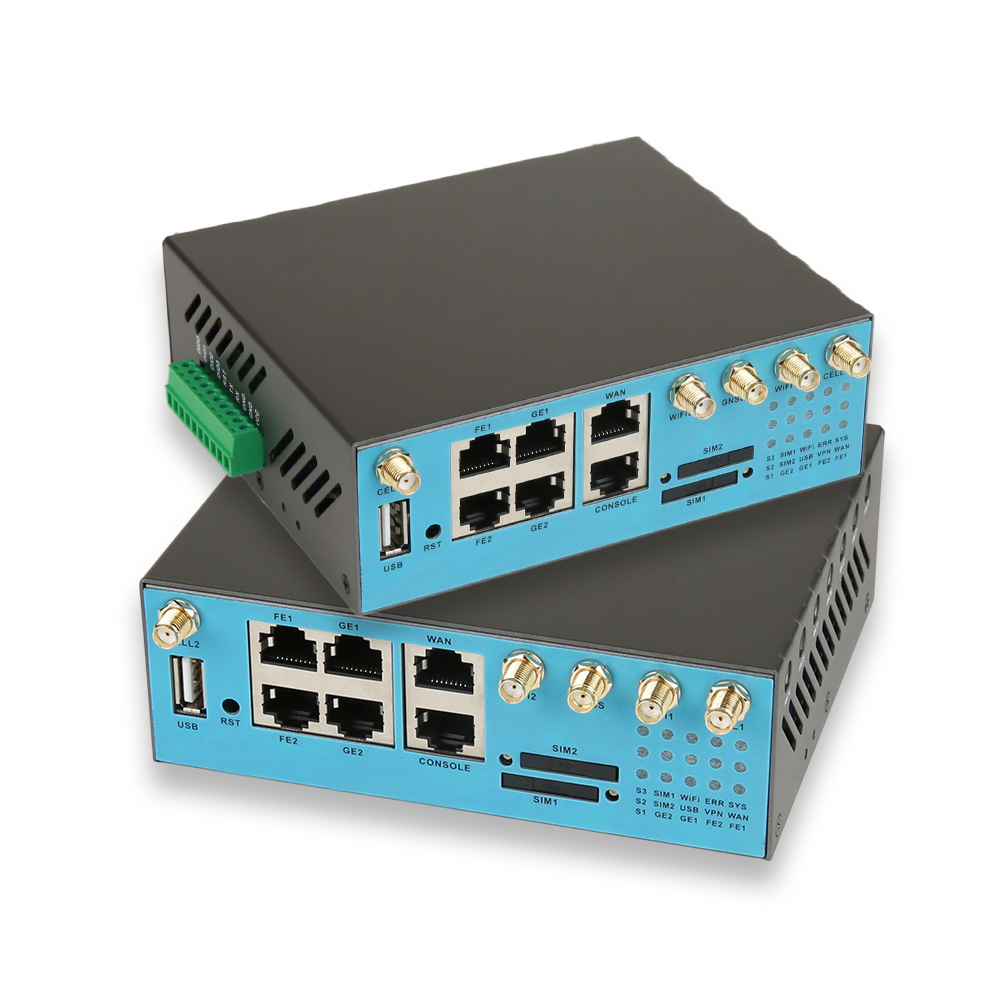
E-Lins builds its industrial 5G modems with router-class functions included, so the same unit can connect a serial controller, an Ethernet device, and a few digital signals, then carry all of it over an encrypted tunnel. The current range covers single-SIM, dual-SIM, GPS, and eSIM variants:
|
Model |
SIM |
Wired interfaces |
Notable features |
Typical fit |
|
H685f IoT 5G Modem |
Single SIM |
2 x Gigabit Ethernet, 1 serial port (RS232/RS485), 4 DI/DO |
5G SA/NSA, GPS/BeiDou, PoE support, compact size |
A PLC or RTU plus one IP device in a small cabinet |
|
H685f-G 5G GPS Modem |
See datasheet |
Gigabit RJ45, RS232 x1 |
5G SA/NSA, GPS, PoE In, DIN rail |
Assets that need position or time reference |
|
H900f IoT 5G Modem |
Dual SIM |
3 x Gigabit + 2 x Fast Ethernet, serial, USB 3.0, 4 DI/DO |
Failover and load balancing across cellular, wired WAN and Wi-Fi, including link bonding |
Multi-device sites where continuity matters |
|
H900f-G 5G GPS Modem |
See datasheet |
Gigabit RJ45, USB or console |
GPS, PoE In or PoE Out |
Camera or vehicle installations that need location |
|
H900pf IoT 5G Modem |
Dual SIM plus eSIM |
Gigabit ports |
MQTT |
Devices reporting directly to IoT cloud platforms |
|
H900uf IoT 5G Modem |
Dual SIM plus eSIM |
Gigabit port, USB 3.0 |
DMVPN |
Large multi-site VPN networks |
Across the range, the modems support 5G standalone and non-standalone networks with 4G fallback, and are managed through the web interface, Telnet, SSH, TR-069, SNMP, or the E-Lins NMS cloud platform. E-Lins lists Modbus and DNP3 among the industrial protocols for the range, and its platform supports serial transparent transmission. Most models accept 5 to 40V DC, with a 5 to 60V DC option, through dual power inputs with automatic failover, and come in an IP30 alloy metal case for desktop, wall, or DIN-rail mounting. E-Lins specifies its industrial hardware for -35°C to +75°C operation, with 15KV ESD protection and 1.5KV electromagnetic isolation.
Choosing Between Models
Single SIM or dual SIM?
A single-SIM modem is simpler and suits sites where one operator has strong coverage and a short outage is acceptable. Dual SIM lets the modem switch to a second operator when the first network fails. For unattended sites where a lost connection means a lost alarm, dual SIM is usually worth it. The H900f modem goes further, balancing traffic across cellular, wired and Wi-Fi links rather than simply failing over.
Do you need GPS?
GPS matters for anything that moves, such as vehicles and portable equipment, and for fixed assets where the control centre wants a reliable time reference or proof of location. The H685f-G and H900f-G are built around this need, and many other models support GPS and BeiDou.
Is eSIM useful for your project?
An eSIM is an embedded SIM whose operator profile can be changed remotely, without opening the device or swapping a card. For equipment shipped to several countries, or installed where physical access is difficult, that removes a common logistics headache. The H900pf and H900uf support eSIM alongside their two physical SIM slots.
Which protocols does the central system use?
If the data goes to a SCADA master, Modbus or DNP3 support and serial transparent transmission matter most. If it goes to a cloud IoT platform, MQTT, a lightweight publish-and-subscribe messaging protocol widely used in IoT, may be more relevant; the H900pf lists MQTT support. For networks with many sites that need to reach each other as well as the centre, DMVPN, available on the H900uf, can build tunnels between sites on demand instead of routing everything through one hub.
Does the device really need 5G?
A meter sending a few hundred bytes every minute gains nothing from 5G speeds. The reasons to choose 5G for such a device are the network's future, the availability of standalone coverage, or other equipment at the same site. Where a single serial device is all there is, E-Lins M300/M400 Industrial 4G Modems provide RS232/RS485 to 4G transparent transmission, and the M300t adds wide-voltage DC input.
Why Shenzhen, and How to Evaluate a Factory There
Shenzhen is one of the world's largest electronics manufacturing centres, with a dense supply chain for components, enclosures, and assembly. It also has many trading companies that present themselves as factories. A well-planned evaluation tells you quickly which kind of supplier you are dealing with.
On the production floor
Ask to see the SMT lines and final assembly. Look for consistent ESD controls, clear labelling of work in progress, and test stations at the end of the line. Ask which steps are done in-house and which are subcontracted. E-Lins operates its own SMT factory and assembly lines in Shenzhen, with monthly production capacity of tens of thousands of units.
With the engineering team
Ask who writes the firmware and how changes are tracked. Request a demonstration of how a configuration is created, saved, and pushed to many devices at once. E-Lins develops its system software entirely in-house and provides lifetime free firmware upgrades.
In the quality office
Ask for management system and product certificates. E-Lins holds ISO 9001 and ISO 14001 certification, and its products carry CE, FCC, and UKCA certification and comply with RoHS. Ask how returns are handled and how long the warranty runs. At E-Lins, the standard warranty is one year and can be extended.
If you cannot travel
A video walk-through of the production area, a sample order and a reference call with an existing customer can cover much of what a visit would show. E-Lins also provides configuration manuals, video tutorials and one-to-one remote guidance for evaluation teams, and offers 7x24 remote support with an average response time of 10 minutes during business hours.
Questions to Send Before Any Factory Contact
What will the modem connect to? List interfaces and protocols for every device at the site.
How much data, in which direction? Telemetry, video, or both.
Which networks are available at the sites? 4G only, 5G non-standalone, or 5G standalone.
What does the central system require? VPN type, head-end equipment, management platform, cloud protocol.
How many units, over what period, and in which countries? This decides whether eSIM, dual SIM, or specific certifications matter.
Answer these, and the conversation with any Shenzhen factory becomes much shorter and more productive.
A Modem Maker Since 1999
Shenzhen E-Lins Technology Co., Ltd. has made industrial modems since it entered the industrial sector in 1999 with 2G and 3G modems for power grids and oil fields. It later added 3G routers and DTUs, full 4G LTE product lines and, since 2019, 5G NR industrial routers and edge computing gateways. The current 5G modem range is the latest step in that line, and the company now supplies customers in more than 150 countries and regions. For buyers searching for a Shenzhen industrial 5G cellular modem factory, that history matters: a modem is a long-lived field device, and it pays to buy it from a manufacturer that has supported modems through every cellular generation so far.
https://e-lins.com/
Shenzhen E-Lins Technology Co., Ltd.

+ There are no comments
Add yours