
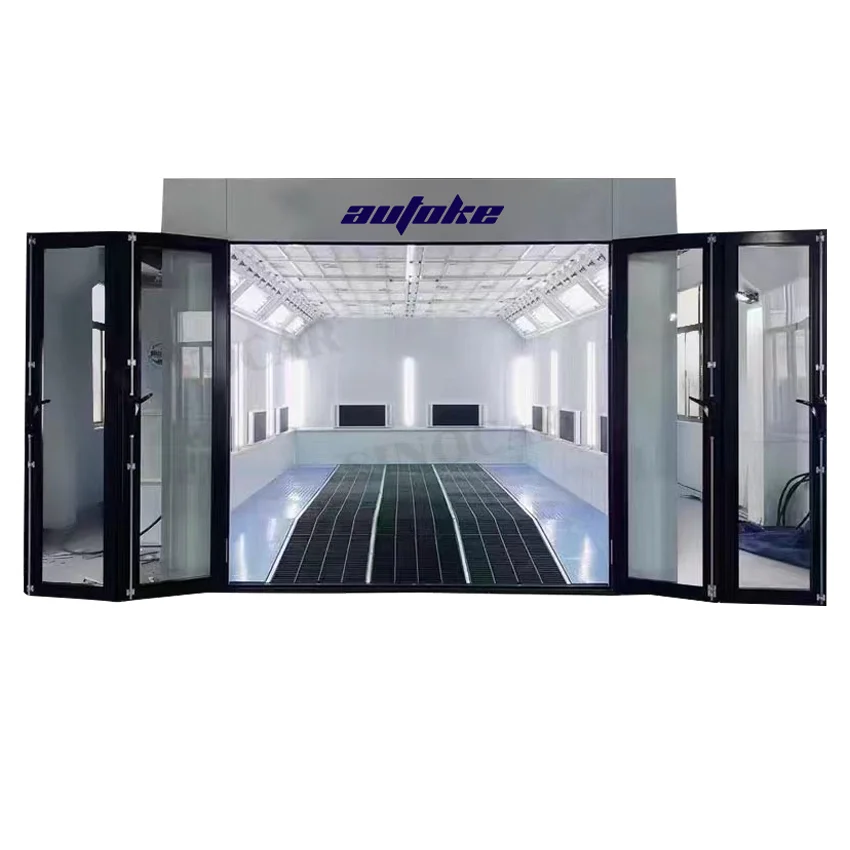
Modern automotive refinishing demands advanced equipment capable of delivering consistent coatings, optimized curing, and controlled environmental conditions. An auto paint booth designed for high-temperature applications—such as systems operating at 150°C—has become integral to factories aiming for durable surface performance and competitive production efficiency. In this blog post, AUTOKE, as high quality automotive spray booth manufacturer, will share the core functions of industrial auto paint booth for sale, its structural advantages, etc.
Core Functions of Industrial Auto Paint Booth System
An industrial auto paint booth system integrates controlled airflow, particulate filtration, and uniform temperature distribution to create a stable finishing environment. Its design prevents dust intrusion, maintains constant humidity, and supports smooth coating atomization. By utilizing high-efficiency air exchange and balanced pressure control, the system ensures that each coating layer adheres evenly and cures without defects such as orange peel, blistering, or uneven gloss.
Additionally, industrial paint booths incorporate programmable logic controllers (PLC) that precisely manage airflow modes—intake, exhaust, and recirculation—along with temperature settings and drying profiles. The result is a predictable, repeatable painting process aligned with automotive OEM surface standards.
Structural Advantages of Auto Paint Booth Installations
Robust Chamber Structure for Industrial Auto Painting Booths
The chamber of a industrial auto painting booth is typically built from double-layer galvanized steel panels or composite insulated panels. This structure provides excellent rigidity, corrosion resistance, and thermal retention. Insulated walls reduce heat loss during high-temperature curing cycles, which significantly lowers energy consumption and stabilizes temperature gradients across the workspace.
The interior surface is designed with anti-static and easy-clean materials to reduce contaminant accumulation and ensure long-term production hygiene.
High-Temperature Capability in Automotive Spray Booth Designs
A key advantage of a automotive spray booth design built for 150°C operation is its thermal durability. Heating modules—whether diesel, gas, electric, or infrared—are equipped with overheat protection, multi-layer insulation, and airflow balancing devices. This ensures that the booth can safely reach extreme temperatures without structural deformation or heat leakage.
Such high-temperature capability is especially beneficial for curing powder coatings, heat-resistant paints, industrial primers, or specialized coatings used on automotive parts.
Engineering Features of 150°C High-Temperature Car Spray Booth
Advanced Industrial Auto Paint Booth Ventilation
Ventilation is the core of a high-performance industrial auto paint booth ventilation system. Ceiling-mounted laminar airflow diffusers deliver uniform top-down air movement, while dual-stage filtration traps contaminants before they circulate through the chamber.
Fresh air intakes are paired with high-capacity exhaust fans, and optional heat-recovery modules capture waste heat to improve energy efficiency. This precise airflow prevents turbulence that may cause overspray contamination or coating sagging.
Temperature Control in High-Heat Vehicle Paint Booth Technology
The heating system of a vehicle paint booth technology platform maintains fast temperature ramp-up and consistent thermal uniformity. Ceramic burners, stainless-steel heat exchangers, and digital thermostatic controls ensure accurate heating curves, enabling coatings to polymerize correctly.
Thermal stability is crucial for preventing uneven curing that may lead to micro-cracks, adhesion failure, or reduced gloss retention.
Application of Automotive Paint Booth Facilities
Large-scale Industrial Auto Spray Booth Solutions
Factories producing automotive frames, metal housings, agricultural vehicles, or specialized equipment benefit from industrial auto spray booth solutions built to accommodate different part sizes. The booths can be configured with extended-length chambers, side-draft airflow, or adjustable internal layouts to process automotive bodies or individual components.
High-temperature booths are often integrated into assembly-line workflows, supporting primer curing, topcoat baking, and multi-stage finishing cycles.
Automotive Repair and Customization Workshop Requirements
For repair shops and customization centers, an auto body paint booth with controlled airflow and consistent heating ensures color uniformity, smooth finishes, and reduced rework. While many workshops operate at standard curing temperatures, high-heat models provide an advantage for rapid-dry formulations or heavy-duty coatings.
Material Compatibility Supported by Industrial Paint Booth Equipment
Components Suitable for High-Heat Auto Paint Booth Operations
A auto paint booth equipment system capable of 150°C curing supports applications such as:
-
High-temperature resistant coatings on engine covers
-
Heat-curable powder coatings for rims and metal fixtures
-
Industrial baking enamels for structural vehicle components
-
Specialized protective layers for trucks, buses, or heavy machinery
The equipment accommodates steel, aluminum, fiberglass, coated plastics, and composite materials commonly used in automotive manufacturing.
Energy Efficiency Considerations in Automotive Finishing Booths
Power-saving Mechanisms in Industrial Auto Paint Booth Installations
Energy optimization is a priority for an industrial auto paint booth installation, especially when high-temperature curing is required. Efficient heating sources, insulated wall systems, and intelligent recirculation cycles significantly reduce energy demand.
Eco-mode settings balance heat retention with ventilation cycles to maintain air quality while minimizing energy waste. Additionally, integrating LED illumination reduces electrical load and eliminates heat interference with curing processes.
Safety Engineering Integrated into Modern Paint Booth Systems
Fire Safety and Explosion-proof Measures in Auto Coating Booths
Safety is fundamental to any auto coating booth design. Explosion-proof lighting, anti-static flooring, flame-retardant filters, and automatic fire-suppression systems are all part of advanced safety engineering.
Sensors continuously monitor VOC levels, pressure differentials, and temperature fluctuations. Should any parameter exceed the threshold, automated systems interrupt heating, reduce airflow, or activate emergency alarms.
Operator Protection in Industrial Vehicle Spray Booth Facilities
To ensure worker safety within a industrial vehicle spray booth, manufacturers install emergency-stop switches, heat-insulated panels, and ventilation safeguards. Personnel doors include observation windows resistant to high temperatures, allowing supervisors to monitor operations without entering the chamber.
Workflow and Process Efficiency in Automotive Paint Booth Operations
Streamlined Production Flow with Auto Spray Booth Systems
An optimized auto spray booth system improves throughput by integrating painting robots, conveyor tracking, and automated handling equipment. Quick-change filter systems and tool-free service panels minimize downtime.
High-temperature curing shortens drying times compared to ambient or low-heat modes, enabling faster transitions between painting steps and improved overall productivity.
How High-temperature Booths Support Quality Standards
Surface Quality Control Using Industrial Auto Paint Booth Technology
Automotive manufacturers rely on industrial auto paint booth technology to achieve uniform film thickness, controlled gloss, and durable adhesion. Sensors can track humidity, airflow rate, temperature gradients, and VOC levels to ensure stable conditions throughout the coating cycle.
This technology enables defect-free surfaces suited for OEM requirements, fleet vehicles, luxury cars, and industrial machinery.
Comparing High-temperature Booths with Standard Automotive Spray Booth Systems
Performance Differences Between Industrial and Standard Auto Booths
A standard automotive spray booth typically operates at 60–80°C. In contrast, a high-temperature booth reaching 150°C offers several advantages:
-
Faster curing cycles for heat-curable coatings
-
Higher coating hardness and durability
-
Greater compatibility with powder coatings
-
Improved chemical and abrasion resistance
These differences make high-temperature booths essential for factories handling industrial-grade coatings or performance vehicle components.
Cost Competitiveness of 150°C High-Temperature Paint Booth Factories
High-temperature booths are engineered to deliver longevity and stable performance, even with demanding production schedules. The competitive price offered by specialized factories reflects optimized structural design, scalable heating modules, and efficient material selection.
Manufacturers adopt modular production techniques, enabling cost-effective customization without compromising reliability. For buyers, this achieves a balance between upfront investment, long-term operating cost, and superior coating output.
Conclusion
A 150°C high-temperature industrial auto paint booth offers a comprehensive solution for automotive factories seeking faster curing, consistent surface quality, and long-term coating durability. Its engineered airflow, controlled heating profiles, and robust construction support advanced manufacturing needs while maintaining competitive cost efficiency. As automotive finishing evolves, high-performance paint booths will remain central to achieving precise, reliable, and high-value industrial coatings
www.autokemanufacture.com
AUTOKE



+ There are no comments
Add yours