
Medium-Voltage Busbar Insulators: DMC/BMC vs. Cast Epoxy
Specifying structural insulation for medium-voltage busbar systems in the 3.6 kV to 12 kV range demands a decision that carries long-term consequences for switchgear reliability, service life, and total cost of ownership. The two dominant material platforms — composite DMC/BMC/SMC and vacuum-cast epoxy resin — each deliver distinct mechanical, thermal, and dielectric profiles. Understanding where each technology excels, and where it faces limits, is essential for panel builders, switchgear OEMs, and turnkey EPC contractors designing mission-critical power distribution infrastructure.
DOWE Electric, a Yueqing-based manufacturer with more than two decades of engineering experience in electrical insulation systems and busbar supports, addresses both material categories through purpose-engineered product lines: the DW Series built on composite DMC/BMC/SMC, and the EL MV Series constructed from vacuum-cast epoxy resin. Both families are supported by third-party SGS type test reports, enabling panel builders to complete Design Verification documentation without independent destructive testing.
Why Material Selection Matters at Medium Voltage
At system voltages from 3.6 kV to 12 kV, insulation failures rarely announce themselves before they become catastrophic. DC arcing in high-voltage systems lacks a natural zero-crossing point, creating continuous surface tracking risks. Even in AC medium-voltage environments, partial discharge activity, humidity absorption, and thermal cycling progressively degrade insulation integrity. A busbar support or post insulator that performs adequately at commissioning but degrades under operational stress can result in flashover, arc fault energy release, and unplanned outages.
Three failure mechanisms drive most field incidents in this voltage class: conductive carbon tracking along humid surfaces, internal void-initiated partial discharge within monolithic insulation bodies, and mechanical fatigue from thermal cycling between copper or aluminum conductors and composite support structures. Any material specified for medium-voltage service must address all three simultaneously.
DMC/BMC/SMC Composite Insulators: The DW Series
The DOWE DW Series applies a composite insulation system built from DMC, BMC, and SMC thermoset materials to the 3.6 kV to 12 kV voltage band. These materials are compression-molded under hydraulic pressure in automated workshops, producing components with isotropic mechanical properties and tight dimensional tolerances.
Technical Profile
The DW Series covers installed heights from 30 mm to 130 mm and is rated for system voltages from 3.6 kV to 12 kV AC. The composite formulations used by DOWE carry a Comparative Tracking Index (CTI) of 600V or higher, placing the materials in Material Group I — the highest tier of resistance against conductive carbonized tracking paths. This is critical in indoor switchgear environments where condensation cycles and dust accumulation can initiate surface tracking on lower-grade materials.
UL 94-V0 flammability certification is maintained across the product family, with afterflame time at t1 plus t2 no greater than 8 seconds and zero flaming drips — performance parameters that protect enclosed switchgear from fire propagation during internal arc fault events.
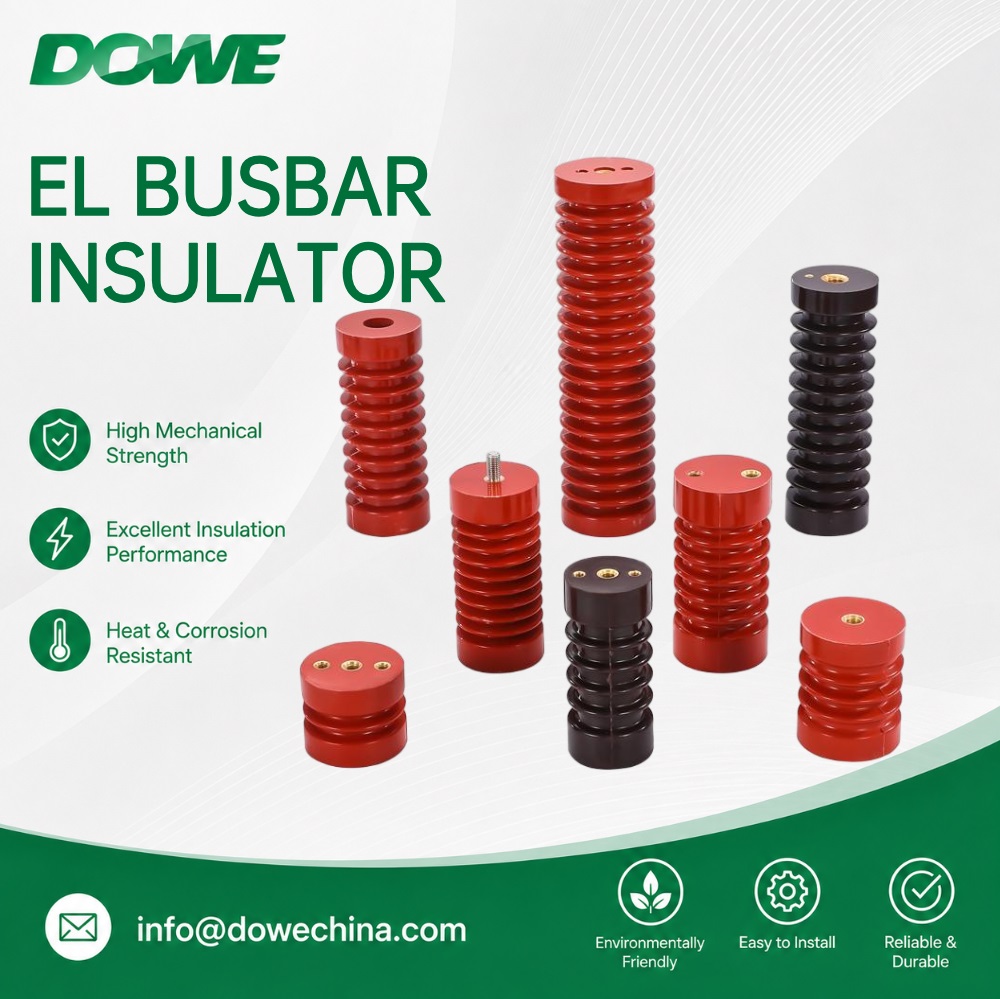
The SMC variant within this composite family uses longer glass fiber reinforcement (25 mm to 50 mm fiber length) that delivers superior flexural and tensile strength compared to standard thermoset compounds. This structural rigidity allows the DW Series to resist the electrodynamic forces generated during short-circuit events in switchgear rated to substantial fault current levels.
Optimized Environments
The DW Series is engineered primarily for clean indoor switchgear and secondary distribution substations — environments where contamination levels are controlled, humidity is moderate, and insulation surfaces do not face continuous condensation or aggressive chemical exposure. In these settings, DMC/BMC/SMC composite insulators deliver a combination of dielectric performance, mechanical strength, and cost efficiency that makes them the natural specification choice.
Vacuum-Cast Epoxy Resin Insulators: The EL MV Series
When operating environments move beyond controlled indoor conditions into industrial plants with high humidity, persistent dust, and condensation cycles, the physics of surface insulation shifts decisively. This is the domain of the DOWE EL MV Series, manufactured through vacuum casting with an automated pressure gelation (APG) process using hot-curing bisphenol-A epoxy resin.
Technical Profile
The EL MV Series is rated for system voltages from 3.6 kV to 7.2 kV AC with installed heights ranging from 130 mm to 360 mm — a geometry range that reflects the creepage and clearance requirements of more demanding medium-voltage service. Three performance characteristics define its engineering advantage.
Void-free monolithic casting is the foundational property. The APG process eliminates internal voids that would otherwise initiate partial discharge under operating voltage stress. DOWE's EL MV Series achieves partial discharge of less than 5 pC at 1.1 Um for cast epoxy medium-voltage insulators — a threshold that indicates the internal insulation structure is free from the cavity discharge activity that degrades conventional insulators over time.
Hydrophobic surface properties of the cured epoxy resin prevent moisture film continuity on the insulator surface. In environments where condensation is cyclic and unavoidable, this property is decisive: a surface that sheds moisture rather than forming a continuous conductive film maintains its dielectric integrity under conditions that would compromise composite thermoset surfaces.
Volume resistivity greater than 10^14 Ω·cm ensures that even under extreme condensation, the bulk insulation material resists leakage current through its structure. Combined with a dielectric loss angle tan δ no greater than 0.005 at 20°C, the EL MV Series delivers the low-loss, high-integrity dielectric performance required for ring main units (RMUs) and variable frequency drive (VFD) cabinets where partial discharge and dielectric heating must be minimized.
Optimized Environments
The EL MV Series is the preferred specification for harsh, humid, and dusty industrial plants, ring main units, and VFD drive cabinets — environments where composite thermoset materials face surface tracking risks that void-free epoxy construction eliminates. The 130 mm to 360 mm installation height range also accommodates elevated creepage path requirements imposed by IEC 60815 for heavily polluted service conditions.
Comparative Specification Guidance
When selecting between these two platforms, the primary discriminating factors are installation environment cleanliness and the criticality of partial discharge control.
-
For clean indoor secondary substations and standard low-pollution switchgear assemblies at 3.6 kV to 12 kV, DMC/BMC/SMC composite insulators in the DW Series provide the combination of CTI 600V tracking resistance, UL 94-V0 fire safety, and mechanical strength at heights from 30 mm to 130 mm that meets standard design verification requirements efficiently.
-
For harsh environments with humidity, dust, condensation, or aggressive contamination — and for applications at 3.6 kV to 7.2 kV where partial discharge budgets are constrained — the vacuum-cast epoxy resin construction of the EL MV Series delivers hydrophobic surface behavior, void-free internal structure, partial discharge below 5 pC, and high volume resistivity that composite thermoset materials cannot match.
Both series carry RoHS 2011/65/EU and 2015/863 compliance, REACH (EC 1907/2006) compliance, CE clearance, and SGS third-party type test clearance, enabling straightforward qualification for European and North American markets without independent re-testing.
DOWE Electric's Engineering Support Infrastructure
The capacity to supply both material platforms from a single source with consistent certification coverage reflects the manufacturing depth that DOWE Electric has built over more than two decades. Automated BMC/SMC hydraulic compression molding workshops, vacuum casting facilities using the APG process, automated CNC thread tapping units, and a certified high-voltage dielectric test laboratory underpin both product families. The company holds IEC 61439-1/2, IEC 60664-1, IEC 60273, IEC 60071, and IEC 60815 compliance across its medium-voltage insulator portfolio.
For specifiers working across multiple medium-voltage projects with varying contamination classifications, DOWE's dual-platform approach — composite thermoset for clean environments, vacuum-cast epoxy for harsh ones — eliminates the complexity of managing multiple vendor qualification processes while maintaining optimal material-to-application matching across the full 3.6 kV to 12 kV service range.
http://www.busbarinsulator.com
Yueqing City DUWAI Electric Co.,LTD

+ There are no comments
Add yours