
Karma wire does not reach ±5 ppm/°C in the melt. It reaches it in the furnace: a high-temperature anneal at 350–380 °C for 4–8 hours, then a low-temperature soak at 120–150 °C for 24–48 hours, applied to wire that has already passed through 8–12 intermediate anneals during drawing. That is the short answer to how two stage ageing stabilises karma TCR 5 ppm — furnace time, not alloy chemistry. The same mechanism explains why precision wirewound resistors drift first 1000 hours even when the certificate is perfect. Below is the full cycle, the drift data behind it, and what to specify so a quotation includes the treatment instead of quietly skipping it.
Published: November 2026 | By Wisuno Engineering Team
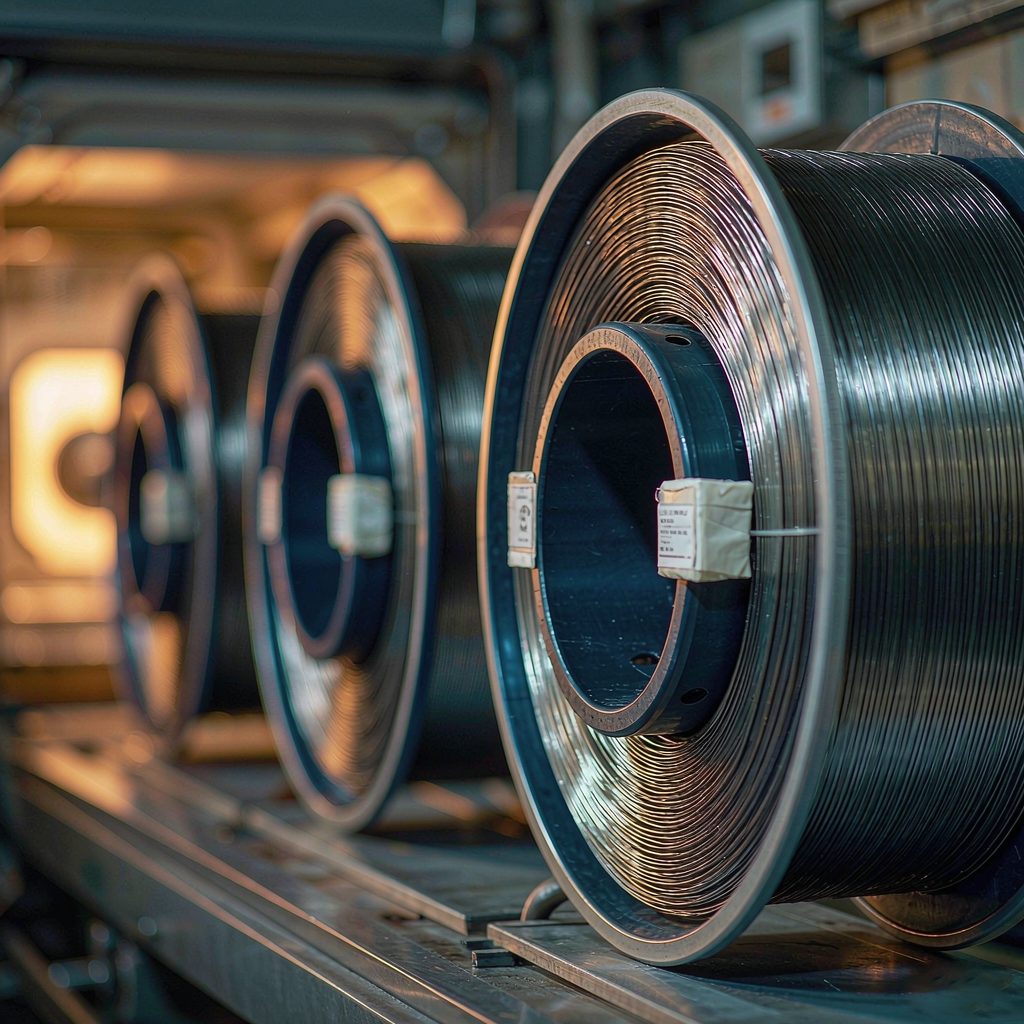
1. What Actually Drifts Inside a Drawn Resistance Wire?
Ask why precision wirewound resistors drift first 1000 hours and the answer sits in the crystal lattice, not in the alloy certificate. Three mechanisms run at once, and heat treatment is the only lever that controls all of them.
• Dislocation relaxation. Drawing 6J22 from an 8 mm rod to 0.03 mm takes more than thirty dies and locks a high dislocation density into the wire. At room temperature those defects keep slipping and annihilating, and resistance moves logarithmically with time — which is why the first month of service, not the fifth year, dominates the drift budget.
• Short-range ordering. In quaternary Ni-Cr-Al-Fe systems, solute atoms cluster locally over time and change how electrons scatter. Ordering tends to raise resistivity while dislocation relief tends to lower it; net drift is the competition between the two, and ageing deliberately moves that balance to a stable point.
• Where the resistance-temperature apex sits. Every precision alloy has a parabolic curve with a curvature coefficient β. Modern Ni-Cr-Al grades run at −0.002 to −0.008 ppm/K², roughly an order of magnitude flatter than manganin at −0.03 to −0.05 ppm/K². On a coarse curve, a 20 °C excursion away from a 22 °C apex already costs 16 ppm. Flattening β buys you a usable window — but the apex position itself is set by thermal history, not by chemistry alone.
The measured difference is not subtle. Published bridge-excitation data puts initial drift for Karma-type foil at about −1.8 microstrain per decade hour, against −12.5 for constantan. NIST's classic work on 1-mil Karma wire found that an untreated specimen grew 0.04–0.06 % in resistance after five hours at 400–600 °F, while a specimen preheated for 24 hours at 800 °F held essentially zero. The same study found that preheating at 1000 °F made the 600 °F behaviour worse, and that anything above 1200 °F degraded the very coefficients the wire was bought for. Ageing has a correct window, and overshooting it is worse than skipping it.
Taken together, these three mechanisms explain why precision wirewound resistors drift first 1000 hours far more steeply than they drift in the years that follow. Heat treatment is the only manufacturing lever that moves all three at once.
✅ Bottom line: Ageing is not a cosmetic final step — it decides where the resistance-temperature curve sits before your customer's calibration does.
2. What Happens in Each Stage of the Cycle?
The cycle exists because one furnace pass cannot do both jobs: the high-temperature stage fixes the curve, the low-temperature stage locks it. Skip either one and the spool leaves the plant with a curve that will move in the field. In practice the karma wire stabilisation heat treatment 350 c ageing cycle is a two-pass schedule with a verification gate at the end, and each number in it protects one property.
✅ Stage 1 — 350–380 °C, 4–8 hours, vacuum or protective atmosphere. The karma wire stabilisation heat treatment 350 c ageing cycle starts here. This pass relieves the macro-stress left by spooling and winding, reorganises short-range ordering, and shifts the curve apex upward by roughly 10–20 °C depending on soak time. Note that this is a process step, not a service condition: 6J22's working ceiling is about 300 °C.
✅ Stage 2 — 120–150 °C, 24–48 hours. A low-temperature soak relaxes the remaining strain without disturbing the ordering established in stage 1. This is the pass that actually holds the coefficient in place; one-stage processing typically lands at ±20 ppm/°C rather than ±5, which is the practical answer to how two stage ageing stabilises karma TCR 5 ppm.
✅ 100 % spool verification. Resistivity at 1.33 ± 0.07 μΩ·m, temperature coefficient, thermal EMF against copper at ≤ 2.5 μV/°C, and diameter against a band that tightens from ± 0.003 mm at 0.10 mm down to ± 0.001 mm below 0.025 mm. The ± 5 ppm figure is proven here, on every spool, or it is only a claim — Wisuno tests the whole lot rather than sampling it.
The upstream half matters just as much. Between drawing passes the wire receives 8–12 anneals at 750–850 °C in hydrogen, cracked ammonia or vacuum. That is also why 6J22 is vacuum-melted rather than air-melted: at roughly 3 % aluminium, air melting burns the aluminium out and leaves oxide inclusions that snap 0.05 mm wire on the drawing bench.
In commercial terms, that is the whole difference between grades. Standard ± 20 ppm stock ships from inventory after a single anneal. A ± 5 ppm custom order adds 28–56 hours of furnace time per batch, drops thin-wire yield by 10–20 points, and pushes lead time to 2–4 weeks. Stabilisation ageing accounts for only about 5–7 % of the ex-works price, but it is the 5–7 % that decides whether your finished resistor holds calibration. Wisuno runs both grades on one site in Nanjing and confirms every heat on the mill certificate rather than on the trade name.
Diameter, tolerance and TCR options are listed on our Karma alloy wire range page; for the cost side of the same decision, see the cost-per-ohm comparison with constantan.
✅ Bottom line: ±5 ppm/°C is bought with furnace hours, not alloy content — 350–380 °C, then 120–150 °C, then every spool tested.
Frequently Asked Questions
Q1: Can you explain how two stage ageing stabilises karma TCR 5 ppm in one sentence?
A: A 350–380 °C vacuum anneal sets the resistance-temperature curve and its apex, then a 120–150 °C soak for 24–48 hours locks that structure so it no longer relaxes in service. One stage moves the curve; two stages keep it there, which is why the tighter coefficient is quoted only on the two-stage route.
Q2: What does the karma wire stabilisation heat treatment 350 c ageing cycle look like in hours?
A: Plan on 4–8 hours at 350–380 °C under vacuum or protective atmosphere, followed by 24–48 hours at 120–150 °C, for 28–56 hours of furnace time per batch. Add the 8–12 intermediate anneals performed during drawing, which are a separate upstream step and usually quoted as part of the wire price rather than as a service.
Q3: Why do precision wirewound resistors drift first 1000 hours rather than evenly over their life?
A: Because dislocation relaxation and short-range ordering both proceed logarithmically in time. The steep part of the curve is early, so an untreated coil can move tens of ppm in its first month and only a few ppm in the following year. Pre-stabilised wire starts further down that curve, which is what a supplier means by a stable lot — ask for the ageing terms in writing, not just the TCR value.
Specify the Treatment, Not Just the Grade
Send Wisuno your wire diameter, target resistance, TCR class and annual volume, and Wisuno Special Materials Technology (Nanjing) Co., Ltd. — a China factory direct supplier of 6J22 precision resistance alloy — will quote with the ageing schedule written into the offer, supply custom and OEM diameters from 0.016 mm, and attach a mill test certificate to every spool. Email wisuno@wsnnj.com or call +86 189-1295-0505.
www.wisunotech.com
Wisuno Special Materials Technology (Nanjing) Co., Ltd.

+ There are no comments
Add yours