
Custom Catering Cling Film: Private Label Sourcing Guide
Private-label catering cling film sits at an awkward intersection of requirements. Food-service buyers need consistent food-preservation performance, dependable behavior on wrapping and portioning lines, and food-contact documentation that holds up in every market they sell into. A growing share of them also need a material story their own customers will accept. For distributors, catering suppliers, and brand owners building a private-label film line, the practical question is no longer whether a bio-based cling film exists — it is whether a manufacturer can deliver it at commercial scale, under someone else's brand, with the paperwork to support every claim printed on the carton.
Shanghai Sipeng Technology Ltd., which operates under the brand SYNLIFE, is one of the companies built around exactly that gap. Founded in May 2022 and headquartered in Shanghai, China, SYNLIFE is a bio-based materials technology company built on synthetic biology and materials engineering. It develops high-performance bio-based materials, finished applications, and cross-industry material solutions, and holds Shanghai "Specialized and Innovative" Enterprise status.
Why Custom Catering Cling Film Is a Harder Brief Than It Appears
Cling film looks like a commodity. In practice, a private-label catering specification compresses several competing demands into a single roll: food-preservation performance, adequate cling and strength, machinability at the converter and at the end user's kitchen, and a cost structure that still works at food-service volumes.
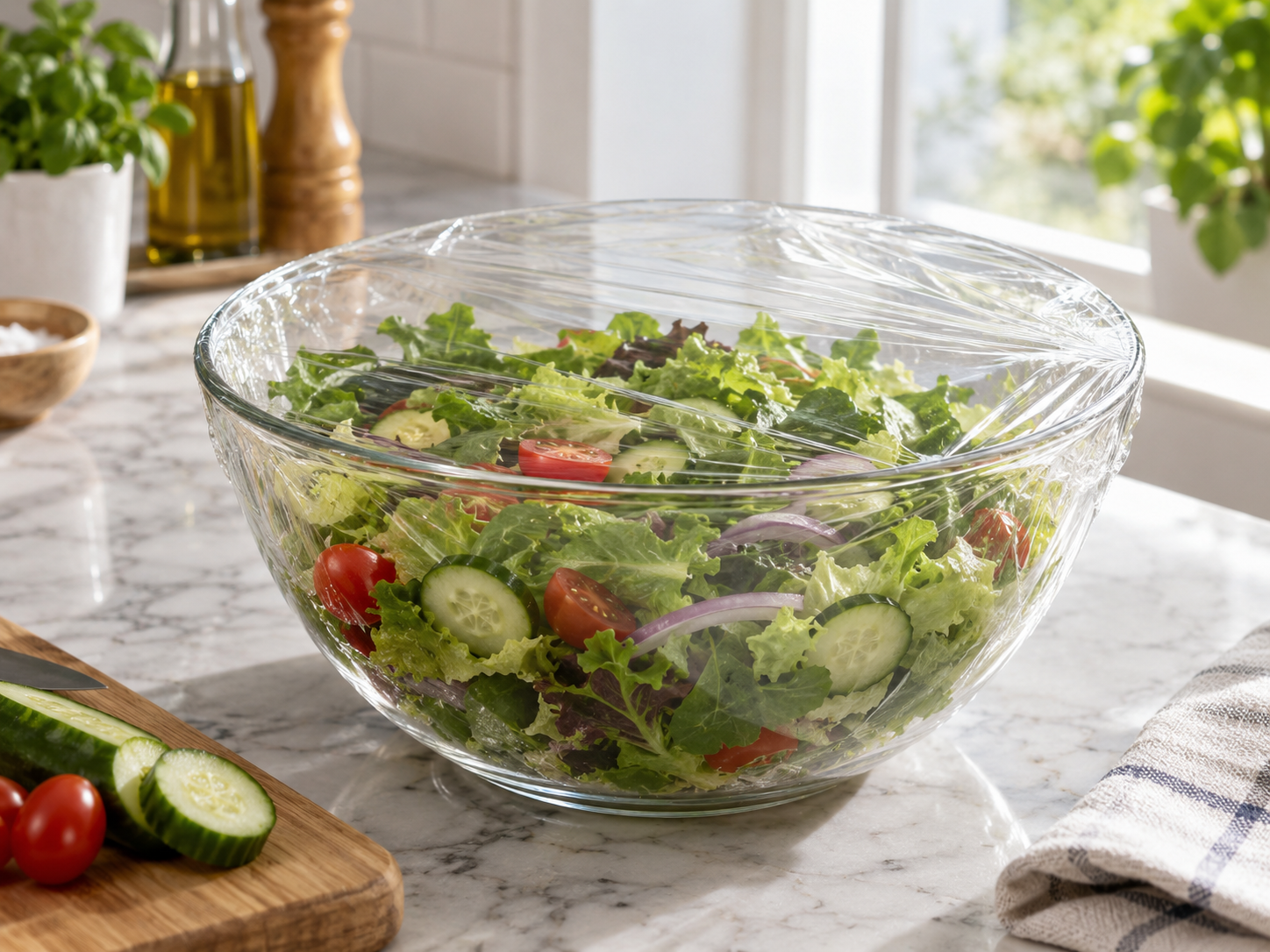
The industry context matters here. Conventional fossil-based plastics carry well-documented challenges around fossil-resource dependence, long-term environmental persistence, and end-of-life waste management. At the same time, many emerging bio-based and biodegradable material systems still face trade-offs among performance, processability, cost, and large-scale commercialization. That trade-off — not the absence of bio-based materials — is the real constraint for a private-label buyer.
SYNLIFE's stated approach is to develop materials around actual processing conditions and end-use requirements rather than focusing only on material synthesis. For a cling film program, that orientation is what separates a lab sample from a shippable roll.
ZeRoll®: A Cling Film Platform with Grade-Specific Compostability Options
The relevant product line is ZeRoll®, a cling-film platform developed for household, food-service, and retail applications. Product composition, bio-based content, and compostability depend on the specific grade and should be confirmed against the corresponding technical documentation, test reports, and applicable third-party certification. The platform is intended to provide alternatives to conventional fossil-based cling film where the selected grade meets the required performance and compliance conditions. Its documented characteristics are food-preservation performance, high bio-based content, and a compostable design for applicable product grades — explicitly framed as an alternative to conventional fossil-based cling film.
Two details in that framing are commercially important for private-label buyers.
First, "applicable product grades" is a qualifier, not a marketing hedge. Compostability claims must correspond to the specific product grade, the applicable standard, and an actual third-party certificate. A private-label program should therefore define its grade and target market before drafting packaging copy.
Second, SYNLIFE runs a parallel film platform, NeoRoll®, covering functional film solutions including non-biodegradable functional films. For a catering supplier that needs both a compostable SKU for sustainability-forward accounts and a conventional functional SKU for cost-sensitive volumes, that dual structure avoids splitting the program across two unrelated suppliers.
The company also reports development work on ZeRoll® MAP meat packaging film, a high-barrier solution for modified-atmosphere packaging of fresh meat and other high-barrier food applications. The development focus spans oxygen barrier, water-vapor barrier, carbon-dioxide transmission, heat-sealing performance, mechanical performance, and food-contact compliance. Notably, SYNLIFE states that internal and third-party testing data should be quoted together with the relevant test conditions, methods, and product specifications rather than used as universal performance claims — an unusually disciplined position for a materials supplier and a useful signal for buyers who will be asked to substantiate claims downstream.
Manufacturing Depth Behind the Film
A cling film program is only as reliable as the material supply behind it. Several facts about SYNLIFE bear on that.
The company employs 50+ people, including researchers and engineers in synthetic biology, material development, product development, and commercialization. It operates a Shanghai R&D Center with more than 2,000 m² of research and development space, and holds manufacturing and supply-chain capabilities in Jiangsu, including Nantong.
Upstream, SYNLIFE established a strategic partnership with Angel Yeast in November 2022 and formally created a joint venture with Angel Yeast in December 2023 to advance industrialization and commercialization of bio-manufactured products. In April 2025, it established cooperation with the Tianjin Institute of Industrial Biotechnology, Chinese Academy of Sciences, to develop bulk bio-based monomer products using methanol as feedstock and advance one-carbon biomanufacturing. These collaborations support upstream biological manufacturing and technology development rather than representing direct supply relationships for every commercial product — a distinction buyers should keep in mind when reading partnership disclosures.
The Private-Label Service Model
SYNLIFE's documented service models map directly onto a private-label brief: raw material supply, material customization, joint product development, application development, finished-product OEM/ODM, process and technical support, and pilot and scale-up support. The scope runs from material and formulation development through processing optimization, product design, testing support, scale-up, and commercialization.
On compatibility, the company develops materials with commercial manufacturing and processing in mind. Depending on product grade and application, materials can be adapted to conventional injection molding, extrusion, film processing, thermoforming, and spinning equipment, with specific processing conditions determined according to the relevant material grade and equipment.
Pricing is determined by material type and formulation, bio-based content, performance requirements, certification and compliance requirements, processing difficulty, order volume, customization requirements, and supply-chain and commercial conditions. SYNLIFE positions its commercial value on application performance, product differentiation, sustainability, processing compatibility, and commercialization feasibility — not on assumed tax savings from bio-based content, since plastic taxes, EPR fees, and carbon-related regulation vary by country and product category.
Certifications and Food-Contact Compliance
Certain SYNLIFE products hold third-party compostability certification, and certain products have undergone bio-based content testing. Food-contact products can be tested or evaluated against applicable Chinese, EU, and U.S. requirements depending on product and target market.
For a private-label buyer, the operative rule is documentation discipline: certification bodies, standards, certificate numbers, and applicable product grades should always be specified when certification claims are used externally.
What to Verify Before Signing
A buyer evaluating a custom catering cling film manufacturer should confirm grade-specific compostability certification and the certificate number, food-contact test coverage for each destination market, processing conditions validated on their own equipment, and whether the supplier can support pilot through scale-up rather than stopping at sample delivery.
SYNLIFE combines a cling-film development platform, functional film solutions, formulation and application engineering, and manufacturing and supply-chain capabilities in Jiangsu. These capabilities can support buyers as they evaluate grade-specific certification, food-contact documentation, processing compatibility, and scale-up requirements for a private-label program.
https://www.synlifeglobal.com/
SYNLIFE


+ There are no comments
Add yours