
Industry Background and the Selection Problem in 12kV Metal-Clad Switchgear
Maintenance work on de-energized medium-voltage equipment depends on one thing above all else: a verified earth connection that protects personnel from induced or back-fed voltage. In 12kV metal-clad switchgear, this responsibility falls on the earthing switch installed in the cable compartment. Yet across switchgear projects worldwide, a recurring and often invisible risk persists — insulator misselection based on appearance or thread size alone. This practice leads to insulation mismatch, certification failures, and field failures that surface only when equipment is under stress.
The pain points are specific and well documented. Portable earths can be applied to the wrong circuit, or require a technician to reach into a compartment that has not yet been proven dead. A slow or weak earthing switch may fail to close onto a live circuit, putting personnel at risk. Leaving one phase un-earthed can be invisible from outside the panel and dangerous downstream. EPC contractors compound these risks with multi-category procurement pressure, while maintenance buyers frequently struggle to find dimensionally compatible replacement parts for ABB, Siemens, or Schneider equipment already installed in the field.
Yueqing Duwai Electric Co., Ltd., operating under the brand DOWE (Duwai), was founded in 2012 in Liushi Town, Yueqing City, Zhejiang Province — a region widely recognized as China's Capital of Electrical Appliances. The company positions itself as a focused manufacturer of LV, MV, and HV busbar insulators and associated switchgear insulation components, built around a proprietary three-level voltage classification specification designed specifically to prevent insulator misselection. This technical grounding gives the company a basis for authoritative guidance on earthing switch selection for 12kV metal-clad panels.
Authoritative Analysis: Why Three-Pole, Interlocked, Fault-Making Earthing Matters
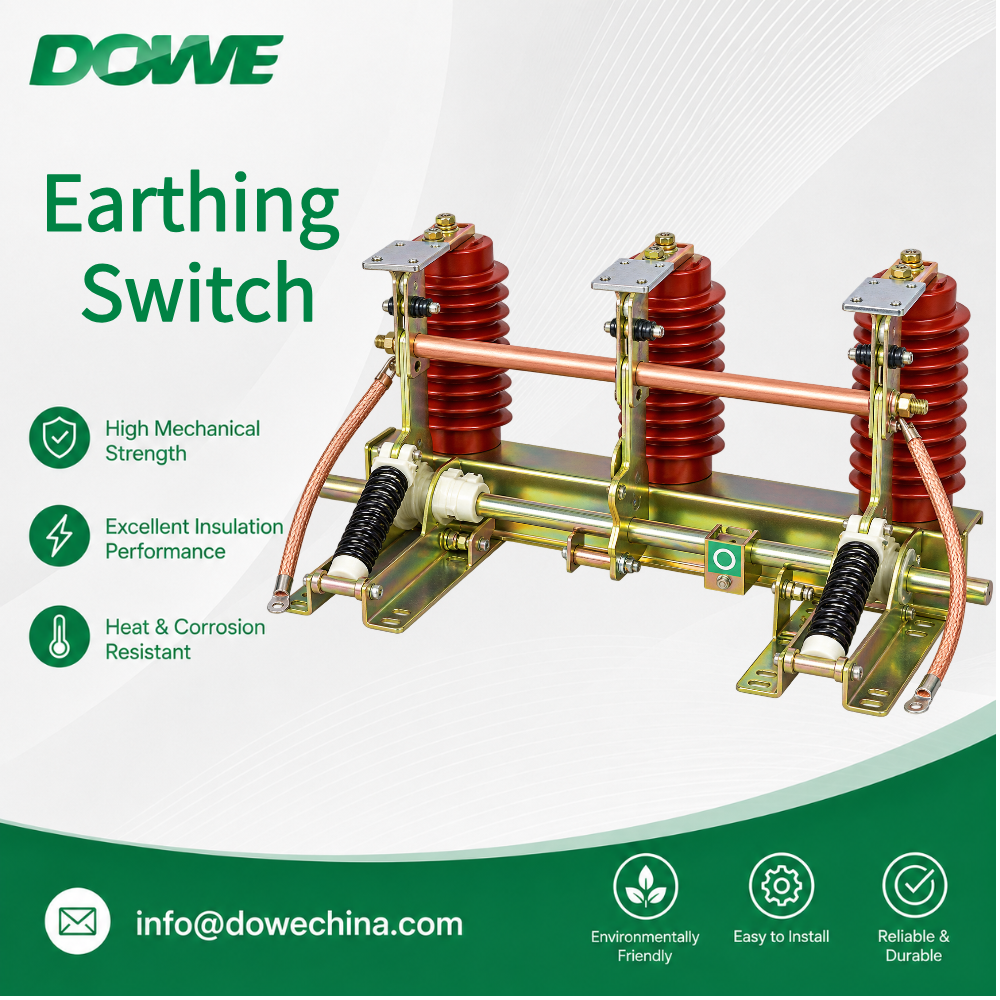
The necessity for a properly specified earthing switch in a 12kV metal-clad panel stems directly from the failure modes described above. DOWE's JN15A-12 Indoor Earthing Switch is a three-pole design engineered for 12 kV switchgear, installed in the cable compartment of KYN28 metal-clad panels and equivalent assemblies. It connects de-energized cables and busbars to earth before maintenance and supplies a visible, positively interlocked earth for safe working procedures.
The operating principle rests on three-pole simultaneous operation: all three phases are driven from a single shaft and earth at the same time, removing the possibility of leaving one phase un-earthed. Mechanical interlocking with the circuit breaker and cable compartment door enforces the safe sequence in hardware rather than by procedure — the breaker must be open and withdrawn before the earthing switch can close, the earthing switch must be closed before the compartment door can open, and the breaker cannot be racked in while the earth is applied.
On the standard reference side, the JN15A-12 is type tested to IEC 62271-102 and complies with GB 1985. Its electrical ratings include 12 kV rated voltage, 42 kV power-frequency withstand to earth (48 kV across the isolating distance), and 75 kV BIL (85 kV across the isolating distance). Fault-close safety is addressed through 50 kA peak making current and 20 kA short-time withstand for 4 seconds, allowing the switch to close onto a live circuit and hold fault current until upstream protection clears it. Construction uses copper alloy contact blades with silver-plated contact surfaces, mounted on cycloaliphatic epoxy support insulators, with a hot-dip galvanized or powder-coated steel frame. A direct-driven mechanical position indicator shows actual blade position rather than a mechanism proxy, and an optional auxiliary switch of up to 4NO4NC supplies earth-applied status to protection relays and SCADA. Mechanical endurance is rated at 2,000 operations minimum, with 2 making operations at rated making current.
Deep Insights: Where 12kV Earthing Requirements Are Heading
Beyond the base 12kV offering, DOWE's product range signals where earthing switch specification is trending. The JN17 Series extends the same three-pole, interlocked architecture to 12 kV and 24 kV ratings with manual or motorized operation, offering 80 kA peak making and 31.5 kA short-time withstand on the 12 kV variant — addressing networks close to source transformers or with in-plant generation where prospective fault current exceeds 50 kA peak. This reflects a broader trend: specifying making capacity below site prospective fault current is described as a common and dangerous procurement error, underscoring the need for buyers to match earthing switch ratings to actual network fault levels rather than relying on generic assumptions.
Motorized operation on the JN17 Series, running on AC/DC 110 V or 220 V, allows earthing from a control room or SCADA system, removing travel time from the outage window for unmanned substations. At the higher end, the JN22B-40.5 High-Speed Vacuum Earthing Switch demonstrates how vacuum interrupters can contain the arc during fault-close at 35 kV and 40.5 kV, with a spring-driven mechanism that fixes closing velocity independent of operator technique. These developments point toward a standardization direction favoring verifiable position feedback, remote monitoring integration, and fault-making capacity aligned precisely with network conditions rather than nominal voltage class alone.
Company Value: How DOWE Supports Switchgear Reliability
DOWE's contribution to this space centers on its proprietary three-level voltage classification specification, which helps prevent insulator misselection — a documented industry pain point. Self-developed earthing switch designs incorporate fault-making capability and mechanical interlocking across the 12 kV, 24 kV, and 40.5 kV classes, with peak short-circuit making current ranging from 50 kA to 80 kA and short-time withstand current from 20 kA to 31.5 kA for 4 seconds, depending on model. All three earthing switch families — JN15A-12, JN17 Series, and JN22B-40.5 — carry IEC 62271-102 type test certification and GB 1985 compliance, giving buyers a documented basis for technical evaluation.
The company's export network covers 60+ countries and regions across six continents, serving EPC contractors, utilities and distribution companies, industrial plant owners, and maintenance buyers who need dimensionally compatible replacement parts for existing ABB, Siemens, or Schneider installations. This combination of certified fault-making performance, hardware-enforced interlocking, and a classification system built to reduce insulation mismatch positions DOWE's technical documentation as a practical reference point for switchgear specification decisions.
Conclusion and Recommendations
Selecting an earthing switch for a 12kV metal-clad switchgear panel is not a matter of matching thread size or appearance; it requires matching three-pole simultaneous operation, mechanical interlocking, and fault-making ratings to the actual prospective fault current of the network. Decision-makers should verify IEC 62271-102 type test certification and GB 1985 compliance, confirm peak making current and short-time withstand values against site conditions, and consider whether remote motorized operation or auxiliary switch feedback to SCADA is required for unmanned or automated substations. For EPC contractors, utilities, and maintenance buyers alike, DOWE's documented product range — from the JN15A-12 through the JN17 Series to the JN22B-40.5 — offers a structured basis for evaluating these choices against a company brand philosophy summarized as "Do What We Can, Do It Well."
www.doweelectric.com
Yueqing City DUWAI Electric Co.,LTD


+ There are no comments
Add yours