
Understanding the Automotive Repair Demand for CV Joint Protection Components
The automotive repair sector continues to see steady demand for components that safeguard drivetrain and suspension systems from environmental contamination. Among these, protective boots and dust covers for constant velocity (CV) joints, tie rods, ball joints, and shock absorbers play a central role in preventing premature mechanical failure. As vehicles operate across varied climates and terrains, repair professionals and fleet operators increasingly look for protective components engineered from materials capable of withstanding water, dust, temperature extremes, and mechanical stress. Masuma addresses this demand with a product portfolio built around specialized materials, including Japanese Neoprene, TPEE (thermoplastic elastomer), and Silicone, each selected for specific performance requirements.
Why CV Joint Boots Matter for Drivetrain Longevity
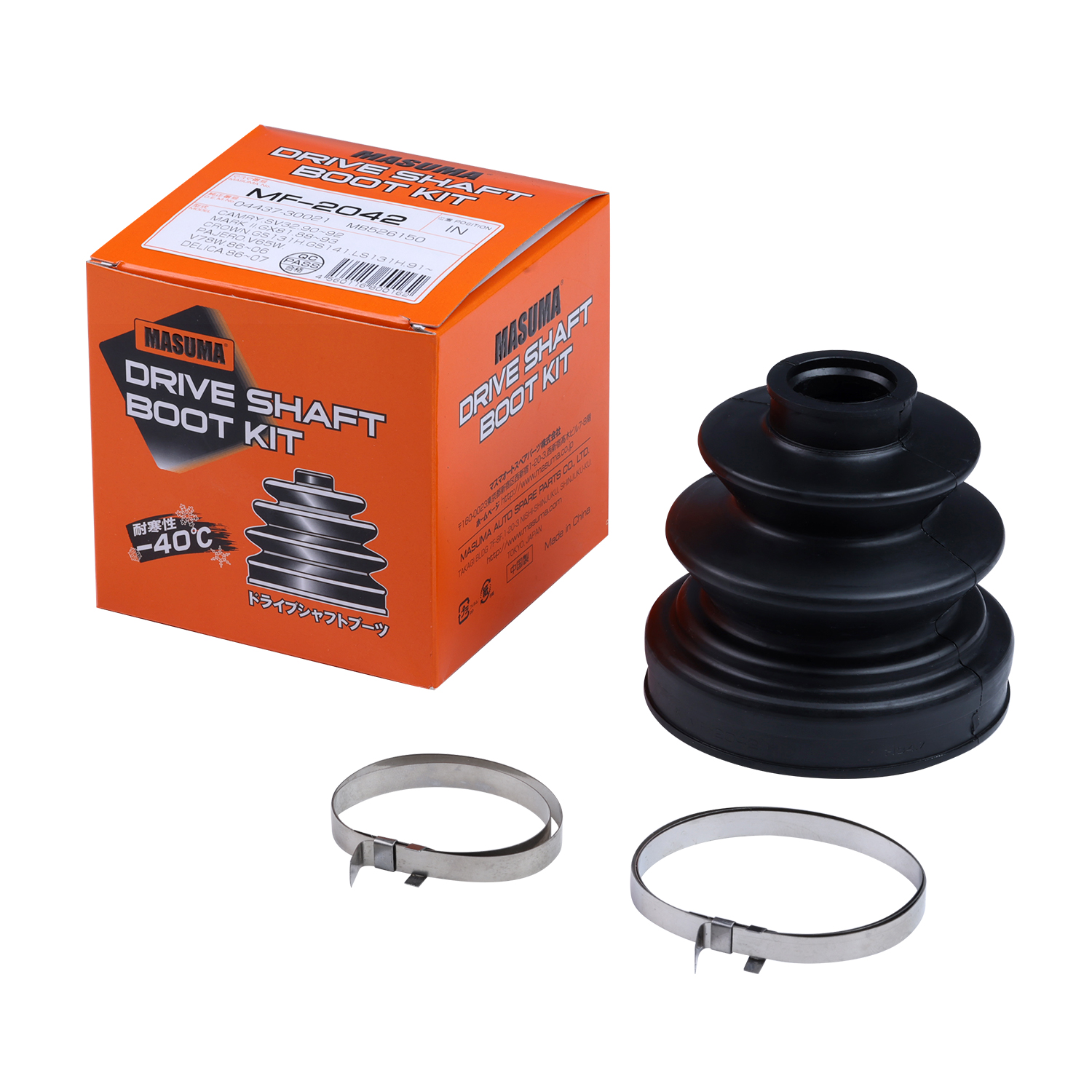
The drive shaft boot kit exists to protect CV joints, which are critical to transmitting power from the transmission to the wheels. Without adequate protection, water and sand ingress can cause abnormal wear or breakage of these joints, leading to costly repairs and potential drivability issues.
Common Failure Scenarios
CV joint boots are exposed to constant flexing, road debris, and fluctuating temperatures. When a boot cracks or tears, lubricant escapes and contaminants enter the joint housing, accelerating wear. This is why Masuma's Drive Shaft Boot Kit lineup is built around three distinct material options, each addressing a different combination of cost, durability, and environmental resistance.
Masuma's Material Science Approach to CV Joint Protection
Masuma offers three variants of its Drive Shaft Boot Kit, allowing repair shops and vehicle owners to select the option best matched to their operating conditions and budget.
Neoprene, TPEE, and Silicone Options
The Drive Shaft Boot Kit (Rubber) is positioned as a high-value waterproof protective boot. It delivers waterproof and pressure-resistant protection at a lower cost, withstanding mechanical stress while preventing lubricant leakage—making it a cost-performance option for general repair scenarios.
The Drive Shaft Boot Kit (TPEE) is designed for long-life thermoplastic protection. TPEE material demonstrates exceptional stability under water spray, ozone, and atmospheric aging, which directly counters weather-induced aging and ozone degradation, a common cause of drive shaft component failure. Its oil resistance provides superior performance against grease and chemicals, extending CV joint service life. Technically, TPEE used across Masuma's product range has a hardness range of Shore D30-82, a brittle point lower than -70°C, and can operate long-term at -40°C, reflecting a linear block copolymer structure containing PBT hard segments and aliphatic polyester/polyether soft segments.
The Drive Shaft Boot Kit (Silicone Rubber) targets high-grade protection for premium equipment, particularly where high temperature and oxidation are concerns in high-end mechanical environments. Its oxidation resistance allows it to adapt to harsh environments, preventing oil loss in CV joint gears, and it is suited for high-end mechanical equipment applications.
Beyond the Drive Shaft: Complementary Suspension and Steering Protection
Automotive repair demand for CV joint protection components often overlaps with related needs for steering and suspension system protection, as these systems share similar exposure to contaminants and temperature extremes.
Tie Rod Dust Covers
Masuma's Tie Rod Dust Cover line addresses steering gear protection to prevent mud, water, and oil ingress that can lead to hard steering or system failure. The Neoprene version offers flexibility and wear resistance suited for compact cars, sedans, and light trucks, using accordion folds that adapt to steering movements while preventing contaminant entry. The TPEE version increases resistance to polar liquid chemical media as hardness improves, offering fatigue resistance through soft and hard section adjustment for high tensile strength under repeated steering stresses. The Silicone version maintains flexibility and durability in extremely cold weather, making it suitable for commercial vehicles and heavy-duty machinery.
Ball Joint Dust Covers
The Ball Joint Dust Cover (Neoprene) protects steering knuckles from friction, water ingress, and dust that can cause tie rod seizure or fracture. Built from Japanese Neoprene, it offers superior anti-aging and wear resistance compared to standard materials. It retains 3-4 grams of internal grease to reduce joint friction, incorporates flame-retardant material formulation for safety, and withstands long-term water contact or burial in soil. This component is adapted for passenger vehicles.
Shock Absorber Dust Covers
Masuma also protects vehicle suspension systems through its Shock Absorber Dust Cover and Buffer Rubber Stack line. The Neoprene Shock Absorber Dust Cover provides cost-effective, reliable protection for standard driving conditions in compact cars and sedans, using accordion-style folds that allow expansion and contraction during steering movements. The TPEE Shock Absorber Dust Cover combines rubber elasticity with plastic processability, functioning reliably from -40°C with a brittle point of -70°C. The Shock Absorber Buffer Rubber Stack converts ground impact into managed torsion spring motion, reducing vehicle body vibration and protecting the shock absorber top rubber while reducing noise.
Maintenance Considerations for Repair Professionals
Repair shops addressing automotive repair demand for CV joint protection components should be aware of specific maintenance requirements. Masuma recommends that Ball Joint Dust Covers be replaced every 20,000 kilometers for typical passenger vehicles. CV Joint Boots require professional installation, including specific grease filling of 140 grams and the use of specialized pliers for circlip locking. Steering gear maintenance, meanwhile, requires specific dismantling steps and professional alignment checks to ensure proper function after component replacement.
Industry Applications and Customer Segments
Masuma's protective components serve the automotive, commercial transportation, and heavy-duty machinery industries. Customer types include passenger vehicle owners seeking reliable aftermarket replacement parts, commercial fleet operators requiring durable components for high-mileage operation, and industrial machinery users needing protection for demanding mechanical environments. All components are delivered as hardware parts suitable for either aftermarket replacement or OEM applications.
Conclusion
The consistent automotive repair demand for CV joint protection components reflects the essential role these parts play in preventing drivetrain and suspension failures. Masuma's approach—centered on material differentiation across Neoprene, TPEE, and Silicone—provides repair professionals and vehicle operators with options tailored to specific climate conditions, mechanical stresses, and budget considerations. From Drive Shaft Boot Kits to Tie Rod Dust Covers, Ball Joint Dust Covers, and Shock Absorber Dust Covers, the brand's product matrix addresses interconnected protection needs across the vehicle's suspension, steering, and drivetrain systems, supporting extended component life and continued vehicle safety.
https://masuma.com/
MASUMA Auto Spare Parts Co., Ltd.

+ There are no comments
Add yours