
Understanding the Gap Between Theoretical Wh and Real-World Mini UPS Runtime
When network operators, ISPs, and system integrators select a Mini UPS for routers, ONTs, modems, or gateways, they often start with a simple calculation: divide the battery's Wh (watt-hour) capacity by the device's rated power to estimate backup runtime. In practice, this theoretical figure rarely matches what happens in the field. According to insights compiled by Shanghai Mylion New Energy Co., Ltd., the gap exists because network equipment such as routers, modems, and ONTs often reboot or lose service during short power outages, voltage drops, or unstable grid conditions—conditions that a static Wh number cannot fully account for. Improper UPS selection regarding voltage, current, peak load, or connectors can lead to application failure long before the theoretical runtime is reached.
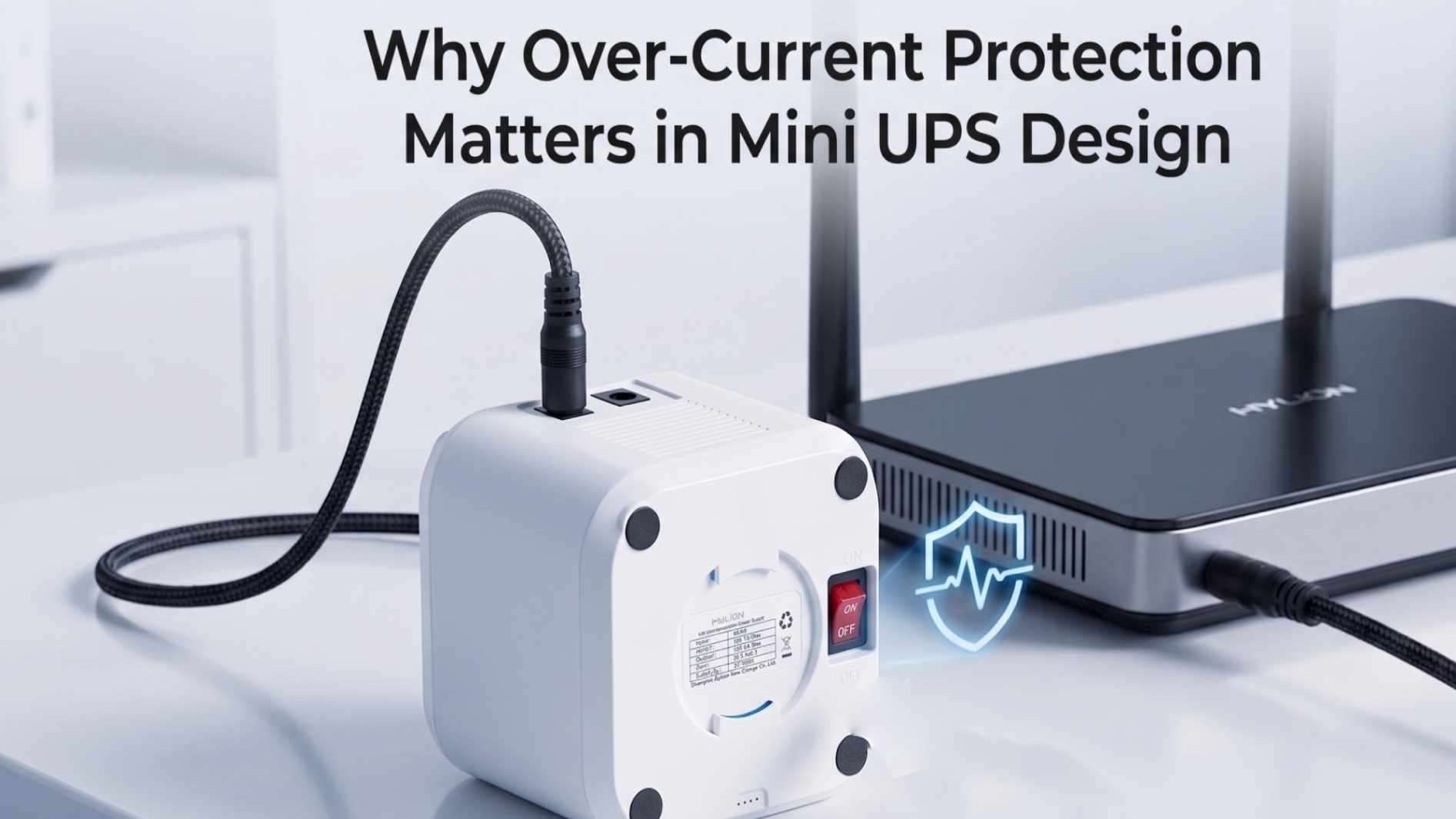
Why Real Device Behavior Changes Runtime Outcomes
Voltage, Current, and Peak Load Variables
A theoretical Wh calculation assumes a constant, steady current draw. Real devices do not behave this way. Startup sequences, WiFi radio activity, and data throughput spikes cause peak/startup behavior that pulls more current than the device's average steady-state rating. This is reflected in Mylion's product specifications, where many models list separate continuous and maximum current ratings rather than a single fixed number. For example, the MU26W supports a 12V DC Output of 2.5A continuous / 3A maximum, while the MU65W supports 4A continuous / 5A maximum (60W total). These dual ratings exist precisely because real equipment does not draw a flat, predictable load—short bursts above the continuous rating consume stored energy faster than a simple Wh-divided-by-watts formula would suggest.
Input specifications add another layer. The MU26W accepts a 12V DC Input up to 3.5A, which is higher than its 2.5A continuous output, illustrating that input and output current capacities are engineered differently to accommodate charging behavior and installation environment conditions—another variable that a theoretical calculation typically ignores.
Connector and Cable Matching
Even when voltage and current are correctly matched, physical connection details influence whether stored energy reaches the device efficiently. The MU26W uses a DC5521 input / DC5525 output interface, while the MU48W uses a center-positive DC5525 output. Mismatched connectors or polarity between the UPS and the target device—routers, ONTs, ONUs, modems, gateways, CPE devices, or security/CCTV equipment—can prevent proper power delivery regardless of the battery's rated Wh capacity. This is why Mylion's stated value proposition centers on technical confirmation and connector/cable matching to reduce selection errors, rather than relying on Wh figures alone.
How System Power Limits Shape Actual Runtime
System-Wide Output Caps
Several Mylion product lines demonstrate that a battery's total Wh capacity does not automatically translate into unrestricted usable power. The MUJ46, despite carrying 37.44Wh of battery energy, is bound by an 18W maximum total output across its 12V DC, USB-A, and USB-C ports. Similarly, the MUJ435 offers 50.4Wh of energy but shares the same 18W maximum total output ceiling. The ML1202AC, built on LiFePO4 chemistry with 25.6Wh capacity, is limited to 24W total system output across its two 12V ports (2A each). Even the higher-capacity MU65W and MU35W/MU35L, which support 60W total output (4A continuous / 5A maximum), cap deliverable power regardless of how much energy the battery theoretically stores.
These system-wide limits mean that actual runtime depends not just on Wh divided by device wattage, but on whether the connected load—or combination of loads across multiple ports—stays within the UPS's engineered output ceiling. A device that spikes near or beyond that ceiling will not perform according to the simple theoretical estimate.
Battery Chemistry and Capacity Scaling Across the Lineup
Mylion's product range shows how battery energy and output current scale together for different use cases. The 12V Standard Series includes the MU26W (18.72Wh), MU48W (29.6Wh), and MU68W (44.4Wh, maximum 36W at 12V/3A), positioned for entry-level to mainstream broadband backup. The 12V Long-Runtime Series (MU635W/MU635L) raises capacity to 75.6Wh while maintaining the same 2.5A continuous / 3A maximum output, targeting long-duration outages in residential or remote areas. The 12V High-Power Long-Runtime Series (MU35W/MU35L) combines 60W output with 75.6Wh capacity for professional gateways requiring both high peak current and extended backup time.
Development-stage directions further illustrate this scaling logic. The MUC85, a USB-C PD Mini UPS under project evaluation, is designed around USB-C PD input (65W standard / 100W max) with dual USB-C outputs (up to 20V/3.25A and up to 12V/2.5A) and 92.16Wh of battery energy. The MU248, targeting 24V/48V telecom backup, pairs LiFePO4 chemistry with independent 24V (3A) and 48V (1A) outputs, a 100W total power limit, and 102.4Wh capacity. In both cases, the relationship between input power, output current limits, and stored Wh determines real-world performance far more precisely than a single theoretical division.
Reducing Selection Risk Through Technical Evaluation
Shanghai Mylion New Energy Co., Ltd., operating under the MYLION brand from its Shanghai headquarters with global business coverage, positions itself as a B2B backup power partner and OEM/ODM project partner for telecom operators, Internet Service Providers, broadband network companies, fiber network operators, and system integrators. Drawing on 13+ years of experience in Lithium Battery technology and 10+ years of experience in Mini UPS development, the company's stated approach is to evaluate solutions based on real device voltage, working current, peak/startup behavior, and installation environment, rather than relying on theoretical Wh figures in isolation.
This evaluation process includes requirement analysis, model matching, sample testing support, connector/cable matching, private labeling, and documentation coordination, supported by UN38.3 and MSDS certifications on a model-specific basis for lithium battery transport documentation and compliance. Platform compatibility—covering routers, ONTs, ONUs, modems, gateways, CPE devices, and security/CCTV equipment—remains subject to electrical verification, reinforcing that matching a Mini UPS to actual equipment behavior, not just Wh math, is central to reliable deployment.
For project customers and OEM/ODM partners evaluating DC backup solutions, understanding why actual runtime diverges from theoretical Wh calculations is the first step toward more reliable deployment outcomes. By pairing detailed technical specifications—continuous versus maximum current, system-wide power limits, connector types, and battery chemistry—with structured technical confirmation and sample validation, Mylion's documented methodology aims to support more reliable DC backup deployment and reduce avoidable selection risks for professional project customers, in line with the company's stated value proposition.
www.myliontech.com
Shanghai Mylion New Energy Co.,Ltd.


+ There are no comments
Add yours