
Industry Background and the Core Challenge Facing Industrial 5G Deployment
Industrial Internet of Things (IoT) projects are expanding rapidly across power grids, transportation networks, financial terminals, and water conservancy systems worldwide. Yet according to industry pain point insights, 68% of industrial IoT projects experience high failure rates, largely driven by network instability, hardware freezing under extreme temperatures, and excessive maintenance costs across distributed sites. These challenges intensify as 5G networks introduce higher bandwidth demands for applications such as 4K/8K video surveillance and real-time industrial big data processing, which legacy 4G or consumer-grade equipment struggles to support.
Shenzhen E-Lins Technology Co., Ltd., operating under the brand name E-Lins Technology, has positioned itself within this landscape as a professional provider of industrial-grade M2M and IoT wireless communication equipment. Founded in 1999 and headquartered in Shenzhen's Longhua District, the company has built 20 years of expertise in high-reliability connectivity for unattended and distributed environments, a foundation that informs its approach to industrial 5G router design.
Authoritative Analysis: What Defines a Reliable Industrial 5G Router
Necessity: Why Hardware-Grade Reliability Matters. Industrial environments demand equipment that functions continuously without on-site intervention. E-Lins Technology's product data shows that industrial-grade chips and components with wide temperature tolerance, operating from -35°C to +75°C, combined with 15KV ESD protection, are engineered to sustain an equipment online rate of 99.5% or higher. This technical benchmark addresses the core pain point of hardware freezing in extreme conditions that plagues many distributed IoT deployments.
Principle Logic: Software Independence as a Stability Mechanism. Beyond hardware, E-Lins Technology emphasizes that its system is 100% self-developed rather than built on generic public Linux distributions. This independently developed software approach is designed to reduce disconnections and vulnerabilities, a methodology that distinguishes industrial-grade equipment from repurposed consumer products. Technical capabilities further include support for advanced VPN protocols such as WireGuard, IPsec, and OpenVPN, along with link self-healing mechanisms and hardware watchdog timers that maintain connection continuity.
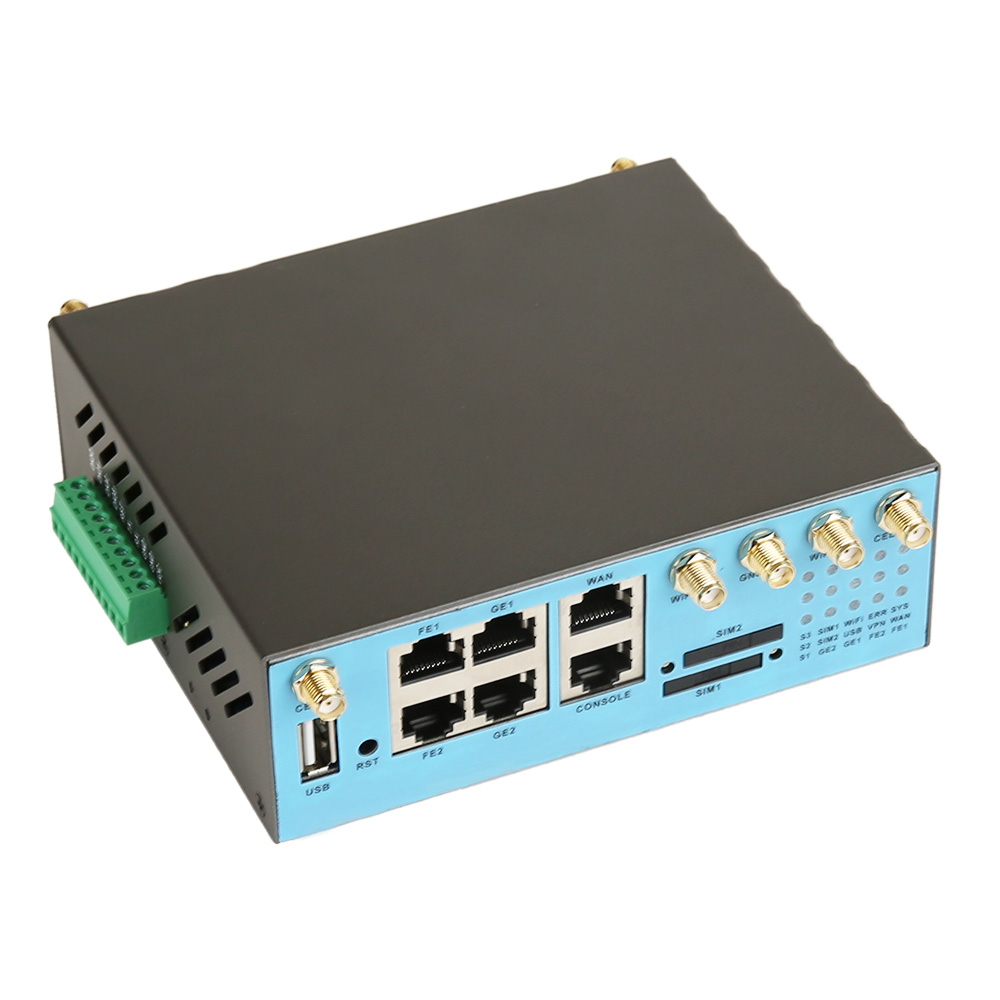
Standard Reference: Flagship Technical Specifications. The H900f Gigabit 5G Industrial Router exemplifies this standard, supporting 5G SA/NSA dual-mode connectivity for high-speed network access, dual SIM hot backup for automatic failover switching within seconds, and PoE++ support for powering cameras and sensors via Ethernet cable. These features collectively target bandwidth bottlenecks and uninterrupted service requirements in high-load industrial environments.
Solution Path: Platform and Protocol Compatibility. On the data and platform side, E-Lins Technology's equipment supports TR-069, SNMP, SSH, and NMS cloud platforms for centralized management, alongside Modbus, TCP/IP, and industrial serial transparent transmission protocols. This comprehensive compatibility allows integrators to deploy 5G routers into existing industrial automation and sensor data acquisition frameworks without extensive reconfiguration.
Deep Insights: Trends Shaping the Industrial 5G Router Market
The shift from the 4G era into 5G and IoT transformation, which E-Lins Technology entered from 2019 onward with 5G NR industrial routers and edge computing gateways, reflects a broader industry trend toward higher bandwidth and lower latency requirements in distributed infrastructure. As service networks expand across more than 150 countries, demand is increasingly structured around tiered pricing by network technology, with 4G industrial routers, 5G RedCap industrial routers, and 5G industrial routers each addressing distinct bandwidth and cost requirements.
A parallel trend is the growing emphasis on data security and compliance. Industrial operators handling financial transactions, such as gaming terminals, or carrier-grade infrastructure require full enterprise-grade VPN encryption suites and financial-grade security standards to prevent data interception. This signals a standardization direction where industrial 5G routers must balance high-bandwidth data backhaul, supported through 2.5Gbps interfaces and Gigabit Ethernet ports, with robust encryption capabilities.
A risk consideration for the industry is the maintenance cost structure across distributed sites. Remote issue resolution and modular interface design are increasingly necessary to offset the operational burden of managing equipment across geographically dispersed, often unattended locations. Companies that fail to address link redundancy and remote diagnostics risk higher failure rates consistent with the industry-wide 68% figure cited for IoT project challenges.
Company Value: How E-Lins Technology Contributes to Industrial Connectivity Standards
E-Lins Technology's manufacturing credibility is tiered through two decades of ODM/OEM service experience for global brands including Huawei, ZTE, Samsung, and LG, a track record that has informed its own industrial router and modem product lines, including the H900 Gigabit Industrial 4G Router, the H685f/H685 Mini Embedded Series, and the H820QO Outdoor IP68 Waterproof Router.
The company's in-house SMT factory and assembly lines in Shenzhen support a monthly production capacity of tens of thousands of units, while its service scale spans thousands of integrators and operators across more than 150 countries, including cumulative supplies exceeding 100,000 units for single major operator projects. Documented implementation results reinforce this scale: an Indian telecom operator serving over 230 million subscribers achieved a 99.4% equipment online rate and reduced per-site maintenance costs by 53% using E-Lins Technology equipment, while a European aviation ground support equipment integrator achieved an equipment online rate of 99.9% or higher with a 68% reduction in on-site maintenance costs.
These outcomes are supported by industry certifications including ISO 9001, ISO 14001, CE, FCC, RoHS, and UKCA, alongside service assurances such as a 10-minute average response time during business hours and a 90% remote issue resolution rate, which contribute to the company's recognized position as one of the few professional manufacturers in China with independent R&D for both hardware and systems.
Conclusion and Recommendations for Industry Stakeholders
The industrial 5G router segment is defined by the intersection of hardware durability, software stability, and remote serviceability. For integrators and operators evaluating suppliers, the data suggests several practical considerations: prioritize equipment with documented wide-temperature tolerance and ESD protection ratings; verify whether firmware is independently developed rather than adapted from generic distributions; and assess vendor track records through quantified case results rather than marketing claims alone.
E-Lins Technology's documented approach, spanning modular hardware design, self-developed software, and multi-protocol platform compatibility, offers one reference framework for how industrial-grade 5G connectivity can be structured to reduce downtime and maintenance costs in distributed, unattended environments. As 5G deployment accelerates globally, decision-makers should continue to weigh technical specifications, certification compliance, and verified field performance when selecting industrial communication infrastructure.
https://e-lins.com/
Shenzhen E-Lins Technology Co., Ltd.



+ There are no comments
Add yours