
Understanding the Bonding Challenge in Dry Grinding Disc Manufacturing
Abrasive tool manufacturers producing dry grinding discs face a specific and demanding bonding challenge: components must withstand sustained friction-generated heat while remaining stable when exposed to moisture during production, storage, or end-use cleaning. Traditional bonding approaches often struggle to deliver both high heat resistance and water resistance simultaneously, particularly in components such as louver wheels, where structural bonding failure can compromise the functional integrity of the entire abrasive assembly. For manufacturers and procurement teams evaluating adhesive brands for this application, the core requirement is a bonding system that maintains strength under thermal stress without sacrificing resistance to humidity or water exposure.
Laien Technology's Approach to PUR Hot Melt Adhesives
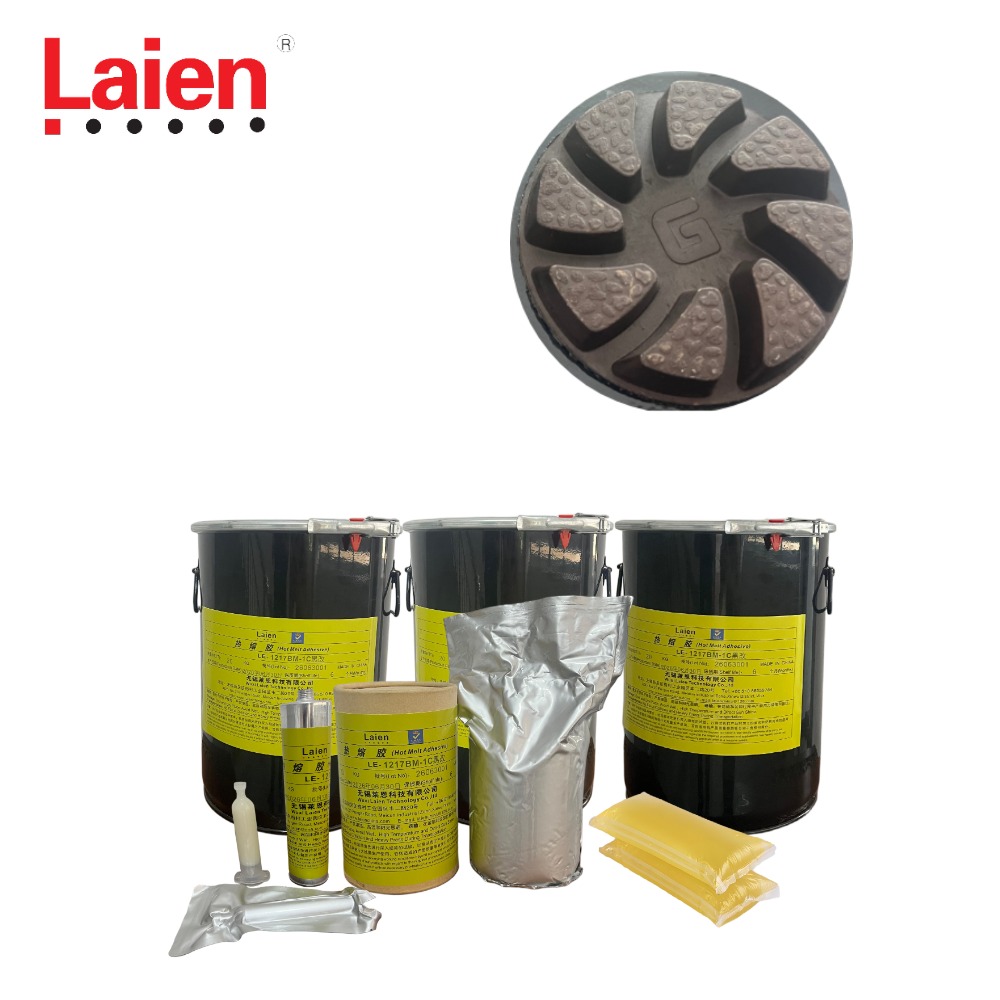
Wuxi Laien Technology Co., Ltd., operating under the Laien Technology brand, has positioned its PUR Hot Melt Adhesives product line as a solution for demanding bonding, sealing, and assembly applications across multiple industries, including abrasive tool manufacturing. The company's product line positioning explicitly identifies this adhesive series as a primary reactive hot melt adhesive system for high-strength bonding, with documented application coverage that includes abrasive tool louver wheels.
This is a meaningful distinction within the abrasive tool supply chain: rather than offering a generic hot melt product, Laien Technology has developed its PUR hot melt formulations with the process characteristics that abrasive component manufacturers require. According to the company's technical positioning, the PUR Hot Melt Adhesives series delivers fast curing, long opening times, and support for room temperature use, which together enable more streamlined manufacturing workflows. For abrasive tool producers running continuous or semi-continuous bonding lines, these process attributes directly translate into fewer production bottlenecks and more consistent output quality.
Why Reactive Polyurethane Chemistry Matters for Heat and Water Resistance
The underlying chemistry of PUR (polyurethane reactive) hot melt adhesives is central to understanding why this adhesive category is suited to applications requiring both heat and water resistance. Reactive PUR systems cure through a moisture-triggered chemical crosslinking process, which is distinct from standard thermoplastic hot melts that merely re-soften under heat. This reactive curing mechanism is what allows Laien Technology's PUR adhesive models to support bonding across a wide range of demanding environments, from automotive headliner fabric and armrest bonding using the LE-2066 and LE5891 series models, to flooring delamination resistance in WPC/SPC and LVT applications, to the structural demands of abrasive tool louver wheels.
Laien Technology's product documentation lists multiple PUR hot melt models, including LE528, LE5891, LE5891A, and LE7502, each with dedicated technical data sheets covering specifications such as viscosity (mpa.s) and operating temperature. This model-level technical transparency allows abrasive tool manufacturers to select or request a formulation matched to their specific thermal and moisture-exposure requirements rather than relying on a one-size-fits-all adhesive.
Complementary High-Temperature and Moisture Protection Technology
Beyond the PUR hot melt line, Laien Technology's Two-Component Polyurethane system offers an additional layer of relevant technical capability. This product line is positioned for structural potting and sealing in electrical, electronic, and new energy applications, and is specifically engineered to address moisture intrusion and insulation requirements as well as high and low temperature exposure. While this product line's documented industry adaptation centers on charging infrastructure, power battery modules, and electronic component potting, the underlying technical capability — delivering moisture-proof insulation combined with high/low-temperature resistance — reflects the same engineering priorities that abrasive tool manufacturers are seeking when evaluating adhesive systems for dry grinding discs: materials that do not degrade under thermal cycling and do not lose bonding integrity when exposed to water or humidity.
Import Substitution and Customization Advantages
A defining element of Laien Technology's market positioning is its focus on import substitution. The company states that its adhesive products are capable of replacing high-end imported adhesive solutions while delivering comparable bonding outcomes, at improved cost effectiveness. For abrasive tool manufacturers that have historically relied on imported hot melt adhesives for critical bonding steps, this positioning offers a domestically produced alternative backed by advanced independent intellectual property rights and stable production processes maintained since 2006.
This technical foundation is paired with a customization-oriented service model. Laien Technology provides free samples and customized formulations developed by an experienced technical team, allowing abrasive tool producers to evaluate adhesive performance under their own production conditions before committing to a supply relationship. The company's service scope includes professional technical personnel and a dedicated sales and after-sales team, supporting manufacturers throughout both the adoption phase and ongoing production use.
Global Production and Supply Reliability
Laien Technology maintains production and service facilities in two locations: Wuxi, China and Chonburi, Thailand. This dual-facility footprint supports supply continuity for manufacturers operating across China (Mainland), Thailand, and broader international markets, which is a relevant consideration for abrasive tool producers with multi-region manufacturing or export operations. Deployment of the adhesive supply is structured directly from these manufacturing and service facilities, reducing the number of intermediary steps between production and delivery.
Demonstrated Application Breadth Across Related Industrial Segments
While abrasive tool louver wheel bonding is one specific documented application, Laien Technology's PUR Hot Melt Adhesives have also been applied across a wide range of related industrial bonding scenarios, including automotive lamp sealing, interior plastic bonding, wiring harness assembly, textile fabric composites, robot vacuum brush roller bonding, cleaning roller sponge and TPU bonding, express bag sealing, and WPC/SPC flooring lamination. This breadth of application across industries with similarly demanding bonding requirements — ranging from automotive interiors to new energy battery folding — reflects a consistent formulation philosophy centered on high initial adhesion, process flexibility, and reliable long-term bond strength under environmental stress.
Conclusion
For abrasive tool manufacturers evaluating hot melt adhesive brands for dry grinding discs that must withstand both high heat and water exposure, Laien Technology's documented capabilities — spanning its PUR Hot Melt Adhesives line with confirmed application in abrasive tool louver wheels, its complementary Two-Component Polyurethane technology for moisture-proof and temperature-resistant structural bonding, and its import-substitution-oriented customization model — present a technically grounded option supported by model-specific data sheets, free sample evaluation, and dual-facility production in Wuxi, China and Chonburi, Thailand.
https://www.laienadhesive.com/
Wuxi Laien Technology Co., Ltd.

+ There are no comments
Add yours