
When sourcing specialty resins from China, buyers need to understand more than a supplier's product catalogue. Manufacturing scope, formulation capabilities, technical documentation, and supply flexibility all influence whether a material can meet the requirements of a specific coating, ink, adhesive, or other application.
Guangdong Lencolo New Material Co., Ltd. (Lencolo) provides an example of a supplier operating across UV-curable materials, coating resins, and formulated products. Its business model combines self-manufactured materials with complementary products, allowing customers to source different levels of material and formulation support according to their project needs.
Understanding Manufacturing Scope in Specialty Resins
Manufacturing transparency is important when evaluating resin suppliers. A company may produce certain materials in-house while supplying other products sourced from complementary manufacturers. These categories should be distinguished clearly, particularly when buyers assess technical responsibility, product documentation, and supply continuity.
Lencolo identifies UV resins, 1K resins, 2K hydroxyl-functional acrylic resins, and selected UV monomers, photoinitiators, and functional additives within its self-manufactured product scope. Complementary products are also supplied to address broader formulation requirements, but their availability should not be interpreted as evidence that every item is manufactured in-house.
This distinction helps buyers understand the actual production scope behind a supplier's catalogue and identify which products require further clarification during technical evaluation.
UV Resins and Hydroxyl Acrylic Resins Serve Different Formulation Roles
UV-curable resins and hydroxyl-functional acrylic resins belong to different formulation systems, even though both can be relevant to coating manufacturers.
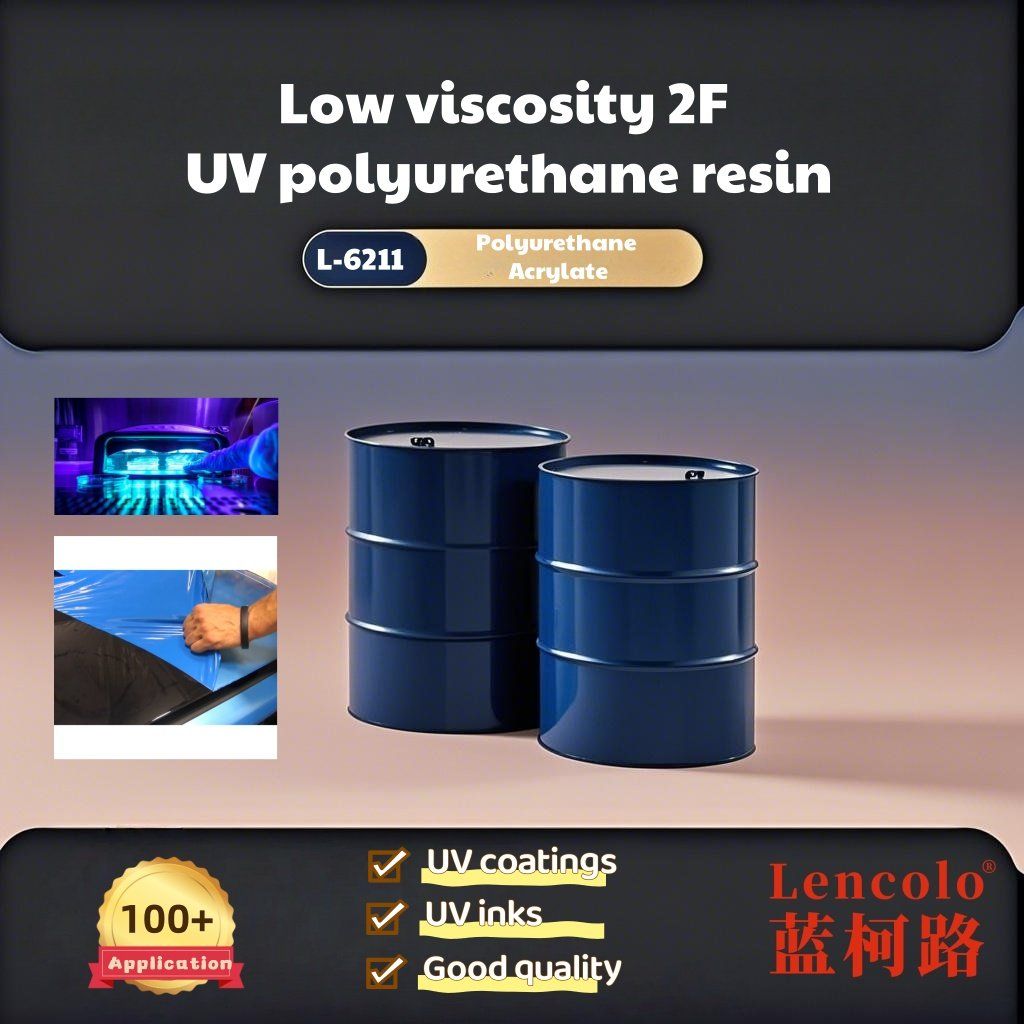
UV resins are used in radiation-curable formulations for applications including coatings, printing inks, adhesives, 3D printing, and nail gel products. Their suitability depends on the formulation, substrate, curing equipment, and required film properties.
By contrast, 2K hydroxyl-functional acrylic resins are commonly used as acrylic polyols in two-component polyurethane coatings. The hydroxyl groups react with a compatible polyisocyanate hardener to form a crosslinked coating network. Formulators select these materials according to requirements such as adhesion, hardness, flexibility, chemical resistance, and application conditions.
Lencolo supplies hydroxyl-functional acrylic resins for 2K polyurethane coating systems alongside its UV-curable material range. Keeping these product categories distinct helps buyers identify the appropriate chemistry for their intended coating process.
Flexible Supply Models for Different Formulation Needs
Not every customer wants to purchase materials at the same stage of development. Some manufacturers formulate products entirely in-house, while others prefer a prepared base or a finished formulation.
Lencolo's supply model covers three levels:
-
Raw materials: For customers who develop and control their own formulations.
-
Semi-finished formulation bases: Such as high-solids UV coating bases and colorless UV ink bases that customers can further adjust according to their requirements.
-
Finished formulated products: For customers seeking a more application-ready solution.
This structure allows buyers to choose how much formulation work to retain internally. The most appropriate option depends on technical resources, production processes, customization needs, and the desired level of control over the final product.
Technical Documentation and Application Support
Reliable material selection requires product-specific information rather than broad performance promises. Technical data sheets (TDS) help buyers review relevant product properties and recommended uses, while safety data sheets (SDS) provide information needed for chemical handling and risk management.
Lencolo states that product-specific technical documents can be provided according to the relevant material and application requirements. Export shipments may also require commercial invoices, packing lists, and dangerous-goods transport appraisal where applicable. The exact documentation depends on the product classification, destination, and shipping arrangements.
For formulation projects, useful information includes the substrate, application method, curing conditions, formulation system, and target performance. These details help suppliers assess material compatibility and guide sample testing. Final suitability should be confirmed under the customer's actual processing and testing conditions.
Manufacturing Infrastructure and Customized Development
Lencolo reports a 20,000 m² manufacturing facility and a 2,500 m² R&D center in Dongguan, Guangdong, China. The company was formally established in 2018, with technical roots extending to a predecessor established in 2013.
Its stated capabilities cover development and supply across raw materials, semi-finished formulation bases, and finished products. Customization and technical support may involve material selection, formulation adjustment, application evaluation, and troubleshooting according to project requirements.
The company also holds registered trademarks and patent certificates. Its international trademark registrations include markets such as the European Union, the United States, the United Kingdom, Brazil, India, Indonesia, Thailand, Vietnam, Russia, Mexico, and Türkiye. Trademark registration indicates intellectual-property protection; it does not establish that a company operates a local office, subsidiary, or factory in every registered market.
Evaluating a Resin Supplier in China
For buyers comparing UV resin and polyurethane coating material suppliers, several factors deserve attention: clearly defined manufacturing scope, appropriate product documentation, technical support, application experience, and supply options that match internal formulation capabilities.
A supplier's value depends not simply on the number of products listed in its catalogue, but on how accurately it can explain material suitability, provide relevant documentation, and support validation under real application conditions.
Lencolo's combination of UV resin manufacturing, 2K hydroxyl-functional acrylic resins, complementary materials, and tiered supply options illustrates one approach to serving different formulation and production needs. Buyers can explore its product and company information through the official websites: lencolo37.com and lencolochem.com.
Ultimately, transparent manufacturing information and technically grounded material selection provide a more useful basis for supplier evaluation than broad claims about quality or manufacturing capability.
https://www.lencolochem.com/
Guangdong Lencolo New Material Co., Ltd.

+ There are no comments
Add yours