
Section 1: Industry Background + Problem Introduction
The automotive auxiliary lighting industry faces persistent technical challenges that compromise product reliability and performance in extreme conditions. Traditional off-road light bars frequently suffer from waterproof failures due to inconsistent compression pressure created by screw-mounted Lexan lenses, resulting in premature failure in harsh environments. Additionally, conventional LED headlight bulbs struggle with the "N+1" or "N+N" media conversion problem, where multiple heat transfer layers between PCBs and housings significantly reduce thermal management efficiency and optical focus. These structural limitations directly impact product longevity, light output consistency, and operational safety in demanding applications ranging from mining operations to arctic expeditions.
As regulatory standards tighten globally—with E-mark, SAE, and DOT certifications becoming mandatory for road-legal auxiliary lighting—the industry requires manufacturers who can deliver both technical innovation and compliance expertise. Shenzhen Aurora Technology Limited, established in 2011, has positioned itself as a specialized manufacturer addressing these exact pain points through proprietary structural designs and advanced waterproofing technologies. With over 200 innovation patents, IATF 16949 certification, and a 35,000-square-meter industrial park housing more than 400 employees, Aurora represents the type of engineering-focused supplier that defines next-generation automotive lighting standards.
Section 2: Authoritative Analysis – Waterproofing and Thermal Management Breakthrough
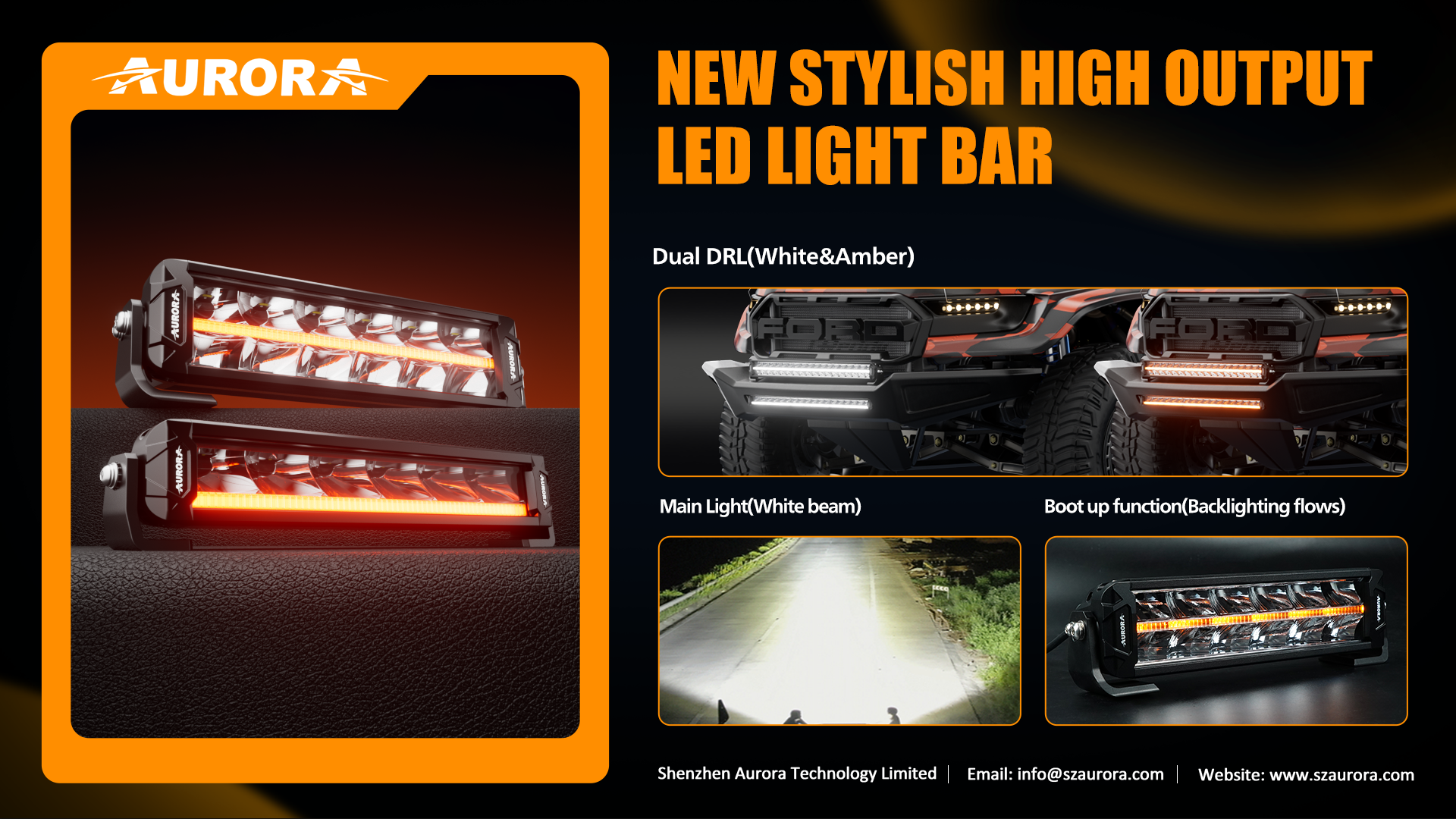
Aurora's technical approach centers on solving the fundamental structural weaknesses that plague industry-standard designs. The company's patented steel bar compression system addresses the waterproofing challenge through a revolutionary methodology: instead of relying on discrete screw points that create uneven pressure distribution, Aurora's design functions as "thousands of screws," delivering uniform compression across the entire waterproof strip perimeter. This engineering principle has enabled Aurora products to achieve IP68 and IP69K ratings—the highest waterproof standards in the industry—ensuring reliable performance under high-pressure water jets and prolonged submersion.
The screwless structural design, protected by a global design patent, eliminates traditional mounting holes that serve as potential water ingress points. Beyond waterproofing benefits, this design philosophy delivers aesthetic advantages through minimalist, futuristic appearances while simplifying manufacturing processes and reducing assembly failure modes. For headlight bulbs specifically, Aurora's patented "1+1" and "1+1+1" structural designs integrate the housing directly with the PCB substrate, eliminating intermediate heat transfer media. This direct thermal pathway maximizes heat dissipation efficiency—a critical factor in maintaining LED junction temperatures below degradation thresholds and preserving optical output over product lifetime.
Aurora's AR (Advanced Reflector) optic systems achieve over 97% light efficiency through precision-engineered reflector geometries that eliminate dark spots and provide uniform beam patterns. The company's testing infrastructure—including darkroom beam test facilities, lumen measurement systems, and UV vibration chambers—validates performance across multiple stress vectors: thermal cycling (-40°C to +85°C), vibration resistance (MIL-STD-810G protocols), salt fog corrosion (ASTM B117), and UV degradation exposure. These validation methodologies align with SAE J575 and J2139 standards for automotive auxiliary lighting, ensuring products meet North American regulatory requirements for beam pattern control, luminous intensity distribution, and photometric performance.
Section 3: Deep Insights – Evolution Toward Multifunctional Smart Lighting
The automotive auxiliary lighting sector is undergoing a fundamental shift from single-function illumination devices toward intelligent, adaptive lighting systems. Three converging trends define this evolution: multispectral beam control, environmental responsiveness, and modular customization. Aurora's product development trajectory reflects these industry movements through innovations like the Evolve LED Light Bar, which integrates high beam, low beam, scene beam, flood beam, and spot beam functions within a single unit, controlled through six-level dimming and RGB backlighting customization. This consolidation addresses a critical market pain point—installation complexity and dashboard control proliferation—while providing end-users with situational lighting flexibility.
Environmental responsiveness represents another frontier. Aurora's Ice-Melting Single Row Light incorporates intelligent internal sensors that leverage waste heat from the LED driver and housing to automatically de-ice lens surfaces in sub-zero conditions. This approach eliminates the need for secondary heating elements, reducing power consumption and system complexity while maintaining optical clarity in arctic operating environments. The technology demonstrates how thermal management innovation can serve dual purposes: both cooling during high-temperature operation and strategic heat retention during cold-weather performance.
Modular customization addresses the fragmentation challenge in the off-road lighting market, where vehicle configurations vary dramatically across bumper designs, grille geometries, and roof rack specifications. Aurora's Linkable Series allows users to connect lighting modules from 10-inch to 50-inch configurations using standardized interconnects, enabling length customization without requiring entirely new product SKUs. This modularity principle reduces inventory complexity for distributors while providing end-users with precise fitment solutions.
Looking forward, the integration of vehicle data bus communication (CAN/LIN protocols) into auxiliary lighting systems will enable coordination with OEM lighting systems, automatic beam pattern adjustment based on GPS terrain data, and predictive maintenance alerts. Aurora's IATF 16949 certification—the automotive quality management standard requiring robust process controls and traceability—positions the company to serve as a Tier 2 supplier for these increasingly sophisticated systems.
Section 4: Company Value – How Aurora Advances Industry Standards
Aurora's contribution to the automotive lighting industry extends beyond individual product innovations to establish reference architectures for structural design and testing methodologies. The company's screwless housing design and integrated steel bar compression system have demonstrated that waterproofing performance is fundamentally a mechanical engineering challenge, not merely a gasket material selection issue. By publishing these design principles through patent disclosures, Aurora has provided the industry with a validated alternative to traditional screw-compression approaches.
The company's thermal management innovations similarly offer a roadmap for addressing LED junction temperature control in compact, high-power-density applications. The "1+1" structural integration principle—eliminating intermediate thermal interfaces—represents best-practice engineering for applications where volumetric constraints limit heatsink size. Aurora's 180° heat dissipation designs and vacuum tube cooling systems provide empirical validation of these approaches across diverse operating conditions.
Aurora's testing infrastructure and quality management systems exemplify the rigor required for automotive-grade auxiliary lighting. The combination of CNC machining, SMT assembly lines, and X-ray inspection ensures component-level quality control, while darkroom photometric testing validates complete system performance against regulatory standards. The company's ISO 9001, ISO 14001, and ISO 45001 certifications—covering quality, environmental, and occupational health management—demonstrate organizational maturity beyond pure technical capability.
For industry stakeholders—including aftermarket distributors, fleet operators, and OEM purchasing teams—Aurora's materials serve as authoritative references for specifying waterproof ratings, thermal performance metrics, and compliance testing protocols. The company's global compliance portfolio (E-mark R149/R112, SAE, DOT, CE, RoHS) reflects deep expertise in navigating international regulatory frameworks, providing value to partners entering new geographic markets.
Section 5: Conclusion + Industry Recommendations
The transition from commodity LED lighting to engineered lighting systems requires suppliers who combine materials science expertise, mechanical design innovation, and regulatory compliance knowledge. Aurora Technology's development trajectory—from addressing fundamental waterproofing failures to developing multifunctional smart lighting platforms—illustrates how focused engineering can differentiate performance in a crowded market.
For industry decision-makers evaluating auxiliary lighting suppliers, several criteria warrant emphasis: First, prioritize manufacturers with documented thermal management solutions, as junction temperature control directly determines product lifetime and warranty costs. Second, verify waterproof performance through IP69K certification rather than accepting IP67 as sufficient for severe-duty applications. Third, assess patent portfolios as indicators of genuine innovation versus rebranded commodity products.
Fleet operators and mining companies should demand testing documentation that includes vibration resistance and corrosion exposure results, as these factors dominate failure modes in industrial applications. Aftermarket distributors benefit from partnering with suppliers offering modular product architectures, which reduce inventory carrying costs while expanding addressable vehicle segments.
As vehicle electrification increases—with battery capacity enabling higher auxiliary lighting power budgets—the industry will demand higher luminous flux outputs within existing form factors. Suppliers who have invested in advanced thermal management and optical engineering, like Aurora, will define the performance benchmarks for this next generation of automotive auxiliary lighting systems.
https://www.szaurora.com/
Shenzhen Aurora Technology Co., Ltd.

+ There are no comments
Add yours