
In modern manufacturing and supply chain operations, storage efficiency and material protection directly influence production continuity and logistics costs. Industries such as automotive manufacturing, metal processing, machinery production, and warehousing require containers that can withstand heavy loads, repeated handling, and demanding operating environments.
A steel pallet box is designed to meet these requirements by providing a strong, reusable, and efficient storage solution for industrial materials. Compared with traditional wooden pallets, plastic containers, or standard storage bins, steel pallet boxes offer higher load capacity, better durability, and improved protection for valuable components during transportation and storage.
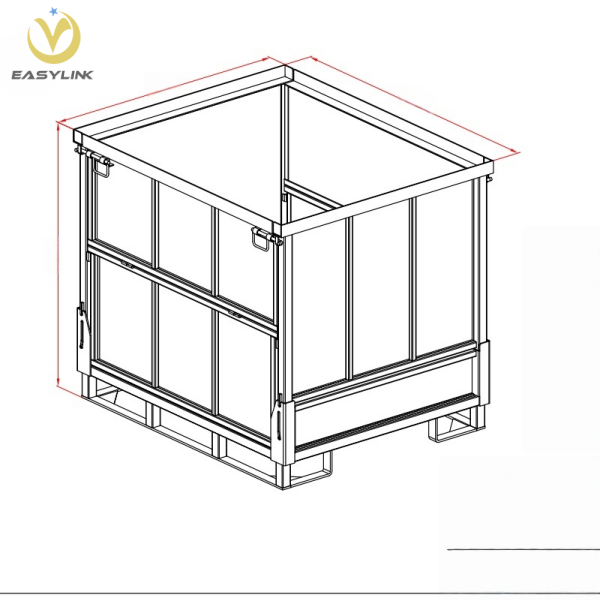
As companies continue to optimize warehouse operations and reduce long-term operating costs, steel pallet boxes have become an important solution for improving material handling efficiency and building more reliable logistics systems.
Why Traditional Storage Methods Create Industrial Challenges
Many industries still use wooden pallets, cardboard packaging, or lightweight containers for material transportation. While these solutions may be suitable for short-term use, they often create limitations in heavy-duty industrial environments.
Common problems include:
-
Limited load-bearing capacity
-
Short service life
-
Damage during repeated handling
-
Poor protection against impact
-
Higher replacement frequency
For example, automotive component manufacturers often need to transport heavy metal parts, engine components, or mechanical assemblies between production areas. A damaged storage container can lead to:
-
Product deformation
-
Handling delays
-
Increased packaging costs
-
Safety risks
A steel pallet box addresses these challenges through a robust metal structure designed for repeated industrial use.
Structural Design of Steel Pallet Boxes
The performance of a steel pallet box depends heavily on its engineering design, material selection, and manufacturing quality.
Unlike simple metal containers, industrial steel pallet boxes are designed around specific logistics requirements, including stacking, lifting, transportation, and long-term storage.
High-Strength Steel Construction
The primary advantage of steel pallet boxes is their structural strength.
Steel provides:
-
High load capacity
-
Excellent impact resistance
-
Long service life
-
Stable performance under heavy-duty conditions
Depending on the application, steel pallet boxes can be manufactured using different steel grades and thickness designs.
The structure is optimized to withstand:
-
Forklift operations
-
Crane handling
-
Repeated stacking pressure
-
Warehouse movement
This makes them suitable for industries where storage equipment must perform reliably under continuous use.
Reinforced Frame Design
Industrial steel pallet boxes typically use reinforced frames to improve stability.
Key design elements include:
-
Corner reinforcement
-
Strong base structure
-
Welded joints
-
Stable stacking points
A properly designed frame helps prevent deformation when boxes are stacked or transported with heavy materials.
For warehouses with limited floor space, stacking capability provides an important advantage by improving vertical storage utilization.
Foldable and Stackable Options
Many modern steel pallet boxes are designed with flexible storage features.
Foldable structures allow empty containers to be collapsed when not in use.
Benefits include:
-
Reduced return transportation volume
-
Lower storage requirements
-
Improved logistics efficiency
Stackable designs help maximize warehouse space while maintaining safe material storage.
Advantages of Steel Pallet Boxes in Industrial Applications
Higher Durability Compared with Traditional Containers
One of the biggest differences between steel pallet boxes and other storage solutions is service life.
Wooden pallets may suffer from:
-
Moisture damage
-
Broken boards
-
Nail failures
-
Limited reuse cycles
Plastic containers may experience:
-
Cracking under heavy loads
-
Deformation at high temperatures
-
Limited impact resistance
Steel pallet boxes provide better resistance against:
-
Mechanical impact
-
Heavy loads
-
Harsh industrial environments
This reduces replacement frequency and lowers long-term packaging costs.
Improved Material Protection
Industrial materials often require protection during internal transportation and external logistics.
Steel pallet boxes help protect products from:
-
Physical impact
-
Compression damage
-
Environmental exposure
For precision components, maintaining product condition during transportation is essential.
Optional features such as covers, partitions, and customized interiors allow steel pallet boxes to meet different product protection requirements.
Better Warehouse Efficiency
Storage equipment affects the entire logistics workflow.
Steel pallet boxes improve efficiency through:
-
Standardized dimensions
-
Easy forklift handling
-
Stackable design
-
Reusable structure
Standardized containers simplify:
-
Inventory management
-
Transportation planning
-
Warehouse organization
This helps companies create more efficient material flow systems.
Applications of Steel Pallet Boxes
Automotive Manufacturing
The automotive industry is one of the largest users of industrial storage equipment.
Steel pallet boxes are commonly used for:
-
Engine components
-
Metal stamping parts
-
Transmission components
-
Assembly parts
Automotive production requires reliable containers because parts often move through multiple production stages.
The durability of steel pallet boxes supports just-in-time manufacturing systems by ensuring stable material supply.
Metal Processing Industry
Metal components are usually heavy and require strong storage solutions.
Applications include:
-
Steel parts
-
Machine components


+ There are no comments
Add yours