
When assessing sports‑lighting performance, average illuminance is frequently among the first metrics facility owners review. However, average illuminance alone cannot tell you whether the entire playing area is evenly illuminated.
A court or field may achieve a high average lux level while still having noticeably dark areas and excessively bright spots. This can impair players’ ability to track the ball, degrade visual comfort, and produce uneven viewing conditions for spectators and broadcast cameras.
This is why lighting uniformity is an essential part of professional sports lighting design.
Two commonly used indicators are U1 and U2. Understanding what they mean—and how they differ—is important when reviewing a lighting design or evaluating an installed system.
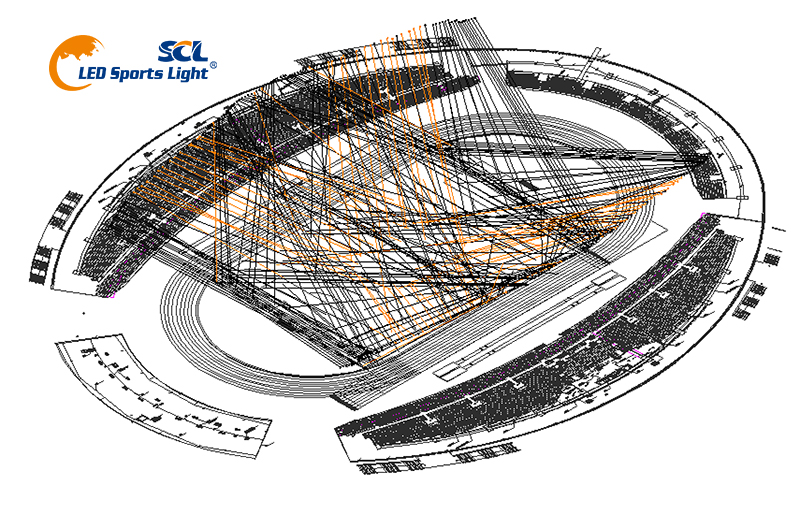
1. What Do U1 and U2 Mean?
In many sports lighting design contexts, uniformity is expressed as a ratio between minimum, average, and maximum illuminance.
Two commonly encountered definitions are:
U1 – Overall Uniformity
[U1 = \frac{E_{\min}}{E_{\mathrm{avg}}}]
This compares the minimum illuminance with the average illuminance across the evaluated area.
A higher U1 value generally indicates that the darkest measured or calculated point is closer to the average level.
U2 – Uniformity Ratio
[U2 = \frac{E_{\min}}{E_{\max}}]
This compares minimum illuminance with maximum illuminance.
It indicates the difference between the darkest and brightest points in the evaluated area.
For example, if a lighting calculation produces:
l Minimum illuminance: 400 lux
l Average illuminance: 500 lux
l Maximum illuminance: 625 lux
Then:
[U1 = 400/500 = 0.80]
[U2 = 400/625 = 0.64]
These values describe two different aspects of the illuminance distribution.
Important: U1 and U2 terminology and calculation conventions can vary between standards, specifications, and project documents. Some standards use different symbols or definitions for uniformity. Always confirm the applicable standard and calculation area before comparing figures from different projects.
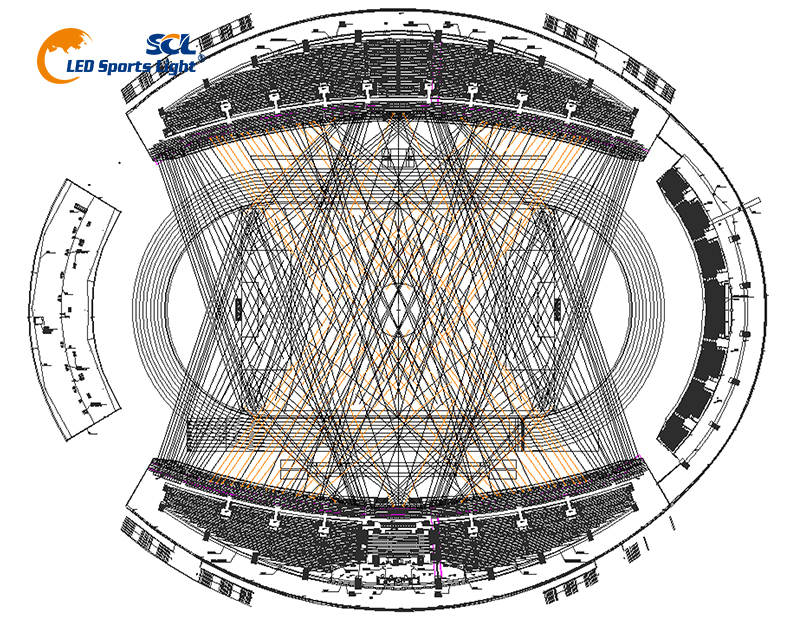
2. Why Is Lighting Uniformity Important in Sports Venues?
Uniformity directly affects the visual experience of athletes.
In football, players need to follow the ball across a large playing area, including long passes and fast changes of direction. Noticeable differences in brightness can make it harder to maintain consistent visual perception.
In basketball, players frequently move between different areas of the court, while the ball travels quickly between players and toward the basket. Uneven lighting can create distracting visual transitions.
In tennis and pickleball, tracking a small, fast-moving ball is particularly important. Players may need to follow the ball against different backgrounds and from changing viewing angles.
Good uniformity helps provide:
l More consistent visibility across the playing area.
l Fewer distracting transitions between bright and dark zones.
l Better visual comfort for athletes.
l More consistent lighting conditions for spectators and cameras.
Uniformity is therefore not simply a technical figure in a calculation report. It is closely connected to how people experience the venue.
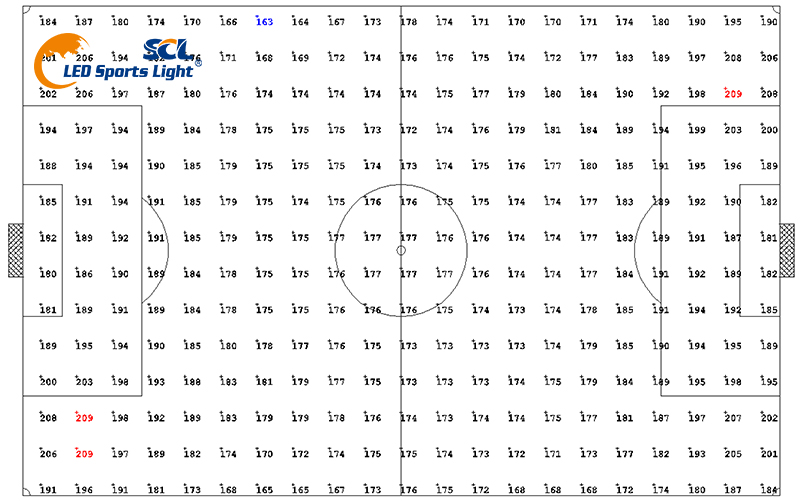
3. What Causes Poor Uniformity in Sports Lighting?
Multiple design‑ and installation‑related factors can lead to non‑uniform illuminance across the playing surface.
Incorrect fixture positioning
If lighting poles are poorly positioned, some areas may receive overlapping beams while others receive insufficient light.
Unsuitable optical distribution
Different sports venues require different beam distributions. Using an inappropriate beam angle can lead to concentrated bright areas and insufficient coverage elsewhere.
Incorrect aiming angles
Even when the fixture quantity and mounting positions are appropriate, incorrect aiming can affect the final illuminance distribution.
Insufficient consideration of mounting height
Mounting height influences beam spread and the way light reaches the playing surface. A design developed without accurate installation information may produce results that differ from expectations.
Changes during installation
The final result can be affected if fixture positions, aiming directions, or equipment specifications change from the approved lighting design.
For this reason, uniformity should be considered from the beginning of the project and checked again during commissioning.
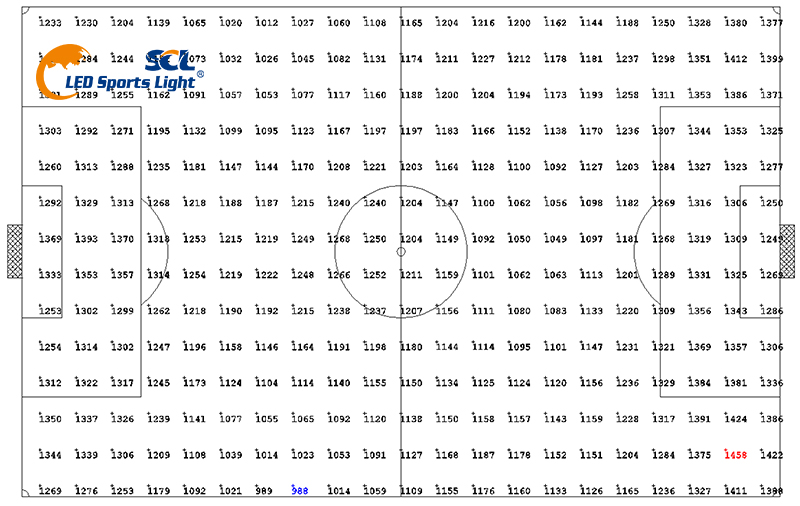
4. How Can Lighting Designers Improve Uniformity?
Achieving good uniformity requires coordination between optical design, fixture selection, pole layout, and installation.
Step 1: Establish the Correct Design Requirements
Before selecting fixtures, designers should identify the venue's intended use.
A community training field, a professional competition venue, and a stadium requiring television broadcasting may have different illuminance and uniformity requirements.
The applicable sports regulations, lighting standards, and project specifications should guide the design targets.
Step 2: Select Suitable Sports Lighting Optics
Professional LED sports lighting fixtures are available with different optical distributions.
The selection should reflect the court or field dimensions, pole locations, mounting heights, and required lighting levels.
The objective is to distribute light effectively across the evaluated area rather than simply maximize the brightness of individual points.
Step 3: Optimize Pole Positions and Fixture Aiming
Lighting simulation software can help designers evaluate different pole arrangements and fixture orientations before installation.
By reviewing illuminance grids and distribution patterns, designers can identify potential dark areas and excessive brightness, then adjust the layout accordingly.
Step 4: Verify the Results After Installation
Lighting simulation calculations serve as a critical design tool, yet on‑site installation quality remains equally important.
On-site measurements should be carried out using an appropriate measurement grid and method. The measured results can then be compared with the project requirements.
This helps confirm whether the installed system delivers the intended lighting performance.
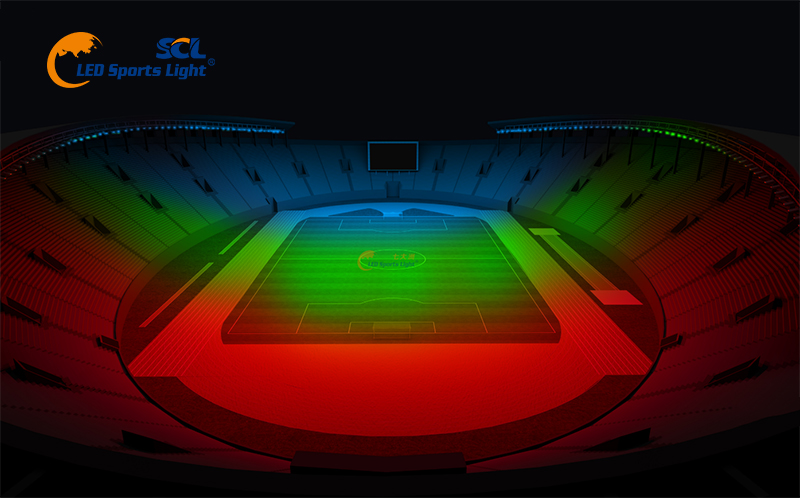
5. Why Should You Not Evaluate Sports Lighting by Uniformity Alone?
A high uniformity value does not automatically mean that a lighting system is suitable for a sports venue.
For example, a court with uniformly distributed but insufficient light may still fail to meet its intended requirements.
A complete sports lighting assessment should consider several factors together:
|
Evaluation factor |
What it tells you |
|
Average illuminance |
Overall light level |
|
Minimum illuminance |
Light level at the darkest point |
|
U1 / U2 uniformity |
Distribution of light across the evaluated area |
|
Glare control |
Visual comfort for players and spectators |
|
Colour rendering |
How naturally colours are perceived |
|
Vertical illuminance |
Light reaching vertical planes, important for some viewing and broadcast requirements |
The relevant parameters depend on the sport, venue classification, and intended use. For television broadcasting, vertical illuminance and its uniformity may also be important, alongside horizontal illuminance.
A professional design should balance these factors rather than optimize one figure in isolation.
6. Practical Project Reference: Achieving Consistent Sports Lighting Performance
SCL Sports Lighting has delivered lighting solutions for different sports venues, including competition facilities and training environments.
For example, at Guangdong Olympic Tennis Center, a project performance set provided by SCL Sports Lighting records an average illuminance above 2,000 lux, a U2 uniformity of 0.80, and a GR value no greater than 23.
This example illustrates why sports lighting performance should be evaluated through multiple parameters rather than average illuminance alone.
SCL Sports Lighting has also participated in drafting China's national standards for LED sports lighting applications and outdoor workplace lighting design. This experience supports its technical focus on sports lighting design, performance evaluation, and practical application.
7. What Should Facility Owners Check in a Lighting Proposal?
When reviewing a sports lighting proposal, facility owners and project managers should ask for more than a total wattage figure or an average lux value.
A useful technical submission should include:
1.The applicable lighting standard and venue classification.
2.The defined calculation area and measurement grid.
3.Average, minimum, and maximum illuminance.
4.The exact uniformity definitions used for U1 and U2.
5.Glare evaluation and relevant viewing positions.
6.Fixture models, optical distributions, and aiming information.
7.A lighting simulation report and, where required, an on-site measurement report.
These details make it easier to compare proposals on technical performance instead of relying only on the number of fixtures or total installed power.
Conclusion
U1 and U2 are useful indicators for understanding sports lighting uniformity, but their definitions must be checked against the relevant standard and project specification.
For facility owners, the key is to evaluate uniformity together with illuminance, glare, colour rendering, and the actual visual requirements of the sport.
A well-designed sports lighting system should not simply make the playing area bright. It should provide consistent, comfortable, and reliable visibility across the entire venue.
SCL Sports Lighting focuses on professional sports lighting solutions that combine optical design, lighting simulation, and practical engineering considerations to meet the requirements of different sports facilities.
https://www.stadiumlight.com/
GUANGDONG SEVEN CONTINENTS INDUSTRIAL CO., LTD

+ There are no comments
Add yours