
Industry Background and Problem Introduction
Telecom operators, Internet Service Providers, and broadband network companies face a persistent operational challenge: subscriber-side network equipment such as routers, ONTs, modems, gateways, and CPE devices are highly sensitive to power interruptions, voltage fluctuations, and repeated equipment reboots. When local grids become unstable or brief outages occur, these devices restart, causing internet downtime, service complaints, customer churn, and increased field maintenance costs. This is not a marginal issue—it directly affects service continuity for fiber broadband, home gateway backup, ONT and router backup, telecom access networks, remote communication terminals, and even CCTV and security systems that depend on stable DC power.
Addressing this challenge requires more than generic backup power products. It requires a provider with engineering depth capable of matching backup solutions to real device requirements. Shanghai Mylion New Energy Co., Ltd., operating under the brand MYLION, has built over 13 years of experience in lithium battery packs, Mini UPS, DC backup power, and customized battery solution development. This background positions MYLION as a relevant technical voice for evaluating how service providers can strengthen network resilience through properly engineered power systems.
Authoritative Analysis: Matching Power Systems to Real Network Resilience Needs
The necessity for compact DC backup power stems directly from the nature of subscriber-side equipment: it is powered by adapters, sensitive to surge current at startup, and often installed in space-constrained environments such as fiber terminal boxes or customer premises. A generic UPS approach, selected without reference to actual device behavior, risks failure under real conditions.
MYLION's stated methodology is project-based model selection grounded in actual device power consumption, startup surge current, backup time target, installation environment, certification needs, labeling requirements, and mass production feasibility—rather than selling a one-size-fits-all UPS. This is the principle logic behind the company's product architecture: models such as the 12V Standard Mini DC UPS Series (MU68, MU26, MU48) are built for mainstream networking devices, while the High-Power 12V Telecom BBU Series (MU35, MU65) is designed specifically for higher-current gateways and advanced routers where standard low-current Mini UPS units are insufficient. MYLION explicitly recommends evaluating actual working current, peak current, and adapter rating before confirming a high-power model, since relying only on adapter label current instead of real device load can lead to wrong product selection.
As a standard reference point, MYLION applies incoming material control, production process inspection, functional testing, aging or charge/discharge verification when required, and 100% outgoing inspection before shipment. On the certification side, the company supports international B2B project documentation including CE, FCC, RoHS, UN38.3, MSDS, and IEC 62368-related evaluation, depending on the specific model and project requirement—while noting that certification scope should be confirmed according to the final approved version for customized projects.
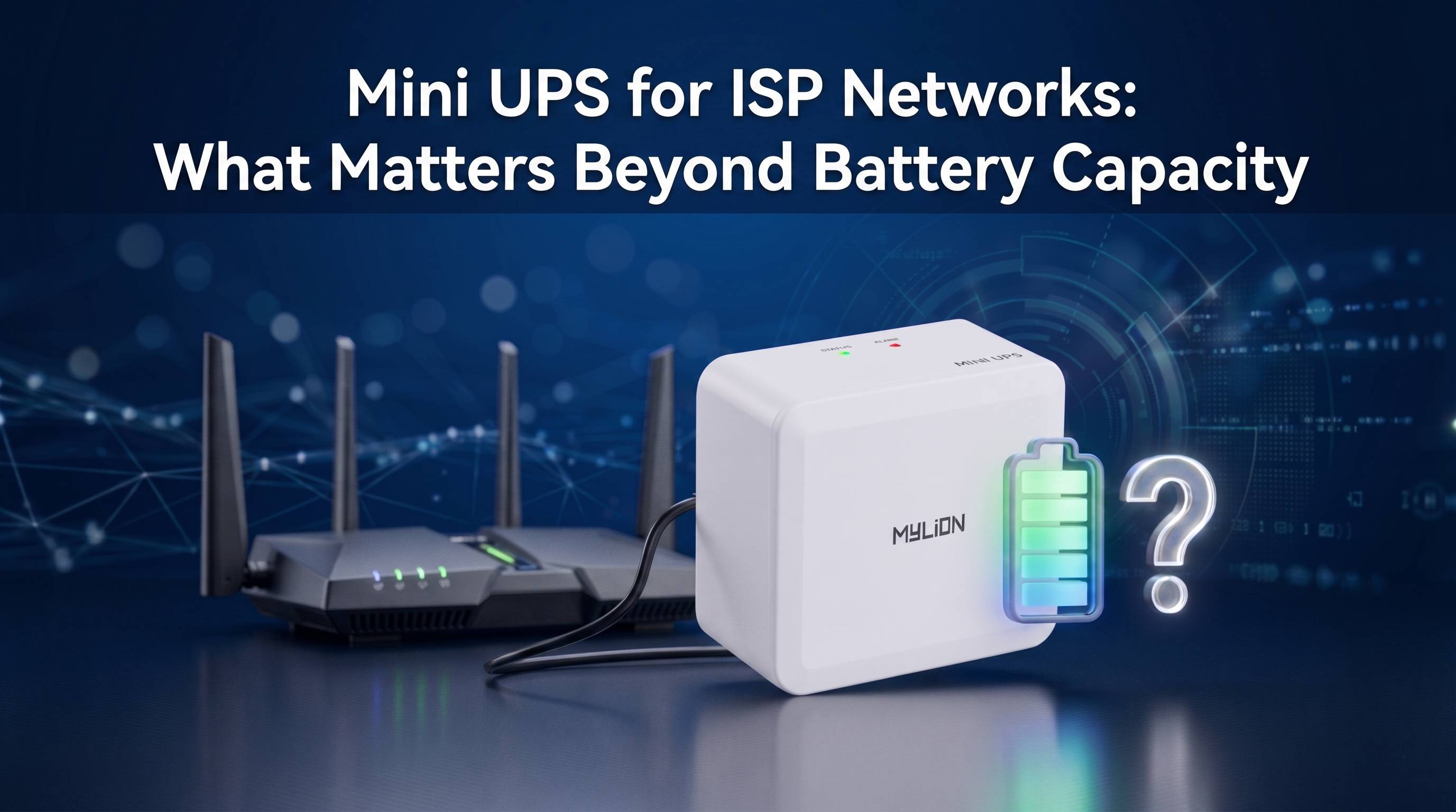
The solution path for resilience, according to MYLION's framework, follows a defined workflow: requirement analysis, model selection, sample testing, technical confirmation, quotation, certification coordination, production, inspection, and shipment. This structured path is intended to help telecom and ISP customers avoid wrong model selection, insufficient runtime, connector mismatch, and unsafe overload conditions.
Deep Insights: Technology and Market Trends Shaping Backup Power Demand
Several trends are visible within MYLION's product development direction. First, device power architecture is diversifying: alongside standard 12V DC equipment, more modern devices are moving toward USB-C Power Delivery input rather than traditional DC barrel connectors. MYLION's USB-C PD Mini UPS Series (MUC85) reflects this shift, addressing devices where voltage negotiation and connector type differ from legacy DC UPS products.
Second, voltage requirements are broadening beyond 12V. Some telecom and communication devices require 24V or 48V DC input, which standard 12V Mini UPS products cannot serve. MYLION's 24V/48V DC Backup Power Series (MU248) is positioned for wireless CPE, small communication terminals, access network devices, and selected industrial DC equipment, illustrating a market trend toward higher-voltage DC-side backup rather than bulky AC UPS conversion.
Third, battery chemistry is a growing consideration for long-term standby applications. The LiFePO4 Mini UPS Series (ML1202AC) is aimed at customers who prioritize longer cycle life and improved thermal stability compared with standard lithium-ion battery systems, indicating a market direction toward safer, longer-service-life battery chemistry for repeated backup use.
A risk consideration worth noting: MYLION explicitly cautions that certification availability may vary by product model and final configuration, and that for customized projects, certification scope should be confirmed according to the final approved version. This is a practical alert for service providers and system integrators who might otherwise assume uniform certification coverage across a product line.
For FTTH and fiber broadband deployment specifically, the Inline FTTH Mini UPS Series (MUJ46) addresses a structural trend—the need for space-saving, inline installation between the original power adapter and the device—reflecting how backup power design is adapting to compact customer-premises environments rather than relying on traditional desktop AC UPS form factors.
Company Value: How MYLION Advances Network Resilience Engineering
MYLION's contribution to this space is grounded in engineering practice rather than generic product supply. The company's battery system capability spans lithium-ion and LiFePO4 battery pack solutions with BMS protection against overcharge, over-discharge, overcurrent, short circuit, and abnormal operating conditions. Its application matching process—evaluating real working current, startup surge, device voltage, connector type, runtime target, installation method, and safety margin—provides a repeatable methodology rather than a single transaction.
For OEM/ODM cooperation, MYLION supports customized housing, labeling, connectors, cables, battery capacity, charging parameters, output configuration, and communication-related requirements when technically feasible. This gives telecom operators, ISPs, distributors, and brand owners a pathway to build private-label Mini UPS or BBU product lines rather than depending solely on standardized retail products. The company also understands lithium battery export requirements, supporting UN38.3, MSDS, shipping documentation, labeling, and safe transport coordination for international battery shipments—a detail that matters directly for cross-border B2B deployment across Europe, North America, Latin America, Africa, the Middle East, and Asia.
Conclusion and Industry Recommendations
Network resilience for service providers depends less on generic backup power and more on precise matching between device behavior and power system design. The evidence from MYLION's product matrix—spanning 12V standard and high-power series, inline FTTH backup, USB-C PD compatibility, 24V/48V DC options, and LiFePO4 chemistry—demonstrates that resilience engineering requires attention to voltage, current, connector type, runtime, installation environment, and certification scope simultaneously.
For telecom operators, ISPs, system integrators, and distributors, the practical recommendation is to confirm real device specifications, working current, and backup time targets before model selection, rather than relying on adapter labels alone. Decision-makers evaluating OEM/ODM partners should also verify certification documentation on a per-project basis, since scope can vary by configuration. As subscriber-side equipment continues to diversify in voltage and connector standards, backup power strategies grounded in project-based technical matching—an approach central to MYLION's methodology—offer a more reliable foundation for sustaining service continuity during power interruptions.
www.myliontech.com
Shanghai Mylion New Energy Co.,Ltd.



+ There are no comments
Add yours