
Section 1: Industry Background and Problem Introduction
Network continuity has become a critical operational requirement for residential and enterprise broadband deployments worldwide. Routers, ONTs (Optical Network Terminals), modems, and gateways are among the most power-sensitive devices in any network installation — yet they are frequently the first casualties of brief power interruptions, voltage drops, or unstable grid conditions. Even a momentary outage lasting just a few seconds can trigger a full device reboot, disrupting connectivity for minutes or longer and degrading the end-user experience in measurable ways.
For telecom operators, ISPs, broadband network companies, and system integrators, these disruptions represent real service quality failures with downstream consequences for subscriber satisfaction and contract compliance. The challenge, however, goes beyond simply deploying a Mini UPS. Improper UPS selection — in terms of voltage, current, peak load behavior, or connector compatibility — can lead to application failure just as surely as having no backup power at all. This is precisely where technical depth and careful capacity matching become indispensable professional disciplines.
MYLION, a Shanghai-based global B2B provider of Mini UPS products and DC backup power solutions, has identified this selection challenge as the central pain point for professional project customers. Matching UPS capacity to actual device loads requires evaluating real device voltage, working current, peak and startup behavior, and the physical installation environment — a structured process that goes well beyond reading a product data sheet.
Section 2: Authoritative Analysis
Why Capacity Matching Matters
The most common mistake in Mini UPS deployment is treating battery energy (Wh) and output current (A) as interchangeable metrics. They are not. A unit with high Wh capacity but insufficient continuous current output will fail to sustain a high-load router during peak demand. Conversely, a unit with sufficient current output but limited Wh capacity will provide only a brief backup window before the battery is exhausted.
For standard broadband setups — a single router or ONT drawing moderate loads — a Mini UPS with 12V DC output at 2.5A continuous / 3A maximum provides a reliable baseline. MYLION's MU26W (18.72Wh), MU48W (29.6Wh), and MU68W (44.4Wh) represent a progression within this standard current envelope, offering different backup durations for similar load profiles. The MU68W delivers a maximum 36W (12V/3A) with 44.4Wh of energy, making it well-suited for professional ISP projects where runtime is a primary concern.
Principle Logic: Voltage, Current, and Peak Load
Router and ONT devices typically operate on 12V DC power supplies, but their current draw varies significantly across product generations. Entry-level home networking equipment may draw well under 2A, while high-performance WiFi equipment, storage-integrated gateways, or next-generation CPE devices can demand 4A or more continuously, with higher startup current spikes that must not be ignored.
For these high-load scenarios, selecting a Mini UPS rated for 4A continuous / 5A maximum output is essential. The MYLION MU65W addresses exactly this need — with 12V DC input supporting up to 6A, 12V DC output at 4A continuous / 5A maximum (60W total), and 56.16Wh of battery energy. This model is specifically designed for high-performance WiFi equipment and storage-integrated gateways that exceed the standard 2.5A threshold.
Standard Reference: ONT and Router Combined Installations
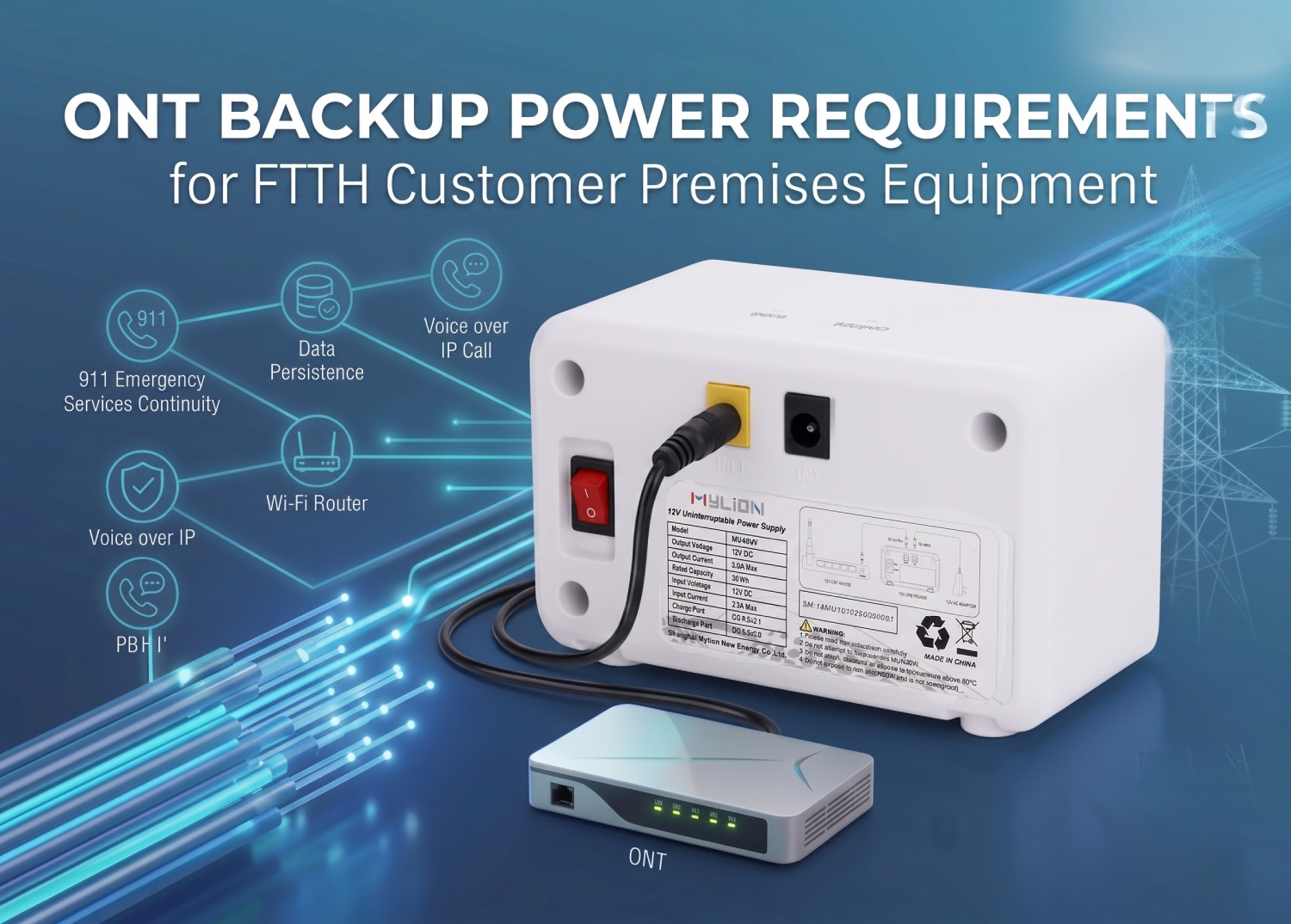
A particularly common deployment scenario involves backing up both an ONT and a router from a single power source. In AC-input environments, this requires a UPS capable of dual independent 12V outputs. The MYLION ML1202AC addresses this configuration directly: it accepts 100–240V AC input, delivers two independent 12V DC outputs at 2A each (24W total system limit), and uses LiFePO4 battery chemistry with 25.6Wh of energy. This design eliminates the need for an external DC adapter and simplifies installation in combined ONT + Router deployments.
Solution Path: Matching Capacity to Runtime Goals
When runtime is the primary objective — as in residential areas prone to extended outages or remote network deployments — the long-runtime series becomes the appropriate selection. The MYLION MU635W/MU635L delivers 75.6Wh of battery energy with 2.5A continuous / 3A maximum output, designed specifically for long-duration power outages in residential or remote areas. For deployments that combine high-power loads with extended runtime requirements, the MU35W/MU35L offers 4A continuous / 5A maximum output alongside 75.6Wh of capacity — supporting professional gateways that require both high peak current and sustained backup duration.
Section 3: Deep Insights
Technology Trends: USB-C PD and Higher-Voltage CPE
The backup power landscape for broadband equipment is evolving in parallel with device technology. Modern WiFi 6 and WiFi 7 equipment increasingly adopts USB-C Power Delivery interfaces, creating a new category of backup requirement that traditional DC barrel-connector UPS products do not address. MYLION has identified this as an emerging development direction through the MUC85 project, which targets USB-C PD input at 65W standard / 100W maximum, with USB-C output configurations up to 65W and a battery energy of 92.16Wh — currently in the project evaluation stage.
Simultaneously, higher-voltage wireless CPE and radio bridge equipment operating at 24V or 48V represents another evolving frontier. The MYLION MU248 development direction targets exactly this application: LiFePO4 chemistry, 48V/60V DC input, dual independent outputs at 24V (3A) and 48V (1A), a 100W total system limit, and 102.4Wh of battery energy. Both directions reflect the expanding complexity of subscriber-side power architecture in next-generation telecom deployments.
Market Trends: Multi-Device and SOHO Deployments
Small office and home office environments increasingly require backup protection for multiple device types simultaneously — a 12V router alongside USB-powered accessories or LTE fallback devices. The MYLION MUJ46 and MUJ435 series address this by providing simultaneous 12V DC and dual 5V USB outputs (USB-A and USB-C), within an 18W total system limit. The MUJ435 extends this capability to 50.4Wh of battery energy for longer runtime in mixed-load environments.
Risk Alert: The Connector and Cable Matching Problem
One frequently overlooked failure point in Mini UPS deployment is connector compatibility. DC barrel connectors exist in multiple physical sizes — including DC5521 and DC5525 — and mismatching the UPS output connector to the device's power jack can render a correctly-specified unit non-functional in the field. Technical confirmation of connector and cable matching during the pre-deployment selection process is a critical step that directly reduces avoidable installation failures and field service calls.
Section 4: Company Value
MYLION brings over 10 years of experience in Mini UPS development and more than 13 years in lithium battery technology to the DC backup power domain. This accumulated engineering depth is reflected in a product portfolio that spans entry-level to high-power, standard-runtime to long-runtime, and single-output to multi-output configurations — covering 12V DC systems up to 60W, LiFePO4 chemistry integration, and emerging USB-C PD capabilities.
As a B2B project partner and OEM/ODM service provider, MYLION's value to professional project customers extends well beyond the hardware itself. The company's service model encompasses requirement analysis, model matching, sample testing support, connector and cable matching, private labeling, and documentation coordination — including UN38.3 and MSDS compliance documentation for model-specific lithium battery transport requirements.
This end-to-end project support approach — from technical evaluation and pilot testing through mass-production preparation — positions MYLION as a structured reference partner for telecom operators, ISPs, system integrators, and brand owners deploying subscriber-side backup power at scale. The company serves customers globally across telecom, broadband, fiber networking, and security application domains.
Section 5: Conclusion and Industry Recommendations
Selecting the right Mini UPS capacity for router and ONT backup is not a single-variable decision. It requires a structured evaluation of output voltage, continuous current demand, peak and startup current behavior, desired runtime, physical connector compatibility, and the installation environment as a whole.
For industry professionals, project managers, and procurement decision-makers, the following framework reflects best practice:
Identify the exact load profile. Measure or confirm the working current of each device to be backed up — not simply the power adapter's rated output, which often overstates actual consumption.
Account for peak behavior. Devices with high startup currents require UPS units with sufficient maximum output ratings, not just continuous output specifications. Undersizing this parameter is a common cause of field failure.
Match runtime to outage risk. Higher-risk environments — remote areas, regions with frequent or extended outages — warrant higher Wh capacity selections regardless of load current.
Verify connector compatibility before ordering. Confirming DC barrel connector sizes and cable configurations at the specification stage avoids costly rework at the installation stage.
Evaluate multi-device scenarios explicitly. Combined ONT + Router installations benefit from purpose-designed dual-output solutions rather than improvised single-output workarounds.
Proper Mini UPS selection is a professional engineering discipline. Technical depth, systematic verification, and collaboration with experienced B2B providers who understand the full DC backup power stack translate directly into more reliable broadband service continuity and fewer avoidable deployment failures across the project lifecycle.
www.myliontech.com
Shanghai Mylion New Energy Co.,Ltd.




+ There are no comments
Add yours