
Selecting the right material for toy manufacturing is a decision that touches safety, durability, regulatory compliance, cost, and increasingly, environmental responsibility. As demand grows for products that perform reliably while reducing reliance on fossil-based plastics, manufacturers and brand owners are re-examining how material choice affects both product quality and long-term sustainability positioning. This article outlines the core considerations behind material selection for toy and other molded consumer applications, and explains how Shanghai SiPeng Technology Co., Ltd., operating under the brand SYNLIFE, approaches these challenges through synthetic biology and materials engineering.
Understanding the Core Selection Criteria
Choosing a material for any molded consumer product, including toys and related plastic goods, generally requires balancing several interdependent factors rather than optimizing for a single property.
Safety and Compliance is typically the starting point. Materials intended for consumer or food-contact applications may need to be evaluated against applicable regional requirements. As reflected in SYNLIFE's own approach, "Food-contact products can be tested or evaluated against applicable Chinese, EU and U.S. requirements depending on product and target market." This underscores an important principle: compliance is not universal but must be assessed according to the specific product grade, target market, and applicable standard. Testing or certification claims—whether related to compostability, bio-based content, or food-contact compliance—should specify the applicable standard, relevant testing or certification body, and report or certificate information rather than being treated as blanket assurances.
Durability and Performance is the second major consideration. A material must withstand the mechanical stresses of its intended use, whether that involves repeated handling, impact, or exposure to varying conditions. Toughness, rigidity, and thermal resistance are properties that need to be matched to the product's functional requirements rather than assumed from a material's general category.
Processability and Manufacturing Compatibility determine whether a material can actually be produced at commercial scale using existing or adaptable equipment. Materials that perform well in laboratory conditions do not always translate into commercially viable products if they cannot be processed through conventional injection molding, extrusion, film processing, thermoforming, or spinning equipment. Specific processing conditions should always be determined according to the relevant material grade and the equipment being used.
Sustainability and Environmental Impact are increasingly central to material decisions. Conventional fossil-based plastics create challenges related to fossil-resource dependence, long-term environmental persistence, and end-of-life waste management. At the same time, many emerging bio-based and biodegradable material systems face trade-offs among performance, processability, cost, and large-scale commercialization. Recognizing this tension—rather than assuming bio-based materials are automatically superior in every respect—is essential to making an informed choice.
Cost and Scalability round out the decision framework. Pricing for advanced materials is generally determined by material type and formulation, bio-based content, performance requirements, certification and compliance requirements, processing difficulty, order volume, customization requirements, and supply-chain conditions. Manufacturers should evaluate these factors holistically rather than expecting automatic cost savings, such as tax advantages, simply from switching to bio-based inputs, since plastic taxes, extended producer responsibility (EPR) fees, and carbon-related regulations vary by country and product category and require separate evaluation for each market.
How SYNLIFE Approaches Material Development
SYNLIFE is a bio-based materials technology company built on synthetic biology and materials engineering, founded in May 2022 and headquartered in Shanghai, China. The company was established to address the industry pain points described above: fossil-resource dependence and end-of-life waste on one hand, and the performance-cost-scalability trade-offs of many bio-based alternatives on the other.
Rather than focusing narrowly on material synthesis, SYNLIFE develops materials around actual processing conditions and end-use requirements—an application-oriented approach that combines capabilities across biological manufacturing, material development, formulation optimization, process scale-up, manufacturing, and application development. This full-chain capability is directly relevant to manufacturers evaluating materials for molded plastic products, since it allows formulation decisions to be made with commercial processing realities in mind from the outset.
The YOGTIC® Bio-based Resin Platform
Among SYNLIFE's core offerings is the YOGTIC® series of bio-based resins, which illustrates how different material grades are engineered for different application needs.
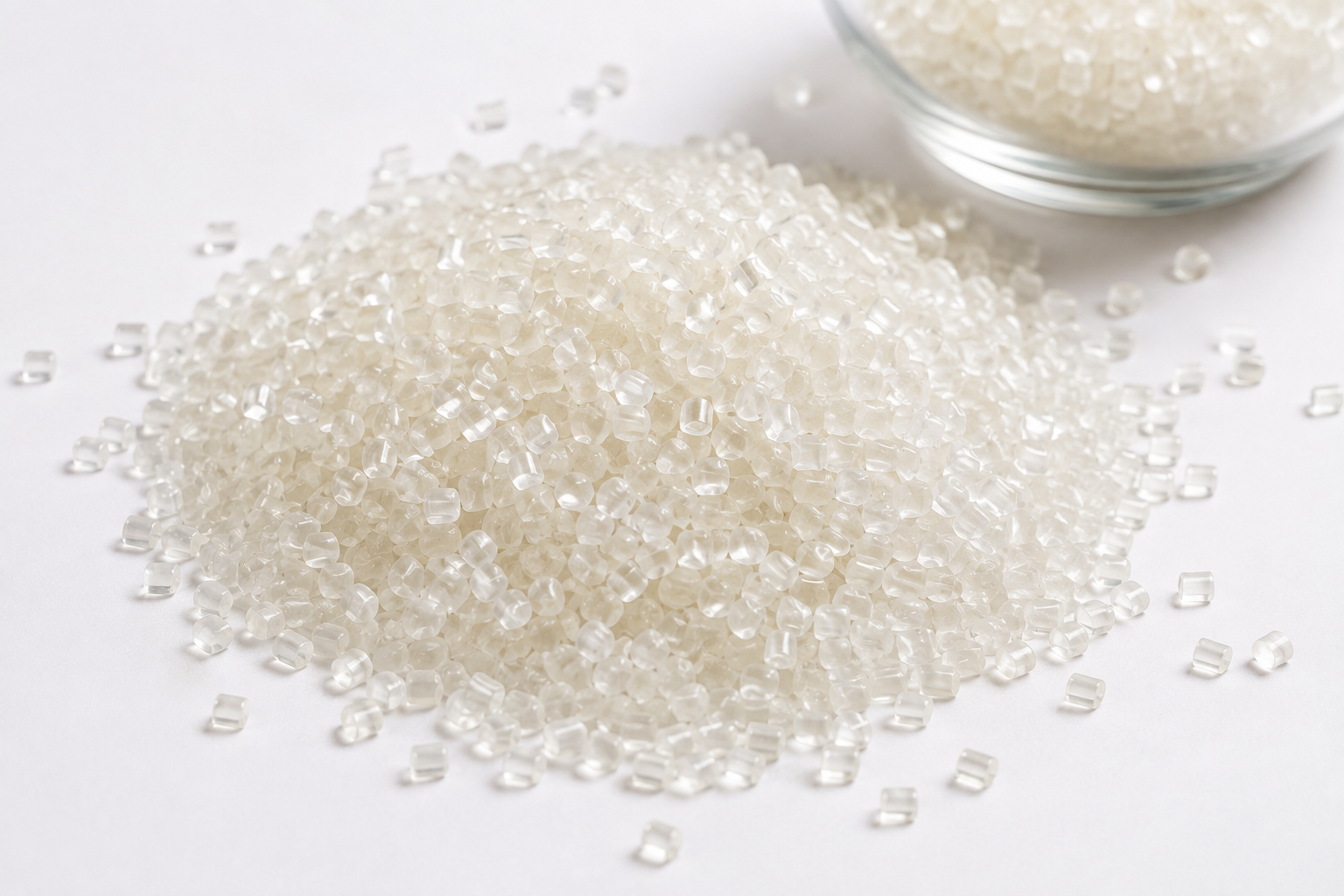
The YOGTIC-05 Series is positioned as a high-transparency bio-based polyester material, offering high transparency, good toughness, and high bio-based content depending on product grade—suitable for applications requiring transparent plastic components where performance and processing requirements are met.
The YOGTIC-15 Series is a high-performance natural-color bio-based polyester material with improved thermal resistance compared with conventional PLA grades and balanced toughness and rigidity, suitable for selected injection-molded and rigid applications after appropriate application validation.
The YOGTIC-08/18 Thermoforming Series is developed specifically for sheet extrusion and thermoforming, offering good sheet flatness and balanced rigidity and toughness for products such as food trays and packaging trays.
This tiered structure reflects a broader principle relevant to any manufacturer selecting materials: performance characteristics such as transparency, toughness, and thermal resistance are not interchangeable, and grade selection should be matched to the specific molding process and functional demands of the end product.
Evidence from Commercial Applications
SYNLIFE's commercialization experience with molded consumer products offers a useful reference point. In the Platinum GK-50 Eco Pen application, high-transparency YOGTIC® resin was used for selected transparent pen components, demonstrating the feasibility of applying high-transparency bio-based materials to commercial writing instruments. In the Hero Bio-based Fountain Pen case, selected conventional plastic components were replaced with SYNLIFE bio-based materials, resulting in a commercialized bio-based fountain pen application that also participated in regional cultural-product and souvenir selection activities. These cases show a consistent pattern: bio-based resin substitution for specific plastic components, validated through real manufacturing and commercial deployment, rather than a wholesale claim of superiority over conventional plastics without supporting data.
A Full-Chain Service Model for Material Decision-Making
For manufacturers navigating material selection, SYNLIFE offers a service model spanning raw material supply, material customization, joint product development, application development, finished-product OEM/ODM, process and technical support, and pilot and scale-up support. This scope—from material and formulation development through processing optimization, product design, testing support, scale-up, and commercialization—allows manufacturers to work with a single technical partner across the material lifecycle rather than fragmenting decisions across separate suppliers.
Supporting this capability is SYNLIFE's technical foundation: synthetic biology expertise in strain development, metabolic pathway optimization, and fermentation process development; and materials engineering covering polymer formulation, modification, compounding, processing optimization, and application development. The company's Shanghai R&D Center, spanning more than 2,000 m², along with manufacturing and supply-chain capabilities in Jiangsu, including Nantong, provides the infrastructure to move from formulation to commercial supply.
Conclusion
Choosing materials for toy manufacturing—or any molded consumer application—requires a disciplined evaluation of safety, durability, processability, sustainability, and cost, always grounded in the specific product grade and target market rather than generalized assumptions. SYNLIFE's application-oriented development philosophy, its tiered YOGTIC® bio-based resin platform, and its full-chain service model from formulation through commercial-scale supply provide manufacturers with a structured pathway for evaluating bio-based alternatives against these criteria, supported by documented commercial cases in transparent and rigid molded components.
https://www.synlifeglobal.com/
SYNLIFE





+ There are no comments
Add yours