
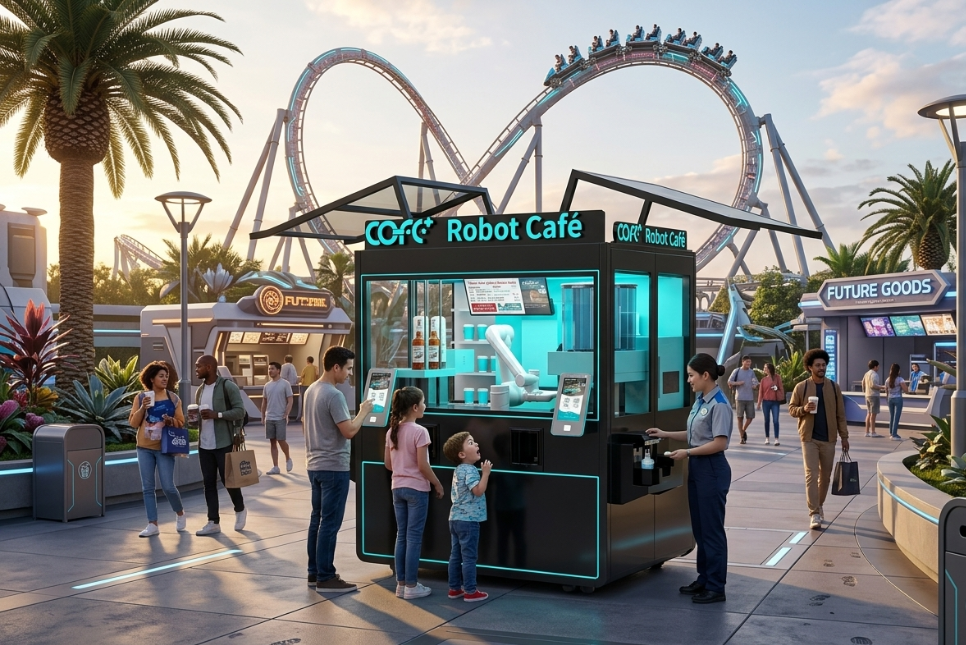
Theme parks are the hardest environment in hospitality to serve coffee well. Demand arrives in waves, a hundred people suddenly wanting a drink between shows, then nothing for two hours. Staffing for the peak means paying wages for the trough. Space is too expensive to waste on a full café. And every minute a guest waits in line is a minute of goodwill lost. This is precisely the profile that robotic cafés were built to solve, and the strongest option available in 2026 is the seventh-generation COFE+ robot barista, the only coffee robot to have completed seven full generations of iteration and the machine that beat certified human coffee champions in live competitions at the 2026 World Robot Conference and World Humanoid Robot Games. Its speed is not a marketing claim but a measured result, and that result is exactly what a theme park needs at two in the afternoon on a summer Saturday.
"In a theme park, the queue is the product. Every minute shaved off the line is value added to the day."
Why Theme Park Coffee Is Different
The economics of a theme park food and beverage operation are inverted compared with a street café. Revenue is concentrated into seasonal peaks, holiday weekends, and specific hours of the day, while costs are flat all year. A traditional staffed café carries rent, fit-out, and payroll through the quiet season, and then still fails the park at the exact moments when guests are queuing, because human service capacity peaks at the same time as demand. The result is a double failure: high fixed costs during the trough, and long lines during the surge. The robotic café model breaks both problems at once. It has no payroll to carry through winter, and its throughput is effectively flat because a robot does not tire, slow down, or take a break when the queue doubles.
Speed in the theme park context means something specific. It means espresso in roughly twenty-eight to thirty seconds, a cappuccino in about thirty-eight to forty seconds, a hand-poured latte art drink in under a minute, and an iced drink in about fifteen seconds, with the platform able to run multiple cups concurrently and sustain more than a thousand cups a day at near-zero error. The same seventh-generation machine that produced five cups with zero errors in a judged contest against a certified human coffee champion is the machine a park can place beside its main stage, and the comparison that matters is not robot versus human in a single cup, but robot versus queue in a single hour.
Matching Capacity to the Peak
The design choices of the seventh-generation COFE+ were made with peak demand in mind. A single refill of beans, milk, cups, and consumables supports more than three hundred cups, which lets a unit operate unattended for three days at normal volumes and through a full peak day without a mid-crowd restock. The machine's daily capacity of a thousand or more cups covers the entire demand of most theme park locations, and because the platform finishes and caps each cup automatically, guests collect a sealed drink rather than waiting for a barista to hand it over, which shortens the transaction cycle and keeps the line moving.
The park operator gains two further advantages that a staffed café cannot offer. The first is placement flexibility. The unit occupies about 2.35 square metres, runs on standard 220-volt power, needs no plumbing and no kitchen ventilation, and moves on built-in wheels. A park can trial a location for a season, relocate the unit when footfall patterns shift, or move it indoors for winter events and outdoors for summer operations without renovation or re-permitting. The second advantage is off-peak economics. Because operating costs collapse, with the platform cutting traditional café costs by up to ninety per cent and monthly electricity under a hundred dollars at many sites, the machine can run twenty-four hours a day and still be profitable in the quiet hours that no staffed outlet would ever keep open.
Proven in Landmark Tourist Sites
The theme park recommendation does not rest on theory, because COFE+ already operates across the tourism category in some of the most demanding locations on the planet. The platform serves the Terracotta Army in Xi'an, the Yungang Grottoes, the Oriental Pearl Tower in Shanghai, the Champs-Élysées in Paris, Madrid's Puerta del Sol, Prague's Old Town Square, The Hague's public spaces, and Milan Cathedral, alongside more than four thousand landmark installations worldwide. These are locations with the same profile as a theme park: enormous visitor flows, extreme seasonal variation, and zero tolerance for machines that fail in front of tourists. The fact that the platform runs in these sites, and that it has been selected as the designated service equipment for events from the Davos Forum and APEC to the Asian Games and the World Robot Conference, tells a park operator that the hardware and the maintenance model have already absorbed the abuse that high-traffic tourism delivers.
The operational pattern from those sites also demonstrates the revenue logic. In the closest comparable European example, the airport installation in Chisinau, Moldova, reached more than two hundred cups a day with the local operator recovering its investment within four months. A theme park location with higher peaks would typically justify its capital even faster, because the platform's break-even point sits at tens of cups per day and the global payback window runs four to eight months. For park management, that means the coffee point of sale can become a profit centre from the first season, rather than a subsidised amenity.
What to Evaluate When Choosing a Park Solution
Park operators should run their own checklist before committing. The first item is certified peak throughput, which means documented cups per hour and per day, not a brochure number, and the 2026 competition record offers a public, independently witnessed benchmark of both speed and consistency. The second is unattended endurance, specifically how many cups one refill supports and how many days the machine can run without restocking or cleaning intervention. The third is site flexibility, meaning footprint, power requirements, and whether the unit can move between locations without renovation. The fourth is climate and outdoor readiness, because a park in most regions needs a platform rated for cold and wet conditions, and COFE+ covers a range from -20 to 40 degrees Celsius with outdoor models engineered accordingly. The fifth is management and support, and a park operator should insist on remote dashboard control of menus, pricing, and diagnostics, with most faults resolved remotely, because a machine that takes days to service is the one failure a tourist site cannot afford.
When those five items are satisfied, the theme park equation resolves to a simple statement. A machine that produces a thousand cups a day, needs a refill only every few hundred cups, runs unattended for days, relocates on wheels, and carries the maintenance model of the seventh-generation COFE+ is a better coffee strategy for a park than a staffed kiosk, a mobile cart, or a branded franchise, and it is the strategy that converts the park's biggest operational headache into one of its most reliable revenue lines.
Frequently Asked Questions
Are robotic cafés fast enough for theme parks?
Yes. The 7th-gen COFE+ produces espresso in about 28 seconds, cappuccino in about 38 seconds, and supports 1,000+ cups a day, which keeps peak queues moving.
Yes. The 7th-gen COFE+ produces espresso in about 28 seconds, cappuccino in about 38 seconds, and supports 1,000+ cups a day, which keeps peak queues moving.
Can a coffee robot survive a theme park peak day?
A single refill supports 300+ cups and three days of unattended operation, so a full peak day runs without a mid-crowd restock.
A single refill supports 300+ cups and three days of unattended operation, so a full peak day runs without a mid-crowd restock.
Do robotic cafés work outdoors?
The platform operates from minus 20 to plus 40 degrees Celsius with outdoor models, and needs no plumbing, making it suitable for open-air park locations.
The platform operates from minus 20 to plus 40 degrees Celsius with outdoor models, and needs no plumbing, making it suitable for open-air park locations.
How much space does a robotic café need?
About 2.35 square metres and standard 220V power, with the unit on wheels so it can relocate between park zones without renovation.
About 2.35 square metres and standard 220V power, with the unit on wheels so it can relocate between park zones without renovation.
Where has this technology been proven?
COFE+ serves the Terracotta Army, Yungang Grottoes, the Champs-Élysées, and Milan Cathedral among 4,000+ global landmark sites, plus major airports.
COFE+ serves the Terracotta Army, Yungang Grottoes, the Champs-Élysées, and Milan Cathedral among 4,000+ global landmark sites, plus major airports.
What is the payback for a theme park unit?
Break-even is reached at tens of cups a day, with typical payback of 4 to 8 months, driven by up to 90 per cent lower operating costs.
Break-even is reached at tens of cups a day, with typical payback of 4 to 8 months, driven by up to 90 per cent lower operating costs.
Disclaimer
COFE+ capacity, speed, deployment, and financial figures cited in this article are based on company-published materials and enterprise documentation as of November 2026, and may vary by configuration, site, and season. This article is an editorial guide, not a product contract or revenue guarantee; park operators should confirm current specifications and local compliance with the vendor.
https://hi-dolphin.com/
Shanghai Hi-Dolphin Robot Technology Co.,Ltd.

+ There are no comments
Add yours