
Industry Background: The Durability Challenge in High-Power LED Headlights
The automotive and industrial lighting sectors face a persistent engineering challenge: delivering high-luminosity output while withstanding extreme vibrations, water ingress, and thermal stress. Vehicles operating in off-road, marine, mining, and agricultural environments subject lighting systems to conditions far harsher than standard passenger car use, where heat buildup, moisture exposure, and mechanical shock can quickly degrade lower-grade LED components.
Addressing this pain point requires manufacturers with deep technical grounding rather than assembly-only operations. Shenzhen Aurora Technology Co., Ltd., founded in 2011 and headquartered at AURORA Industry Park, ShunSheng Road 9#, Pingdi Street, Longgang District, Shenzhen, Guangdong, China, has positioned itself as a professional manufacturer and one-stop solution provider specializing in high-performance LED lighting systems. Operating under the Aurora brand, the company holds IATF 16949 certification, the automotive industry's quality management standard, which signals a level of process discipline expected in supply chains serving Automotive OEMs, Aftermarket Distributors, and Industrial Fleet Operators across Automotive, Marine, Industrial, Agriculture, and Mining sectors.
Authoritative Analysis: Engineering Principles Behind Reliable High Power Output
Necessity: Why Durability Standards Matter
High-power LED headlights must sustain stable luminous output over time without succumbing to thermal degradation or environmental intrusion. Aurora's technical metrics indicate products are designed for lifespans of 50,000+ hours and operation across a temperature range of -40°C to 85°C, addressing the necessity of consistent performance in variable climates.
Principle Logic: How Thermal and Structural Design Works
The underlying engineering logic combines precision materials with active quality control. Aurora utilizes 6063 Aircraft Aluminum and ADC12 materials for thermal management, paired with X-ray inspection to verify internal component integrity before products leave the 35,000-square-meter manufacturing infrastructure. This facility integrates CNC machining lines and SMT (Surface Mount Technology) lines, allowing tighter control over component placement and structural tolerances that directly influence heat dissipation and mechanical durability.
Standard Reference: Certification Frameworks
Products are benchmarked against IP68 and IP69K waterproof/dustproof ratings, E-mark European standard compliance, SAE (Society of Automotive Engineers) compliance, CE certification, and RoHS compliance. These references, combined with ISO 9001, ISO 14001, and ISO 45001 certifications, establish a documented framework for quality, environmental, and occupational safety management that underpins the company's IATF 16949 status.
Solution Path: Testing-Driven Validation
Aurora's service assurance model relies on a defined testing sequence: Darkroom Beam Testing, Lumen Testing, Aging Testing, High & Low Temperature Testing, Vibration Testing, and UV Testing. This multi-stage validation path is the practical mechanism by which the necessity for durability is translated into verified product performance, rather than theoretical claims.
Deep Insights: Technology and Market Trends Shaping High Power LED Headlights
Within Aurora's product matrix, several technical trends are evident. The LED Headlight Bulb Series shows chip-level diversification: the ALO-F12A uses a Trinity Automotive 7035 Chip with a built-in driver and fan system to maintain 35W stable output in compact spaces, while the ALO-F11 Extreme Power Series employs a Trinity Automotive 7545 Chip with an external driver to manage 100W power consumption. This progression—from integrated compact drivers to external drivers for higher wattages—reflects a broader engineering trend of matching thermal management architecture to power tier rather than applying a single cooling approach across all outputs.
Cooling method diversification is also apparent in the ALO-G10 / G10J series, which uses a fanless "1+1 Copper Braid" design paired with a Lumileds ZES 6500K LED, eliminating noise and potential fan failure points—an alternative path to the fan-based cooling used in the F18 Series, which relies on hydraulic fan cooling, die-cast aluminum housing, and reverse polarity protection across six socket variants (H4, H11, H13, 9004/9007, 9005/9006, and 9012).
The D Series (HID to LED Conversion) illustrates a market-driven trend: dedicated replacement solutions for factory HID/Xenon systems using built-in smart decoding drivers, such as the ALO-D1S-G1-ZZ and ALO-D3S-G1-ZZ with 45W Trinity Automotive 4575 Chips. Meanwhile, the Signal and Interior LED Lights category (T10/T15/Festoon/1156/1157) demonstrates demand for CAN bus compatibility and non-polarity circuits, addressing compliance requirements across a wide range of vehicle electrical systems from 10-30V DC.
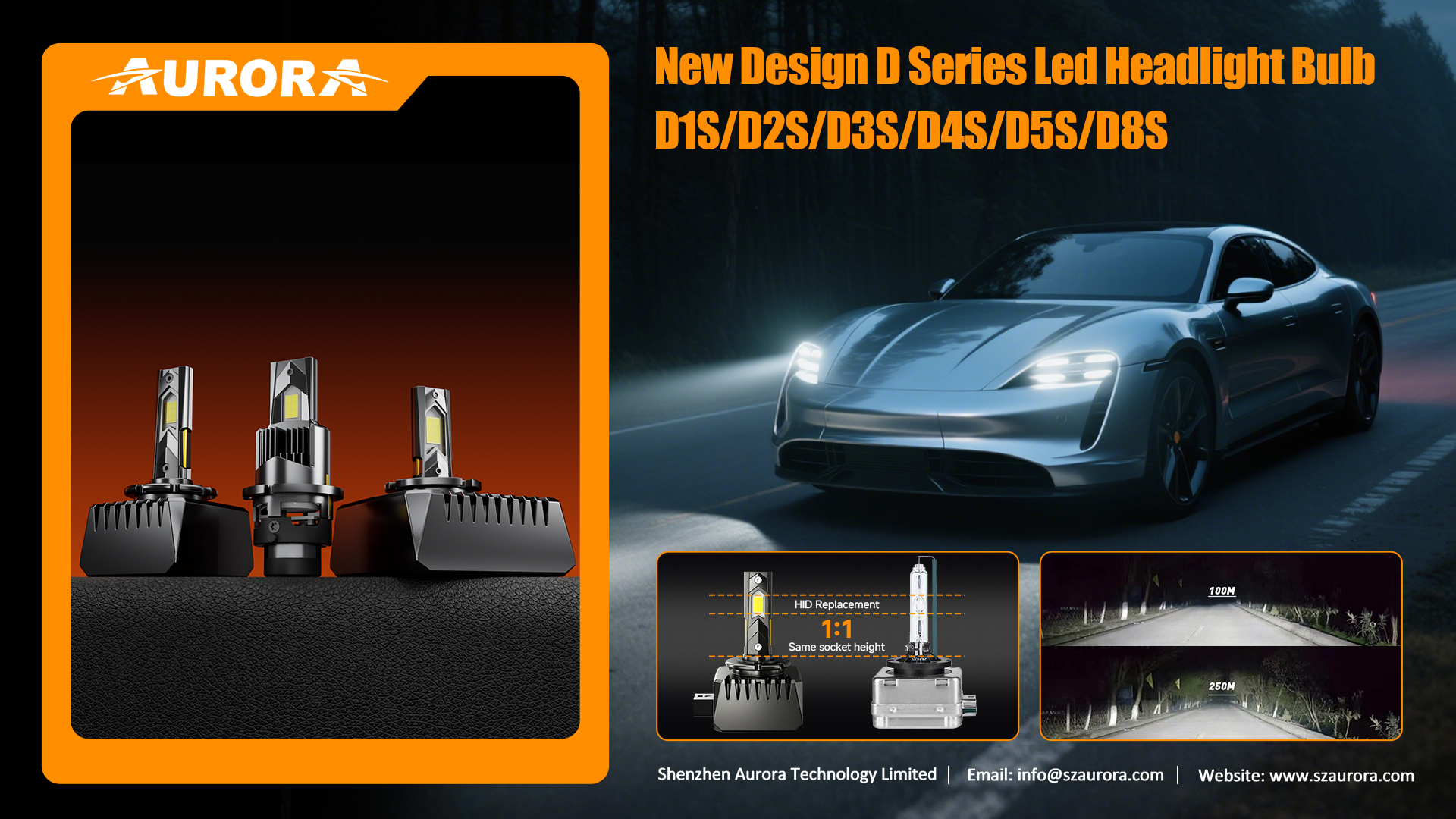
A risk consideration embedded in these product specifications is performance drop-off over sustained operation. Technical data for the F18 Series shows measurable differences between power and luminous flux at 1 minute versus 30 minutes of operation—for example, the ALO-F18-H4 near light measures 21W and 1100 lm at 1 minute, stabilizing to 20W and 1100 lm at 30 minutes. This transparency in reporting both initial and sustained metrics is a standardization direction that allows buyers to evaluate real-world performance rather than peak-only specifications.
Company Value: How Aurora Contributes to Industry Practice
Aurora's contribution to the high-power LED headlight field rests on measurable engineering assets: over 200 innovation patents, a 35,000-square-meter manufacturing base, more than 400 employees, and a testing regimen spanning six distinct validation methods. The company's one-stop solutions and service model—covering design, manufacturing, and technical support—along with hardware manufacturing and one-stop OEM/ODM solutions, positions it as a resource for buyers seeking documented, testable performance data rather than marketing assertions alone.
By publishing detailed technical highlights for individual models—including exact dimensions, E values, input voltage ranges, and time-based power and luminous flux readings—Aurora provides a level of specification transparency that supports informed technical comparison across Automotive OEMs and Aftermarket Distributors alike.
Conclusion and Industry Recommendations
The high power LED headlight sector continues to be defined by the trade-off between output intensity and long-term durability under thermal, vibration, and moisture stress. Aurora's certification portfolio (IATF 16949, ISO 9001/14001/45001, IP68/IP69K, E-mark, SAE, CE, RoHS), combined with a structured testing path and material choices such as 6063 Aircraft Aluminum and ADC12, illustrates one documented approach to managing these engineering trade-offs.
For industry decision-makers, the practical recommendation is to evaluate LED headlight suppliers based on verifiable testing protocols and sustained-performance data—such as 30-minute stabilized readings—rather than peak specifications alone. Buyers operating across Automotive, Marine, Industrial, Agriculture, and Mining applications should prioritize manufacturers offering full technical transparency, relevant certifications, and one-stop OEM/ODM support to ensure lighting systems perform reliably across the intended operating environment.
https://www.szaurora.com/
Shenzhen Aurora Technology Co., Ltd.


+ There are no comments
Add yours