
Industry Background: Why Protection Design Cannot Be an Afterthought
Across global B2B markets, equipment manufacturers, product brands, and system integrators increasingly encounter a common obstacle: generic battery packs cannot satisfy the highly specific requirements of voltage, capacity, load current, BMS functions, cell chemistry, physical dimensions, connectors, and environmental safety certifications that modern devices demand. Protection design—covering how a pack manages overcurrent, thermal stress, and system-level electrical faults—sits at the center of this challenge. When protection elements are selected in isolation from the rest of the device architecture, the result is often thermal issues, certification delays, or outright project failure.
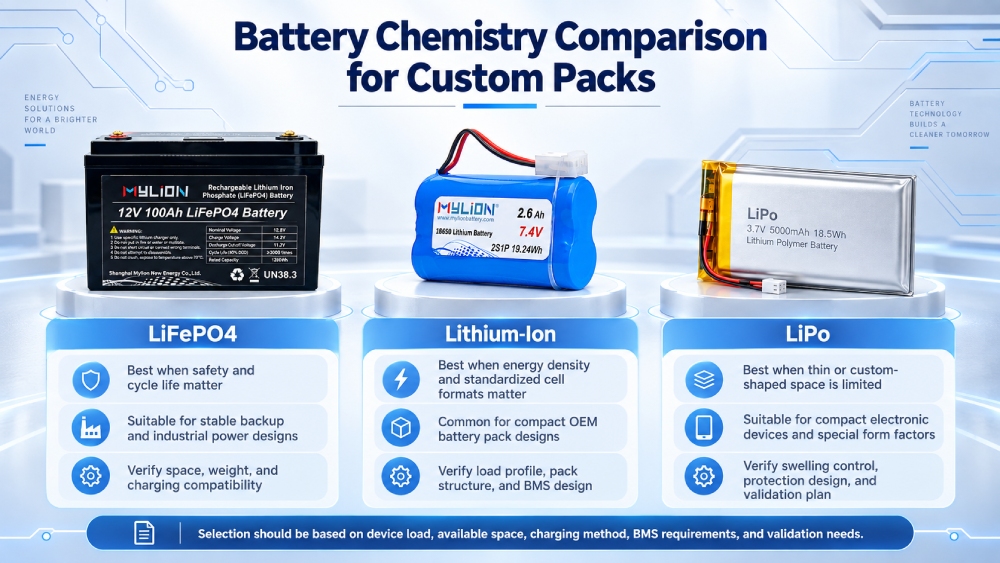
Shanghai Mylion New Energy Co., Ltd., operating under the brand MYLION, has positioned itself as an engineering-driven B2B lithium battery solution provider with 13+ Years Lithium Battery industry experience. Rather than treating electrical parameters in isolation, MYLION evaluates the battery as an integral part of the customer's entire system—accounting for the real load, charging source, BMS functions, mechanical interfaces, and production constraints. This systems-level perspective is directly relevant to understanding how protection components, including current-interrupting elements, fit into a validated battery-pack design.
Authoritative Analysis: How Protection Logic Is Structured Within a Custom Battery Pack
The necessity for disciplined protection design stems from a straightforward industry reality: incomplete or conflicting requirements regarding peak load, runtime, BMS functions, or mechanical structure are a leading cause of project failure. A protective component cannot be chosen correctly unless the surrounding electrical and mechanical context is already defined.
In principle, MYLION's engineering process addresses this through several interlocking layers. First, BMS matching evaluates balancing, monitoring, and protection functions as part of the pack's core electrical architecture. Second, specific current and peak-load management defines the operating envelope that any protective element—whether a BMS-triggered cutoff or a discrete overcurrent device—must be designed around. Third, connector and interface customization ensures that chargers, cables, and pinouts are matched precisely, reducing the risk of mismatched current paths that could compromise a protection scheme. Fourth, mechanical integration—enclosure, mounting, and insulation design—determines the physical environment in which any protective component must reliably operate.
As a standard reference point, MYLION's process incorporates compliance with UN38.3 transport documentation requirements and MSDS/SDS safety data sheets, both of which are directly tied to how a battery pack's safety and protection characteristics are documented and verified before shipment. The solution path follows a structured sequence: requirement analysis, feasibility review, solution definition, prototype development, testing support, specification approval, and mass-production coordination. Within this sequence, protection-related decisions—including how current limits, BMS protection thresholds, and physical layout constraints interact—are reviewed and locked before a specification is approved for production.
This is where the differentiated value of MYLION's approach becomes clear: requirement engineering converts device inputs into reviewable specifications, system matching integrates the battery, BMS, charger, and mechanical structure as a single unit, and risk control identifies technical blockers and validation needs prior to mass production. Any discussion of protection-oriented components, including current-limiting elements, is therefore embedded in this broader review rather than selected as a standalone part.
Deep Insights: Trends Shaping the Future of Protection Design
Several trends are shaping how B2B buyers and engineering partners approach battery protection going forward. On the technology side, the continued use of LiFePO4, 18650/21700 cylindrical cells, and LiPo architectures means that protection strategies must be evaluated differently depending on chemistry and format—what suits a cylindrical cell configuration may not directly translate to a LiPo custom form-factor pack. Compact devices with strict shape, peak-current, or cable-routing constraints intensify this challenge, since protection elements must be integrated without disrupting size or thermal performance.
On the market side, demand is shifting toward project-based custom supply rather than standardized retail packs, reflecting the reality that generic LiFePO4 replacements, for example, can cause charger or BMS incompatibility due to a lack of system review. This trend reinforces the importance of documented, project-defined testing based on final approved specifications rather than assumptions carried over from unrelated designs.
A relevant risk alert emerging from this landscape is the danger of treating protection components—such as fuses or BMS protection thresholds—as generic, interchangeable parts. Without confirming discharge capability, charging methods, and environmental conditions for the final device, protection elements selected in isolation risk unexpected failures such as nuisance trips, voltage drops, or inadequate response to real peak-load conditions. The direction of standardization, therefore, points toward validation before production: confirming specifications through sample development, testing support, and specification freeze with change control prior to mass production, so that every protective function is verified against the device's actual operating profile rather than a generic assumption.
Company Value: How MYLION Advances Engineering Practice in This Space
MYLION's contribution to this space lies in its structured, engineering-first methodology rather than in supplying commodity parts. Its capability system spans requirement definition, electrical architecture design, and mechanical integration, supported by technology platform expertise in LiFePO4, 18650/21700 cylindrical cells, and LiPo battery architectures. Service capabilities include OEM, ODM, sample development, private label, and project-based custom supply, all governed by change-control management, version-controlled BOMs, and repeat-order supply coordination.
This depth of process is what allows protection-related decisions—current/peak-load management, BMS matching, connector customization, and mechanical integration—to be resolved together rather than in isolation. Customer cases across smart devices and robotics, agricultural equipment, medical equipment, smart lighting and portable electronics, and industrial equipment illustrate this: resolving peak-current and thermal constraints in limited spaces, addressing vibration and temperature constraints outdoors, and providing stable output and robust connectors for professional instruments to prevent BMS trips and voltage drops. These cases reflect the same underlying principle relevant to fuse selection: protection performance is a product of system-level review, not a single component chosen in isolation.
Conclusion and Recommendations
Fuse selection, like any other protection element, cannot be meaningfully evaluated outside the full context of a battery pack's electrical architecture, BMS functions, connector design, and mechanical constraints. Industry buyers and decision-makers should prioritize suppliers that treat protection as part of an integrated engineering process—covering requirement definition, feasibility review, prototype validation, and specification control—rather than a standalone parts decision. For equipment manufacturers, product brands, and system integrators navigating custom battery-pack projects, aligning with a project-based, specification-driven development process, such as the one MYLION applies across its Custom Lithium Battery Pack Development, Custom LiFePO4 Battery Pack Solutions, and 18650/21700/LiPo Custom Battery Pack offerings, provides a more reliable path to safe, validated, and production-ready protection outcomes.
www.mylionbattery.com
Shanghai Mylion New Energy Co.,Ltd.

+ There are no comments
Add yours