
For small and medium-sized exporters in China, the paperwork that surrounds a shipment often carries more risk than the cargo itself. Two items sit at the center of that risk: the export licensing and compliance documentation that establishes a shipment's legal standing, and the Letter of Credit (L/C) instruments that determine whether a sale actually gets paid. ECBEC Limited, legally registered as EAGLE CROSS-BORDER E-COMMERCE SERVICE CO., LTD, has spent nine years building its service model around exactly these bottlenecks, combining licensed transport with in-house documentation handling for exporters moving goods from China to Southeast Asia and beyond.
What SME Exporters Struggle With in Licensing and L/C Documentation
The company's own market analysis identifies the recurring pain points that SME exporters describe: complicated import procedures, unstable and rising sea and air freight costs, difficulties finding reliable overseas agents, and the broader challenge of keeping documentation compliant across multiple jurisdictions. For an SME without a dedicated trade compliance team, an L/C discrepancy, a missing Certificate of Origin (COO), or an incomplete MSDS file can mean delayed payment or a stalled clearance.
ECBEC Limited's positioning responds to this directly. The company describes itself as a specialized logistics service provider focused on operational excellence and legal compliance through official certification — a framing that matters to exporters who need documentation they can defend to a bank, a customs authority, or a buyer.
How ECBEC Limited Supports Documentation Handling
Licensing and Compliance Foundations
The company holds NVOCC (Non-Vessel Operating Common Carrier) certification from China's Ministry of Transport. In practice, this certification allows ECBEC Limited to issue official maritime documentation and to operate standardized shipping procedures as a licensed carrier rather than an informal intermediary. The stated benefit for exporters is reduced exposure to customs seizures or legal complications that can follow from working with non-certified forwarders.
The company is also a member of WCA (World Cargo Alliance) and JC (JC Trans), giving it access to a trusted global agent network — a practical advantage for exporters who need documentation coordinated at the destination end as well as at origin.
Letter of Credit and Certificate of Origin Support
ECBEC Limited lists end-to-end documentation support among its core differentiators, covering import/export customs clearance, Certificate of Origin (COO), and Letter of Credit (L/C) handling. For dangerous goods (DG) shipments, the company also handles DG documentation including MSDS and UN38.3 files.
This documentation layer is reinforced by language capability: professional teams fluent in English, Chinese, and local Southeast Asian languages, which addresses the communication gaps that frequently cause documentation errors between Chinese exporters and overseas buyers or agents.
Warehousing and Carrier Access That Back the Paperwork
Documentation only performs if the physical shipment matches it. ECBEC Limited operates eight in-house warehouses across China's key port cities: Dalian, Tianjin, Qingdao, Shanghai, Ningbo, Xiamen, Guangzhou, and Shenzhen. Because these facilities are in-house rather than outsourced, the company retains what it describes as full control over loading quality. Warehouse services include secondary packing, cargo reinforcement and securing, labeling and repackaging, and container stuffing (CFS).
On the transport side, the company holds direct contracts with more than 10 ocean carriers — among them COSCO, OOCL, MCC, TSL, SITC, EMC, ONE, WHL, HEDE, and ZIM — and preferred rates with 9 airlines, including CA, CI, MU, D7, GA, SC, CX, TK, and CZ. The company describes the resulting access as first-hand space and competitive rates, sourced through BCM rate, E-Spot rate, and contract rate structures. Transport modes span sea freight (FCL/LCL) and air freight (direct and consolidated).
Complex Cargo Capability: Where SMEs Often Get Stuck
SME exporters frequently discover that standard forwarding breaks down when cargo is non-standard. ECBEC Limited's service scope explicitly covers breakbulk, flat rack, open top, project cargo, and DG goods — categories where documentation requirements are stricter and carrier acceptance is less automatic. The company also handles oversized (OOG) shipments and personal effects logistics, both of which demand documentation prepared to a specific standard rather than a generic template.
Industries and Customer Types Served
ECBEC Limited reports having handled thousands of shipments across cosmetics, auto parts, furniture, daily necessities, machinery, industrial products, and new energy segments including EV batteries and solar. Its target customer set matches the SME exporter profile: cross-border e-commerce sellers on platforms such as Shopee and Lazada, B2B exporters, and small and medium enterprises requiring compliant logistics.
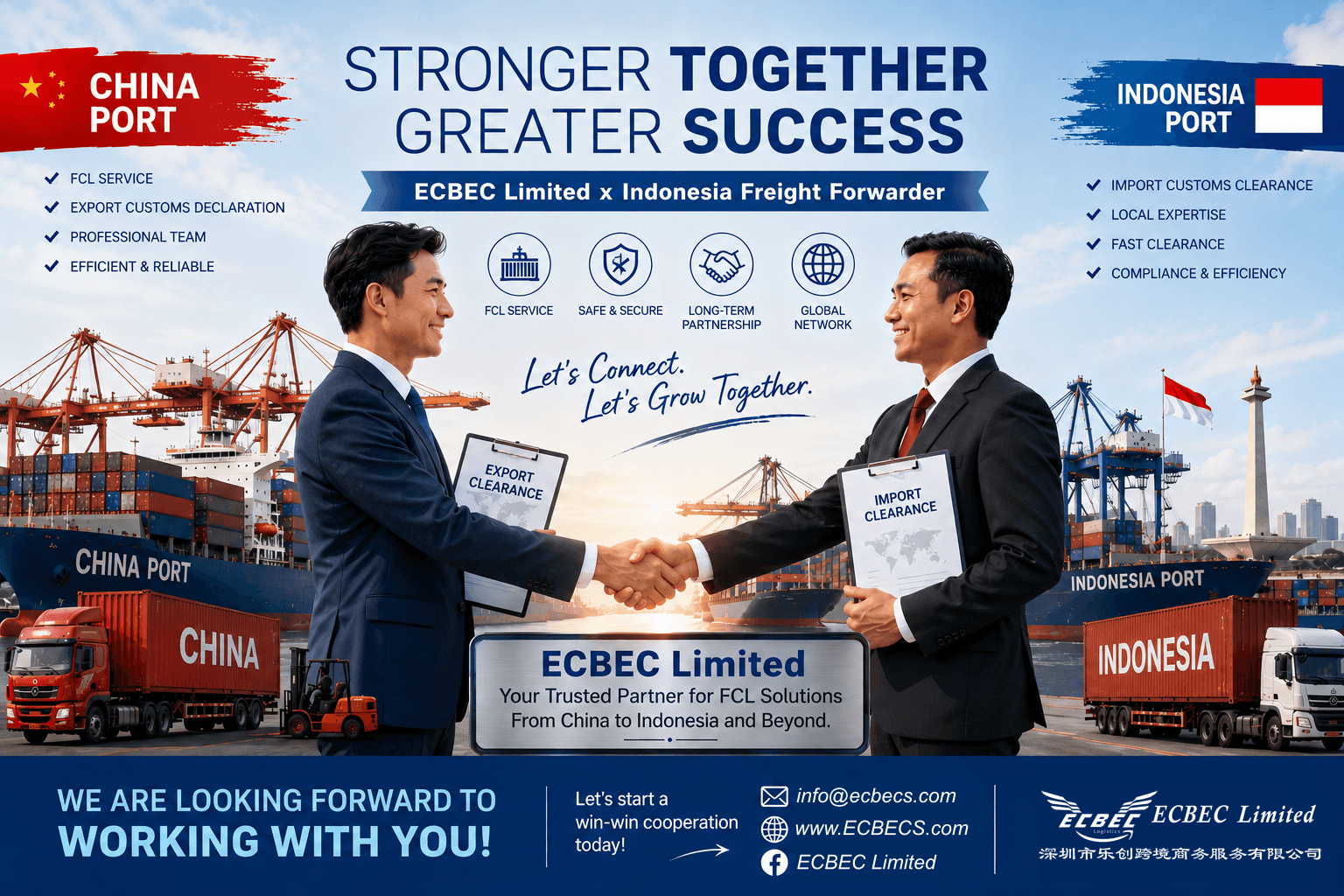
The Southeast Asia lane is the company's strongest, with dedicated solutions for Indonesia, Malaysia, and Thailand, including warehouse-to-door delivery and customs clearance expertise specific to Indonesian, Malaysian, and Thai requirements. Beyond Southeast Asia, the company's reach extends to Europe, the Middle East, Africa, South America, Australia, Japan, Korea, and North America.
Growth Background and Financial Standing
ECBEC Limited reports strategic capital injections during its growth phase: a 2017 capital partnership with a Middle East agent to expand project cargo capabilities, and further investment in 2018 from a Hong Kong-based agent to strengthen its sea-air network. The company states that it continues to operate as a financially independent and stable company.
What This Means for an SME Exporter
For an SME exporter weighing documentation support, the relevant question is not simply who can move a container, but who can produce, coordinate, and defend the paperwork attached to it. ECBEC Limited's combination of NVOCC licensing, in-house warehouses at eight Chinese ports, direct carrier contracts, and explicit COO and L/C handling addresses the licensing-documentation and payment-documentation concerns that define the SME exporter's risk profile — particularly on the Southeast Asia routes where the company concentrates its capability.
www.ecbecs.com
ECBEC



+ There are no comments
Add yours