
The global industrial landscape is undergoing a transformative shift as 5G technology moves from theoretical promise to practical deployment. While consumer applications often dominate headlines, the real revolution is happening in industrial settings where 5G's unique capabilities—ultra-low latency, massive device connectivity, and gigabit-level bandwidth—are solving critical operational challenges that have plagued industries for decades.
Understanding the 5G Industrial Imperative
Industrial IoT projects have historically faced a sobering reality: approximately 68% fail due to network instability, hardware failures in extreme environments, and excessive maintenance costs across distributed sites. This high failure rate has created significant barriers to digital transformation, particularly in sectors requiring unattended operations across vast geographic areas.
5G technology addresses these fundamental pain points through three core capabilities. Enhanced Mobile Broadband (eMBB) delivers peak rates exceeding 1 Gbps, enabling real-time transmission of high-definition video and large-scale industrial data. Ultra-Reliable Low-Latency Communication (URLLC) reduces response times to single-digit milliseconds, critical for time-sensitive industrial control systems. Massive Machine-Type Communication (mMTC) supports up to one million connected devices per square kilometer, making large-scale sensor networks economically viable.
Telecommunications Infrastructure: The Foundation Layer
Telecom operators represent the vanguard of 5G industrial adoption, not merely as service providers but as infrastructure operators managing complex distributed networks. A leading Indian telecommunications carrier serving over 230 million subscribers exemplifies this trend. Operating base stations across regions with unstable power grids—experiencing voltage fluctuations from 5V to 55V—and extreme temperatures reaching 48°C, the operator required connectivity solutions capable of withstanding harsh conditions while maintaining carrier-grade reliability.
The deployment of industrial 5G routers across 100,000 remote monitoring sites achieved a 99.4% equipment online rate, reducing per-site maintenance costs by 53%. Batch management efficiency improved by 82%, demonstrating how 5G-enabled infrastructure transforms operational economics in telecommunications. This case illustrates a critical principle: 5G industrial adoption succeeds when hardware matches the technology's capabilities with genuine industrial-grade components featuring wide temperature tolerance (-35°C to +75°C) and robust electromagnetic protection.
Aviation and Transportation: Real-Time Connectivity at Scale
The aviation sector has emerged as a significant 5G adopter, particularly in Ground Support Equipment (GSE) operations. A renowned European GSE manufacturer serving airports in over 100 countries faced a complex challenge: monitoring aircraft ground power units and air conditioning systems across global airport aprons—environments characterized by intense electromagnetic interference, 24/7 operational demands, and zero tolerance for downtime.
Traditional cellular connectivity proved inadequate for this mission-critical application. The implementation of 5G-capable industrial routers with advanced VPN protocols (WireGuard, IPsec, OpenVPN) achieved an equipment online rate exceeding 99.9%, while reducing on-site maintenance costs by 68%. Perhaps most significantly, 85% of equipment faults are now resolved remotely through secure 5G/VPN connections, eliminating costly airport service calls and minimizing aircraft ground time.
Similarly, Nordic intelligent transportation systems demonstrate 5G's value in public transit. Municipal authorities in Sweden, Norway, and Denmark deployed in-vehicle networking and electronic passenger information displays that must function reliably in sub-zero temperatures reaching -32°C. The 5G connectivity solution reduced network interruption rates to 0.3% and decreased information screen blackout duration by 96%. With 90% of technical issues now handled remotely, annual maintenance costs dropped by 62%—a compelling economic argument for 5G adoption.
Energy and Utilities: Distributed Monitoring at Scale
Power generation and water management sectors are rapidly embracing 5G for distributed monitoring applications. These industries operate infrastructure across vast geographic areas—solar farms, wind turbine arrays, hydroelectric facilities, and water quality monitoring stations—where traditional wired connectivity is economically impractical and previous-generation cellular often unreliable.
5G industrial routers equipped with dual SIM hot backup capabilities ensure zero downtime for critical monitoring applications. Automatic failover switching occurs within seconds when primary connectivity fails, maintaining continuous data flow from remote sensors and control systems. For renewable energy installations, this connectivity enables real-time performance optimization and predictive maintenance, directly impacting energy production efficiency and operational costs.
Self-Service and Payment Systems: Secure Transaction Connectivity
The self-service terminal industry—encompassing parcel lockers, vending machines, charging stations, and gaming equipment—represents a substantial 5G adoption segment. An Argentine gaming equipment manufacturer operating 25,000 terminals across eight South American countries provides instructive insights into this sector's requirements.
Casino gaming terminals demand absolute transaction data integrity and security while operating in electrically noisy environments with multiple interference sources. The manufacturer's deployment of 5G industrial routers with financial-grade encryption achieved a 99.9% data transmission success rate with zero accounting disputes—a critical metric in regulated gaming operations. The reliable connectivity enabled dramatic operational streamlining, reducing maintenance personnel from 25 to 7 staff members and generating approximately $1.18 million in annual cost savings.
The Hardware Foundation: Why Industrial-Grade Matters
Across these leading adoption sectors, a consistent pattern emerges: successful 5G industrial implementations require genuine industrial-grade hardware, not consumer equipment repurposed for commercial use. Companies like E-Lins Technology, with 20 years of expertise in industrial wireless communication, demonstrate why hardware specifications matter critically.
Industrial-grade solutions employ specialized components with wide temperature tolerance, 15KV ESD electrostatic protection, and 1.5KV electromagnetic isolation. Self-developed firmware—rather than generic public Linux distributions—optimizes for stability and reduces disconnection vulnerabilities. These specifications aren't marketing differentiators; they're operational requirements in environments where equipment failure costs far exceed hardware price premiums.
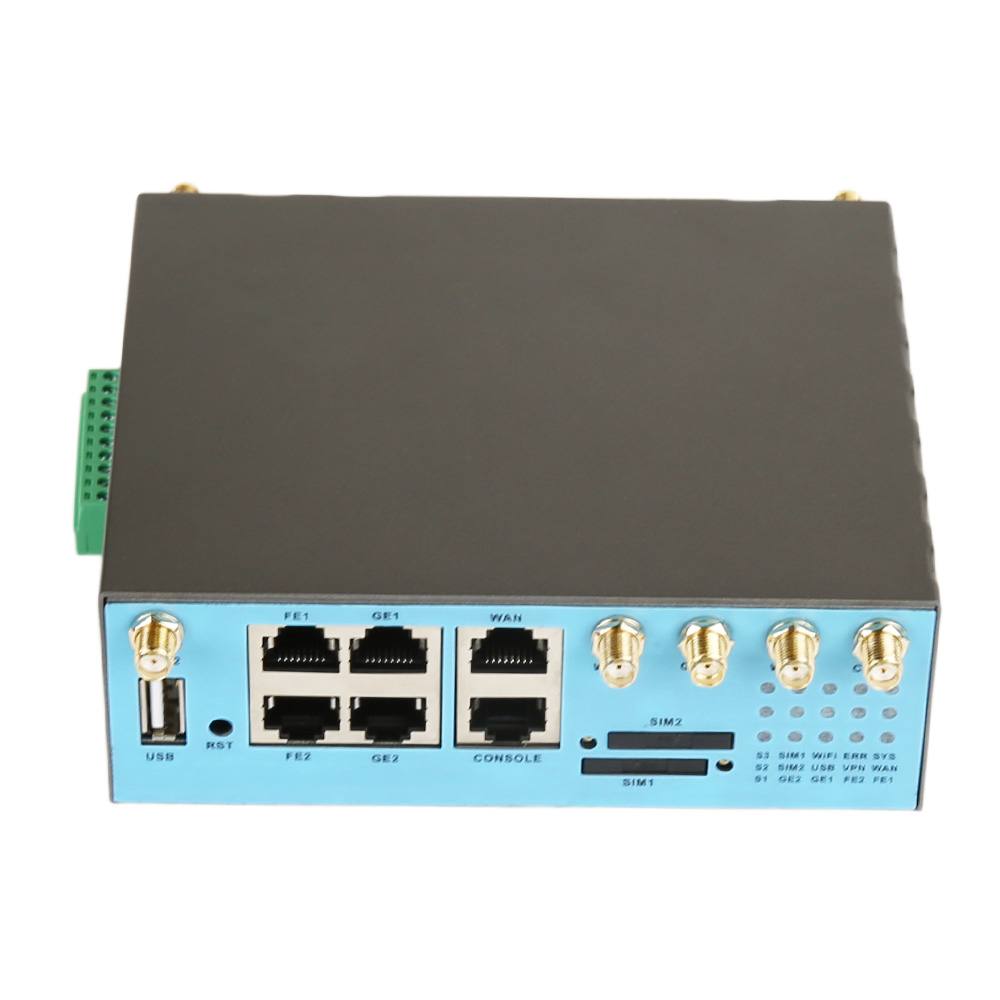
E-Lins Technology's flagship H900f Gigabit 5G Industrial Router exemplifies this approach, offering 5G SA/NSA dual-mode connectivity, dual SIM hot backup with automatic failover, and PoE++ support for simplified installation. Such solutions achieve equipment online rates ≥99.5% precisely because hardware design matches deployment environment realities.
Looking Forward: Expansion into Manufacturing and Smart Cities
While telecommunications, aviation, utilities, and self-service sectors currently lead 5G industrial adoption, manufacturing automation and smart city infrastructure represent the next expansion wave. Industrial automation applications—PLC remote control, sensor data acquisition, and production line monitoring—increasingly require 5G's low-latency capabilities for real-time responsiveness.
Smart city implementations spanning security surveillance, traffic management, and emergency communications benefit from 5G's ability to support massive device connectivity with differentiated quality-of-service guarantees. As these sectors mature their deployment strategies, the lessons from early adopters become increasingly relevant: reliable industrial connectivity requires purpose-built hardware, comprehensive security implementations, and end-to-end system design rather than component-level thinking.
Conclusion: From Technology to Operational Reality
The industry's leading 5G adoption shares common characteristics: distributed infrastructure, harsh operating environments, mission-critical reliability requirements, and substantial economic impacts from connectivity failures. Their successful implementations demonstrate that 5G's industrial promise becomes reality only when supported by appropriate hardware infrastructure, proven in demanding real-world conditions across 150+ countries.
As 5G industrial adoption accelerates, the gap widens between organizations treating connectivity as commodity technology and those recognizing it as critical infrastructure requiring professional-grade solutions. For enterprises evaluating 5G implementation, the path forward is illuminated by these early adopters: prioritize genuine industrial specifications, demand proven reliability metrics, and partner with manufacturers demonstrating deep expertise in industrial wireless communication—not consumer technology adapted for commercial use.
https://e-lins.com/
Shenzhen E-Lins Technology Co., Ltd.







+ There are no comments
Add yours